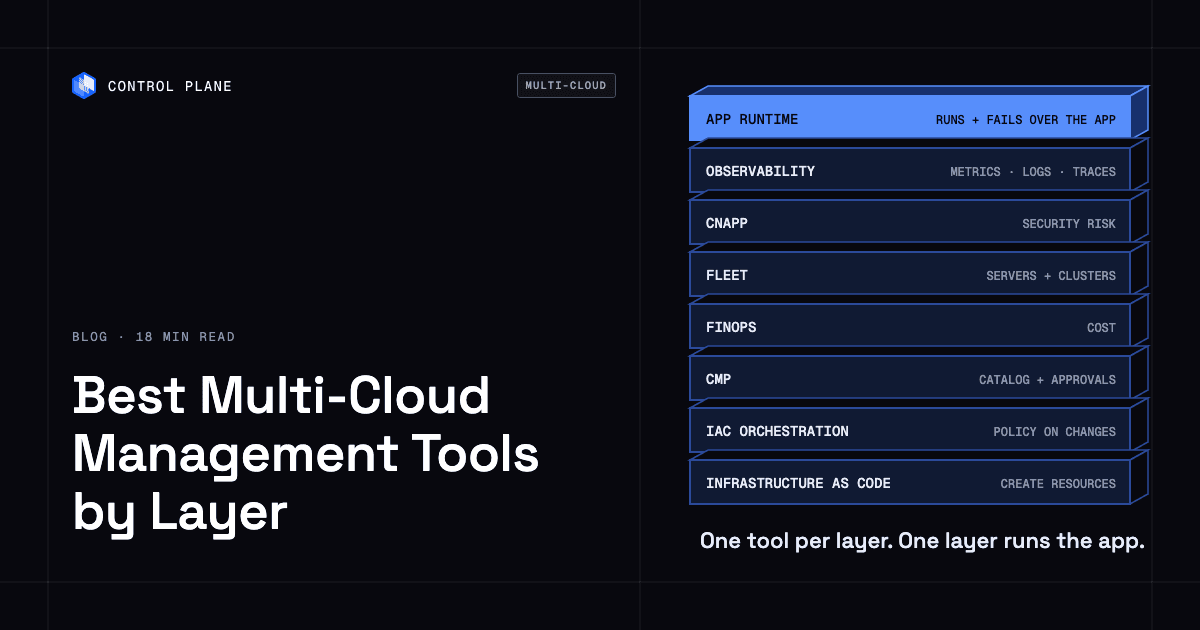
The best multi-cloud management tools in 2026 form a stack with one tool per layer. Infrastructure as code creates resources, an IaC orchestration tool adds policy and approvals, a cloud management platform adds a self-service catalog, a FinOps tool handles cost, a fleet manager covers servers and clusters you already run, a CNAPP finds security risk, an observability platform collects telemetry, and an application runtime layer such as Control Plane runs, scales, and fails over the application across regions and clouds. This guide covers all eight layers with sourced data on 25 tools, the name and ownership changes of 2025 and 2026, a coverage matrix, and stack recommendations by situation. The 10 best multi-cloud management platforms in 2026 compares full platforms in more depth.
Disclosure: Control Plane publishes this guide.
TL;DR
No single tool covers every job in multi-cloud management, so teams assemble a stack of specialized tools organized by layer.
- Infrastructure as code tools such as Terraform, OpenTofu, and Pulumi create and change cloud resources through provider APIs.
- IaC orchestration tools such as Spacelift, env zero, and Scalr add policy, drift detection, and approvals on top of the IaC engine.
- Cloud management platforms such as CloudBolt and HPE Morpheus put a self-service catalog with approvals in front of existing clouds and hypervisors.
- FinOps tools such as Flexera One, CloudHealth by Broadcom, CloudZero, IBM Turbonomic, and IBM Cloudability work from billing and usage data.
- Fleet tools such as Azure Arc, GKE fleet management, Red Hat Advanced Cluster Management, SUSE Rancher Prime, and AWS Systems Manager bring servers and clusters into one console.
- CNAPPs such as Wiz, Cortex Cloud, and CrowdStrike Falcon Cloud Security find and block security risk, and observability platforms such as Datadog and Dynatrace collect metrics, logs, and traces.
- Control Plane is the application runtime layer and handles Day 2 operations for the containers and VMs it runs active-active across regions and clouds, with built-in observability, an audit trail, and access to AWS, GCP, and Azure services without long-lived cloud keys in your code.
- 2025 and 2026 brought several ownership and name changes, including IBM acquiring HashiCorp, Wiz joining Google, Prisma Cloud becoming Cortex Cloud, and GKE Enterprise folding into standard GKE, so check current names and licenses before you buy.
What are the best multi-cloud management tools?
The best multi-cloud management tools are one tool per layer, chosen from the 25 tools in this table, checked November 26, 2026.
| Layer | Tool | What it manages | Clouds covered | Delivery | License or pricing model |
|---|---|---|---|---|---|
| Infrastructure as code | Terraform / HCP Terraform | Creates and manages resources on cloud platforms and other services through their APIs | AWS, Azure, Google Cloud, Oracle Cloud, Kubernetes, and others through providers | CLI you run; HCP Terraform (SaaS); Terraform Enterprise (self-hosted) | BSL 1.1 for Terraform 1.6 and later; HCP Terraform free up to 500 managed resources, then per managed resource |
| Infrastructure as code | OpenTofu | Open source fork of Terraform for creating and managing infrastructure | Through providers | CLI you run | MPL 2.0; Linux Foundation; CNCF Sandbox |
| Infrastructure as code | Pulumi | Infrastructure as code in Node.js, Python, Go, .NET, Java, and YAML | AWS, Azure, Google Cloud, Oracle Cloud Infrastructure, Kubernetes, and others | CLI; Pulumi Cloud (SaaS, self-hosting available) | Engine Apache 2.0; free tier, then per managed resource |
| IaC orchestration | Spacelift | Orchestrates Terraform, OpenTofu, CloudFormation, Pulumi, Kubernetes, and Ansible runs | Whatever the IaC targets | SaaS, self-hosted, or FedRAMP SaaS | Free tier, then tiers by users and workers |
| IaC orchestration | env zero | Policy, drift detection, and IaC runs for Terraform, OpenTofu, Terragrunt, Pulumi, CloudFormation, Kubernetes, Helm, and Ansible | Whatever the IaC targets | SaaS with a self-hosted runner option | Free up to 250 runs a month; paid plans by quote, priced per successful apply or per environment; no per-resource pricing |
| IaC orchestration | Scalr | Terraform and OpenTofu automation | Whatever the IaC targets | SaaS with managed or private agents | Per run, free up to 50 runs a month |
| Cloud management platform | CloudBolt CMP | Self-service provisioning, governance, approvals, and Day 2 actions | Over 25 platforms, including AWS, Azure, GCP, Oracle Cloud, IBM Cloud, VMware, Nutanix, OpenStack, and Kubernetes | Self-hosted (downloadable) | Free plan available |
| Cloud management platform | HPE Morpheus Software | VM and container orchestration, service catalog, and workflows | AWS, Azure, GCP, Oracle Cloud, VMware, Nutanix, OpenStack (AWS, Azure, and GCP need the Enterprise tier) | Self-hosted appliance | Commercial tiers: VM Essentials, Advanced, Enterprise |
| Cloud management platform | ServiceNow Cloud Provisioning and Governance | Cloud catalog and governance | AWS, Azure, Google Cloud, VMware | Not published | Not published; being prepared for future deprecation |
| FinOps | Flexera One | Cloud and AI spend forecasting, allocation, and optimization | AWS, Azure, Google Cloud, Oracle Cloud Infrastructure, Alibaba Cloud, Kubernetes | Not published | No public pricing |
| FinOps | CloudHealth by Broadcom | Multi-cloud cost management | AWS, Azure, Google Cloud | Not published | Not published |
| FinOps | CloudZero | Cost and usage allocation across cloud, AI, and SaaS | AWS, Azure, Google Cloud, Kubernetes | Not published | Single subscription by custom quote |
| FinOps | IBM Turbonomic | Automated application resource management | AWS, Azure, Google Cloud, Kubernetes and OpenShift, VMware | SaaS or on premises | Custom quote |
| FinOps | IBM Cloudability | FinOps visibility, allocation, and commitment management | AWS, Azure, Google Cloud, Kubernetes | Not published | Not published; free trial |
| Fleet management | Microsoft Azure Arc | Servers, VMs, Kubernetes, and SQL Server outside Azure, projected into Azure Resource Manager | Other clouds and on premises | Azure service | Free core tier (inventory, management, VM self-service); add-on services per server |
| Fleet management | GKE fleet management | Clusters and workloads on Google Cloud and attached clusters outside it, through a Connect Agent | Google Cloud, AWS, Azure, attached clusters, and on premises | Google Cloud service | Fleet features included in GKE; multi-cloud clusters per vCPU-hour |
| Fleet management | Red Hat Advanced Cluster Management for Kubernetes | Multicluster application management, policy, and observability | Datacenter, cloud, and edge, for CNCF-conformant Kubernetes distributions | Not published | Commercial; included in OpenShift Platform Plus |
| Fleet management | SUSE Rancher Prime | Kubernetes clusters from one console | EKS, AKS, GKE, RKE2, K3s, and any CNCF-certified distribution, including air-gapped | Self-hosted | Upstream Rancher Apache 2.0; Prime is a commercial subscription |
| Fleet management | AWS Systems Manager | EC2 instances and non-EC2 nodes on premises, at the edge, and in other clouds, through the SSM Agent | AWS plus nodes outside AWS | AWS service | Pay-as-you-go per feature |
| CNAPP | Wiz | Code, cloud, and runtime security | AWS, Azure, GCP, Oracle Cloud Infrastructure | Agentless scanning plus a runtime sensor | By quote |
| CNAPP | Palo Alto Networks Cortex Cloud | Application security, posture, and runtime defense | AWS, Azure, Google Cloud, Oracle Cloud Infrastructure, Alibaba Cloud, IBM Cloud | Agentless scanning plus a runtime agent | Not published |
| CNAPP | CrowdStrike Falcon Cloud Security | CNAPP with cloud detection and response | AWS, Azure, Google Cloud, Kubernetes, Oracle Cloud Infrastructure | Agent and agentless options | Not published |
| Observability | Datadog | Infrastructure monitoring, APM, logs, and security | AWS, Azure, Google Cloud, Alibaba Cloud, VMware, OpenStack, Hyper-V | SaaS | Per product SKU |
| Observability | Dynatrace | Infrastructure and application observability | AWS, Azure, Google Cloud, Kubernetes, hybrid | SaaS or self-hosted Managed | Annual platform commitment with a rate card |
| Application runtime | Control Plane | Runs, scales, and routes containers active-active across locations from one workload definition, and runs VMs on locations joined through Control Plane’s Managed Kubernetes | AWS, GCP, Azure, Oracle Cloud Infrastructure, plus your own Kubernetes clusters or servers, including on premises | SaaS with CLI, console, Terraform and Pulumi providers, and an MCP server | Reserved CPU and memory, plus metered egress and storage |
Read the table a layer at a time and pick the tool in each layer that matches your clouds, delivery model, and license needs. Not published means the vendor pages checked on November 26, 2026, did not state it.
What does each layer of a multi-cloud stack do?
The matrix maps ten common management jobs to the layers that handle them.
| Job | IaC | IaC orchestration | CMP | FinOps | Fleet | CNAPP | Observability | App runtime |
|---|---|---|---|---|---|---|---|---|
| Create cloud resources | Yes | Partial | Yes | Partial | ||||
| Enforce policy before changes | Partial | Yes | Yes | Yes | Partial | Partial | ||
| Self-service catalog with approvals | Partial | Yes | Partial | |||||
| Allocate and optimize cost | Partial | Yes | Partial | Partial | ||||
| Manage servers and clusters you already run | Yes | Partial | ||||||
| Find and block security risk | Yes | Partial | Partial | |||||
| Collect metrics, logs, and traces | Partial | Yes | Yes | |||||
| Run and scale the application in several clouds at once | Partial | Yes | ||||||
| Move users to a healthy location when one fails | Partial | Yes | ||||||
| Give one workload identity access to AWS, GCP, and Azure services without long-lived keys in code | Yes |
This is Control Plane’s mapping built from each vendor’s documented scope, checked November 26, 2026. Yes means the job is a core function of the layer, and Partial means some tools in the layer cover part of the job, or cover it only for their own resources or a single cloud.
- Infrastructure as code creates and changes resources through cloud APIs. Running, scaling, and routing the application afterward is left to other layers.
- IaC orchestration runs the IaC engine with policy gates, drift detection, and approvals, and it provisions nothing the engine underneath cannot. The guide to choosing IaC tools for a small platform team compares the options.
- Cloud management platforms let users request VMs and services from a governed catalog, with approval steps, across existing clouds and hypervisors. The workload runtime, failover, and cross-cloud traffic stay with the platforms underneath.
- FinOps tools read billing and usage data to allocate cost and recommend or automate savings, and they do not deploy or operate the application. The cloud cost optimization tools roundup goes deeper on this layer.
- Fleet management tools project servers or clusters you already run into one console, as Azure Arc does into Azure Resource Manager. Some, such as Red Hat Advanced Cluster Management, also deploy the same application to many clusters, and GKE’s Multi Cluster Ingress fails traffic over between GKE clusters at additional cost, but routing users between clouds and failing over when one goes down stays with you, and the Kubernetes management platforms guide covers the cluster side.
- CNAPPs find and block risk in code, cloud configuration, and runtime, and they do not provision or run workloads.
- Observability platforms collect metrics, logs, and traces and alert on them, while fixing problems and moving traffic belong to other layers. The guide to a single view of cost and security across multiple clouds shows how these signals come together.
- The application runtime layer keeps the application serving across regions and clouds. Control Plane is in this layer, running each workload in every location assigned to it, routing users to locations where the workload passes its readiness probes, and connecting workloads to AWS, GCP, and Azure services through Control Plane’s Universal Cloud Identity.
Identity and single sign-on, secrets management, network connectivity and global DNS, backup and disaster recovery, and GitOps or CI/CD delivery are five adjacent categories that sit outside these eight layers. Most teams already run tools for these, so check that each new tool connects to your identity provider and delivery pipeline before you buy it. Global DNS and load-balancing services can shift users between endpoints you already run, but keeping a healthy copy of the workload in each location is the runtime layer’s job. Control Plane also stores secrets for the workloads it runs and documents GitOps and CI/CD pipelines for deploying them.
What changed in multi-cloud management tools in 2026?
Several tools changed owners, names, licenses, or pricing in 2025 and 2026, and an RFP or renewal that uses the old names can miss those changes.
| Tool | Change | Date | Source |
|---|---|---|---|
| Terraform | IBM completed the HashiCorp acquisition | February 27, 2025 | IBM press release |
| OpenTofu | Accepted into the CNCF Sandbox | April 2025 | CNCF project page |
| GKE | GKE Enterprise folded into standard GKE, with fleet features included | Not dated on the page | GKE Enterprise release notes |
| CloudHealth | Now sold as CloudHealth by Broadcom | Not dated on the page | Broadcom product page |
| Prisma Cloud | Cortex Cloud introduced as its next version | February 13, 2025 | Palo Alto Networks press release |
| Wiz | Joined Google | March 2026 | Wiz blog |
| AWS Systems Manager | Advanced-instances tier removed; Session Manager and Run Command on hybrid nodes moved to pay-as-you-go | June 30, 2026 and September 30, 2026 | AWS Systems Manager pricing |
| ServiceNow Cloud Provisioning and Governance | Being prepared for future deprecation in favor of Cloud Services Catalog | Not dated on the page | ServiceNow documentation |
| CloudBolt CMP | Free plan available | Not dated on the page | CloudBolt CMP Free |
| env0 | Now env zero; env0.com redirects to envzero.com | Not dated on the page | env zero pricing |
| ProsperOps | Now a Flexera company | Not dated on the page | Flexera Cloud Commitment Management page |
Before a renewal or RFP, check each tool’s current name, owner, license, and pricing model on the vendor’s own pages. Several of these changes kept the product’s core function the same while moving its contracts, support, or billing unit, and the guide to comparing multi-cloud discovery and inventory lists the questions to ask in an evaluation.
How do you build a multi-cloud management stack?
The right stack depends on which management jobs your team needs and how many clouds and environments you run.
| Situation | Stack | Why |
|---|---|---|
| Mostly one cloud, some on-premises servers | IaC plus that cloud’s fleet tool (Azure Arc or AWS Systems Manager) plus one FinOps tool | The native fleet tool brings outside servers into the main cloud’s console |
| Platform team standardizing infrastructure changes across AWS, Azure, and Google Cloud | Terraform, OpenTofu, or Pulumi plus Spacelift or env zero, or Terraform or OpenTofu plus Scalr | Every infrastructure change passes policy checks and approval, and drift shows up between changes |
| Enterprise IT with VMs, a service catalog, and approval workflows | CloudBolt or HPE Morpheus | Catalog and approvals across clouds and hypervisors |
| Many Kubernetes clusters across clouds | Rancher, Red Hat ACM, or GKE fleet management | One console for cluster policy and access |
| Production application that must keep serving through a regional or provider outage | Control Plane for the application runtime, plus IaC for the surrounding cloud resources | The application runs active-active across locations and clouds from one definition |
| Production on one cloud or in one region, without a platform team | Control Plane for the application runtime, with IaC for cloud resources outside it | Autoscaling, observability, an audit trail, and cloud service access come with the runtime, and more regions or clouds can join later without changing the workload definition |
| Finance-led cost program | Flexera One, CloudHealth, CloudZero, or Cloudability, with Turbonomic for automated resource optimization | Allocation and optimization across bills |
| Security team that needs one view of risk across every cloud account | Wiz, Cortex Cloud, or CrowdStrike Falcon Cloud Security | Code, posture, and runtime findings for every cloud in one place |
| Operations team that needs one view of metrics, logs, and traces across clouds and on premises | Datadog or Dynatrace | Alerts and dashboards cover every environment from one platform |
- List the jobs you need. Use the coverage matrix to mark the jobs that matter to your organization, since not every team needs every layer.
- Pick one tool per job. Two tools doing the same job create conflicting state and duplicate cost, and the guide to reducing cloud tools and vendors starts with the jobs that overlap.
- Check each tool’s clouds against yours. Oracle Cloud and on-premises coverage vary across tools, and a tool that covers only AWS, Azure, and Google Cloud leaves the rest unmanaged.
- Check delivery model and license. Some tools run only as SaaS and others only self-hosted, and Terraform’s BSL 1.1, OpenTofu’s MPL 2.0, and Pulumi’s Apache 2.0 engine carry different terms.
- Decide where the application runs and fails over. IaC creates the infrastructure and fleet tools manage clusters and can deploy the same application to each of them, but neither moves users to a healthy cloud when a location fails. Control Plane runs the application in every chosen location at once and routes clients away from a location that fails, and the guide to choosing a multi-cloud solution walks through that decision.
How much do multi-cloud management tools cost?
The tools in this guide use at least eight pricing models, so compare them by billing unit before comparing totals.
The billing units are per managed resource (HCP Terraform, Pulumi), per run (Scalr, and env zero’s free tier), per user and worker (Spacelift), per server (Azure Arc add-ons), per vCPU-hour (GKE multi-cloud clusters), per product SKU (Datadog), an annual commitment with a rate card (Dynatrace), and custom quotes (CloudZero, Turbonomic, Wiz, and env zero’s paid plans, which env zero prices per successful apply or per environment), while Flexera One, CloudHealth, Cortex Cloud, CrowdStrike Falcon Cloud Security, IBM Cloudability, and ServiceNow state no pricing model on the pages checked. Free tiers or free plans exist for HCP Terraform up to 500 managed resources, Pulumi, Spacelift, env zero up to 250 runs a month, Scalr up to 50 runs a month, CloudBolt CMP, and Azure Arc’s core tier. GKE includes fleet features at no extra cost, and OpenTofu, the Pulumi engine, and upstream Rancher are open source. Control Plane bills for the CPU and memory a workload reserves, with egress, storage, and other usage metered separately and listed on its pricing page. The multi-cloud management platform pricing guide explains how each model behaves as an estate grows.
How Control Plane fits
Control Plane handles Day 2 operations for you, including autoscaling, built-in observability, and security. A Global Virtual Cloud (GVC) is Control Plane’s named set of locations. One GVC can span locations on AWS, GCP, Azure, and Oracle Cloud Infrastructure, plus Kubernetes clusters or servers you run, including on premises. A Kubernetes cluster you already run joins as a location through Control Plane’s BYOK (Bring Your Own Kubernetes), and servers that are not yet a cluster become one through Control Plane’s Managed Kubernetes. Every workload in the GVC runs in each of its locations from one workload definition. Control Plane runs serverless, standard, stateful, cron, and VM workloads, and VM workloads run on locations joined through Control Plane’s Managed Kubernetes. Control Plane’s Template Catalog installs versioned databases, queues, and services such as PostgreSQL, Redis, and Kafka from the console, CLI, Terraform, or Pulumi, and tracks each installation for upgrade or rollback.
Control Plane gives each workload a canonical endpoint that routes clients to the nearest location where the workload passes its readiness probes. Control Plane’s location routing options set a routing tier per location, so a primary group serves traffic and the next group takes over when every location in the first is unavailable. Control Plane offers a 99.999% SLA for workloads that run at least two replicas in at least two locations. According to Control Plane’s internal incident telemetry, no Control Plane customer experienced downtime during the October 20, 2025, AWS us-east-1 outage; affected workloads in GVCs that included us-east-1 were active and running in healthy locations within 10 seconds.
Universal Cloud Identity, Control Plane’s cloud access feature, lets a workload whose Control Plane identity is linked to a cloud account call AWS, GCP, and Azure services through an IAM role or service-account grant, with no long-lived cloud keys in your code. Every new workload starts with inbound, outbound, and workload-to-workload traffic disabled until you allow it, calls between workloads use mTLS with a unique client certificate per workload, and org secrets are encrypted with envelope encryption and stored in cloud Hardware Security Modules on more than one provider. Control Plane collects logs and metrics for every workload, and traces once tracing is switched on for the GVC or org. Logs are queried with LogQL in Grafana across all cloud providers and regions, built-in metrics cover traffic, CPU, memory, replicas, and network usage and are queried with PromQL, and logs are kept 30 days by default, configurable up to 730 days. A tamper-proof audit trail records every Control Plane action from the console, CLI, Terraform, Pulumi, and the MCP server, plus custom events that workloads send, and Control Plane’s fine-grained permission policies govern who can act on each Control Plane resource. A costs and usage view and API report Control Plane cost per GVC and usage per workload, and Capacity AI, Control Plane’s right-sizing, adjusts a workload’s CPU and memory reservation between the minimum and maximum you set, based on historical usage.
The CLI, console, Terraform and Pulumi providers, and the Control Plane MCP server all work through the same Control Plane API. Control Plane ships its own Terraform and Pulumi providers, so it complements the infrastructure as code you already run. It works alongside FinOps tools for whole-cloud bills, CNAPPs for security posture, and IaC for resources outside Control Plane, and the roundup of tools for deploying applications across AWS, GCP, and Azure covers the deployment side in more detail.
FAQ
These answers cover the questions teams ask most when building a multi-cloud management stack.
What are the best multi-cloud management tools?
The best multi-cloud management tools are a stack with one tool per layer. Teams pair IaC such as Terraform, OpenTofu, or Pulumi with orchestration such as Spacelift, env zero, or Scalr, then add a cloud management platform such as CloudBolt or HPE Morpheus, a FinOps tool, a fleet manager, a CNAPP, and an observability platform. Control Plane is the application runtime layer, running, scaling, and failing over workloads in one region or across regions and clouds and handling their Day 2 operations. The right combination depends on how many clouds you run, which jobs you need, and whether your application must keep serving through a regional or provider outage.
What is the difference between a multi-cloud management platform and infrastructure as code?
Infrastructure as code creates and changes cloud resources from definitions engineers version, while a multi-cloud management platform puts a self-service catalog, approvals, governance policies, and Day 2 actions in front of the clouds for the people who request resources. Terraform, OpenTofu, and Pulumi are IaC tools, and CloudBolt and HPE Morpheus are management platforms. IaC orchestration tools such as Spacelift, env zero, and Scalr sit between the two, adding policy, drift detection, and approvals to IaC runs for engineering teams. IaC defines what infrastructure exists, and a management platform controls who can request it, under which rules, and what happens after it is created.
Is Terraform still open source?
No. Terraform 1.6 and later are source-available under the Business Source License 1.1, which publishes the code and allows production use, including hosting it for internal purposes, but bars offering Terraform to third parties in a paid hosted or embedded product that competes with IBM’s paid versions. Each version converts to MPL 2.0 four years after it is published, and IBM completed its acquisition of HashiCorp, Terraform’s maker, on February 27, 2025. OpenTofu is the open source fork, licensed MPL 2.0 under Linux Foundation stewardship and accepted into the CNCF Sandbox in April 2025.
What replaced Prisma Cloud?
Palo Alto Networks introduced Cortex Cloud as the next version of Prisma Cloud in February 2025. Cortex Cloud covers application security, posture, and runtime defense, with onboarding for AWS, Azure, Google Cloud, Oracle Cloud Infrastructure, Alibaba Cloud, and IBM Cloud.
What happened to GKE Enterprise and Anthos?
Google folded GKE Enterprise into standard GKE, which is now a single offering without editions, and fleet management features are included. Clusters outside Google Cloud attach through a Connect Agent, and multi-cloud clusters are billed per vCPU-hour. Google’s GKE Enterprise release notes page is now an archive of past updates, and cloud.google.com/anthos redirects to the GKE product page.
Which multi-cloud management tools support Oracle Cloud?
Control Plane runs workloads on Oracle Cloud Infrastructure in a Global Virtual Cloud (GVC), Control Plane’s named set of locations, which can also span AWS, GCP, Azure, and your own infrastructure, including on premises. Other tools whose pages name Oracle Cloud are Terraform (through providers), Pulumi (through its Oracle Cloud Infrastructure provider), CloudBolt CMP, HPE Morpheus Software, Flexera One, Wiz, Cortex Cloud, and CrowdStrike Falcon Cloud Security. Coverage depth varies by service, so check each integration against the Oracle Cloud services you use.
Do I need a FinOps tool if I already use infrastructure as code?
Yes, if you need cost allocation and optimization across bills. IaC creates and changes resources but does not read billing data, allocate cost to teams or products, or recommend commitments. Flexera One, CloudHealth by Broadcom, CloudZero, IBM Turbonomic, and IBM Cloudability read billing and usage data for those jobs.
Can one tool manage everything across AWS, Azure, and Google Cloud?
No. Each layer handles a different job, and no single tool covers provisioning, policy, cost, fleet management, security, observability, and the application runtime together. Control Plane covers the application runtime layer with its own observability, access policies, deny-by-default workload firewall, audit trail, and usage reporting, and it works alongside IaC, FinOps, and CNAPP tools for their jobs.
How does Control Plane fit in a multi-cloud management stack?
Control Plane is the application runtime layer, and it takes on Day 2 operations such as autoscaling, observability, and access control for the workloads it runs. It runs every workload in each location of its Global Virtual Cloud (GVC), Control Plane’s named set of locations, which can span AWS, GCP, Azure, Oracle Cloud Infrastructure, and your own Kubernetes clusters or servers, including on premises, from one workload definition. Control Plane’s 99.999% SLA covers workloads that run at least two replicas in at least two locations. Teams manage it with its own Terraform and Pulumi providers next to their existing IaC, and it works alongside FinOps and security tools.
Talk to the Control Plane team to see where the application runtime layer fits your stack, or sign up free to deploy your first workload across clouds.