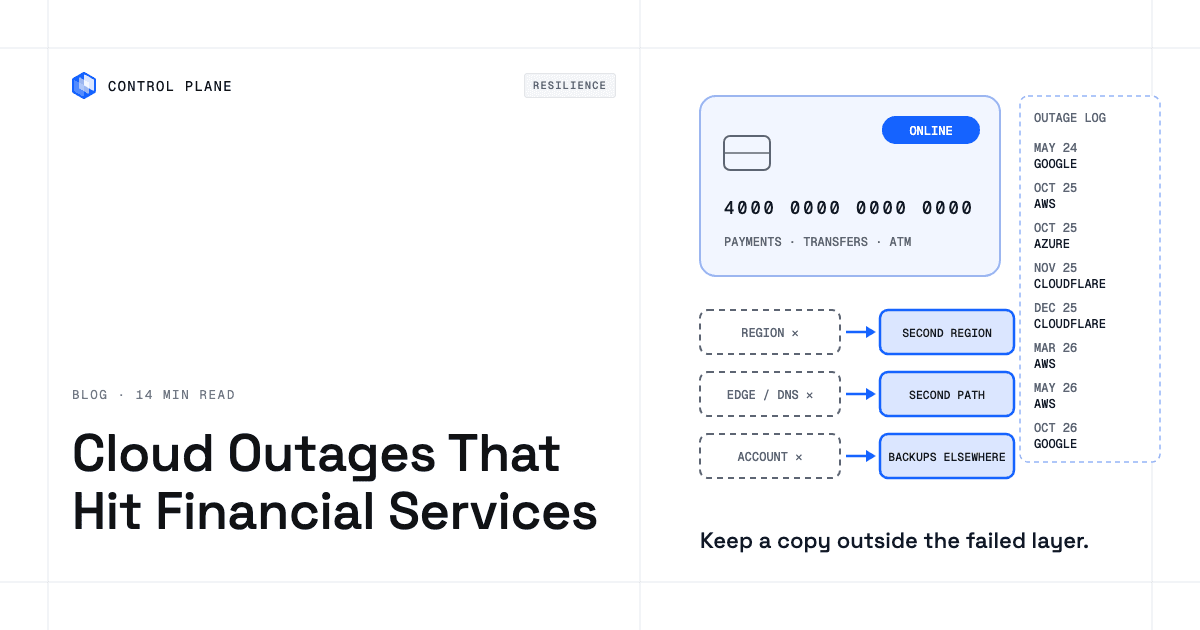
Financial services companies stay online during cloud outages by keeping an independent copy or path for every layer a provider can take down at once: a second region or provider for compute and data, a second DNS or edge path, backups the provider cannot delete, and a fallback channel for customers. They also decide in advance which services must keep running and which can degrade. The eight outages documented here, from May 2024 to October 2026 across AWS, Google Cloud, Microsoft Azure, and Cloudflare, show that zone redundancy fell short three times, that global edge layers disrupted firms regardless of the region their applications ran in, and that where firms described what kept working, it was a copy or path outside the failed layer. Control Plane runs one workload definition across regions and clouds so that traffic moves to a healthy location when one fails.
Disclosure: Control Plane publishes this guide.
TL;DR
Eight cloud outages between 2024 and 2026 disrupted banks, brokers, a pension fund, payment apps, and crypto exchanges across four providers: AWS, Google Cloud, Microsoft Azure, and Cloudflare.
- Zone redundancy fell short three times: a deletion removed both zones of a private cloud at Google Cloud (May 2024), drone strikes damaged more than one Availability Zone in AWS’s UAE and Bahrain regions (March 2026), and a zone power loss at Google Cloud London degraded the region’s other two zones (October 2026).
- Global edge outages at Azure Front Door (October 2025) and Cloudflare (November and December 2025) disrupted firms regardless of the region their applications ran in.
- Identity and sign-in services were affected in three outages, which can lock administrators out of the tools they need to fail over.
- Where firms described what kept working, it was a copy or path outside the failed layer: UniSuper’s backups with another provider, Zerodha’s standalone WhatsApp backup, and SadaPay’s cards and ATMs.
- EU and UK authorities now oversee the largest cloud providers as critical third parties, and UK regulators say firms remain responsible for their own resilience.
- Control Plane runs a workload from one definition across AWS, Google Cloud, Azure, and Oracle Cloud Infrastructure locations and routes traffic to healthy locations when one fails.
Which cloud outages have hit banks and financial services?
Eight provider outages from May 2024 to October 2026 disrupted named financial firms.
| Date | Provider and scope | What failed | Duration | Financial firms affected (basis) |
|---|---|---|---|---|
| May 2024 | Google Cloud VMware Engine, Australia | Google said an internal tool parameter was left blank, so a default one-year term applied and the private cloud, spanning two zones, was deleted when it expired | Not stated (about a week, per The Register) | UniSuper (joint statement with Google Cloud) |
| October 19 to 20, 2025 | AWS us-east-1 (N. Virginia) | A race condition in DynamoDB’s DNS management left the regional endpoint with an empty DNS record; EC2 launches, Network Load Balancer health checks, Lambda, and container services failed, and STS and IAM sign-in returned errors | 14 hours 32 minutes | Coinbase (status page), Robinhood (company statement), Plaid (status page), Lloyds Bank (spokesperson), Halifax (reported), Chime (status page, provider not named; named by American Banker), Venmo (user reports) |
| October 29, 2025 | Microsoft Azure Front Door (global) | Incompatible configuration metadata crashed Azure Front Door edge servers | 8 hours 24 minutes | NatWest (user reports) |
| November 18, 2025 | Cloudflare (global) | A database permissions change doubled the size of a Bot Management feature file, and the core proxy failed across the network | 5 hours 46 minutes (core traffic back in 3 hours 10 minutes) | Coinbase and Kraken (reported) |
| December 5, 2025 | Cloudflare (about 28% of its HTTP traffic) | A global web application firewall change hit a bug in an older proxy version | 25 minutes | Zerodha (company disclosure), Groww and Angel One (reported) |
| March 1 to 2, 2026 | AWS me-central-1 (UAE) and me-south-1 (Bahrain) | AWS said drone strikes hit facilities in the UAE and struck close to one in Bahrain, damaging infrastructure across more than one Availability Zone | Ongoing in parts since March 1, 2026 | SadaPay (company statement) |
| May 7, 2026 | AWS us-east-1, one Availability Zone | A cooling failure cut power to EC2 instances and EBS volumes in one data center | 21 hours 30 minutes to majority recovery | Coinbase (postmortem, via InfoQ) |
| October 20, 2026 | Google Cloud europe-west2 (London) | A cable fault cut one utility feed while the other was isolated, the generators did not start, and zone europe-west2-b lost power; demand surges and cross-zone control-plane dependencies affected workloads in the other two zones | 6 hours 8 minutes | Revolut (spokesperson, via IBTimes UK), Lloyds, Halifax, and HSBC (reported) |
The table includes only outages where a firm’s own statement or status page, or a named news outlet, tied the disruption to the provider, and it was checked on November 26, 2026. The cloud outage tracker lists durations and sources for 83 major provider outages since 2020.
How do financial services companies stay online during cloud outages?
Financial services companies stay online by giving each layer a provider can lose at once an independent copy or path, through seven practices.
- Run tier-1 services in a second region or with a second provider, with capacity already running. During the October 2025 AWS outage, new EC2 launches failed in us-east-1 while instances already running stayed healthy, and DynamoDB global tables kept serving requests in other regions.
- Replicate data outside the failed zone and region. After the Middle East strikes, AWS told customers to consider backing up data and potentially migrating workloads to other regions, and it later said it could not restore access to its damaged Bahrain facility or to resources held only in one UAE zone.
- Keep a second DNS or edge path that does not share the provider’s layer. The Azure Front Door outage and both Cloudflare outages sat in global layers in front of applications, so they reached applications in every region behind that edge; a second path through a different provider, with DNS that does not depend on the failed edge, can keep requests flowing.
- Keep a sign-in and admin path that survives the provider’s identity failure. In the October 2025 AWS outage, STS and IAM sign-in returned errors and console sign-in failed for some users in other regions; parts of Entra ID were affected in the Azure Front Door outage, and Cloudflare Access logins failed in November 2025. A separate path keeps administrators able to reach the tools they need for failover.
- Hold backups with another provider. UniSuper and Google Cloud said UniSuper’s backups with an additional service provider minimized data loss after the deletion.
- Provide a fallback customer channel and planned degraded modes. Zerodha’s standalone WhatsApp backup and SadaPay’s cards and ATMs gave customers a way to act while the main app was unavailable. Impact tolerances and the regulation behind them are covered in the guide to financial services cloud outage resilience.
- Test failover under realistic load before an outage forces it. In the October 2026 London outage, Google said some failovers were unsuccessful due to capacity constraints. The guide to testing failover without taking production down covers how to do this safely.
What failed in each outage, and what kept services running?
Each outage broke a specific layer, and the control that kept or would have kept services running maps to that layer.
| Layer that failed | Outages | What kept or would have kept services running | Evidence |
|---|---|---|---|
| One zone | AWS us-east-1, May 2026; Google Cloud London, October 2026 | Automated failover to other zones, plus a second region for when the region degrades | AWS advised customers to use the region’s other Availability Zones in May 2026, and Coinbase’s postmortem traced its trading halt to a matching engine without automated failover to another zone, and Coinbase said it is adding automated cross-zone recovery. In London, Google said some failovers were unsuccessful due to capacity constraints. |
| A whole region | AWS us-east-1, October 2025; AWS UAE and Bahrain, March 2026 | A second region or provider with data replicated there and capacity already running | DynamoDB global tables kept serving from other regions in October 2025. AWS advised Middle East customers to consider migrating workloads to other regions. |
| Global edge, CDN, or WAF | Azure Front Door, October 2025; Cloudflare, November and December 2025 | A second DNS or edge path that does not share the provider’s layer | Azure Front Door edge servers crashed globally, and both Cloudflare outages returned errors to end users wherever the application ran. |
| Identity and sign-in | AWS us-east-1, October 2025; Azure Front Door, October 2025; Cloudflare, November 2025 | A sign-in and admin path that does not depend on the failed region or edge | STS and IAM sign-in returned errors at AWS, parts of Entra ID were affected at Azure, and Cloudflare Access logins failed. |
| Provider-side deletion | Google Cloud VMware Engine, May 2024 | Backups held with another provider | The deletion removed both zones of the private cloud, while backups held outside it survived. |
| Customer channel | Cloudflare, December 2025; AWS Bahrain, March 2026 | A separate fallback channel, or card and ATM processing that does not depend on the app | Zerodha’s WhatsApp backup let users exit positions. SadaPay’s cards, ATMs, and point-of-sale payments kept working while the app was unavailable. |
Why did zone redundancy fall short in three of these outages?
Zone redundancy keeps a service running through a zone failure only when the surviving zones are intact and can absorb the load, and three of these outages broke one of those conditions.
In May 2024, Google said its operators left a parameter blank while provisioning UniSuper’s private cloud, so the system applied a default one-year term and deleted the private cloud when it expired. Google said it has since deprecated the internal tool and reviewed every Google Cloud VMware Engine private cloud. The joint statement said UniSuper had duplication in two geographies and the deletion removed both.
In March 2026, AWS said drone strikes damaged infrastructure in its UAE and Bahrain regions. Two of the three Availability Zones in the UAE region were impaired at once, and AWS later said the damage in Bahrain spanned multiple Availability Zones. A design spread across zones in either region could lose more than one zone at the same time.
In October 2026, a cable fault at Google Cloud’s London region cut one utility feed while the other was isolated for repairs, the generators did not start, and zone europe-west2-b lost power. Google said demand surges on the other two zones and control-plane dependencies across zone boundaries affected workloads there, and some failovers were unsuccessful due to capacity constraints.
A deletion needs a copy outside the provider, damage to several zones needs a second region, and a capacity shortfall during failover needs a second region with capacity already running. Two related guides cover reducing the blast radius of a cloud provider outage and designing multi-region failover to a target RTO and RPO.
What kept services running at the affected firms?
Where firms described what kept working, it was a copy or path the failure could not reach, as at UniSuper, Zerodha, and SadaPay.
UniSuper’s backups with an additional service provider minimized data loss, and Google said backups stored in Google Cloud Storage in the same region were not affected by the deletion and, with third-party backup software, were instrumental in the restoration.
Zerodha said order placement was unavailable from 2:26 to 2:42 PM IST on December 5, 2025, in market hours, and its standalone WhatsApp backup let users exit positions. Its CEO said it was working to reduce its dependency on Cloudflare.
On March 24, 2026, SadaPay said its app was unavailable for all users because its infrastructure ran on AWS in Bahrain, while its cards, ATMs, and point-of-sale payments kept working.
A backup, failover target, or edge path protects a service only when the event that takes down the primary cannot reach it. The guide to designing systems that survive the inevitable applies the same principle to high availability, disaster recovery, and business continuity.
What have regulators done since these outages?
EU and UK authorities brought the largest cloud providers under direct oversight between November 2025 and July 2026.
| Date | Authority | Action | What it means for firms |
|---|---|---|---|
| October 20, 2025 | UK Treasury Committee | Wrote to the Economic Secretary to the Treasury asking why AWS had not been designated a critical third party | Political pressure to bring cloud providers under direct oversight |
| November 18, 2025 | EBA, EIOPA, and ESMA | Designated 19 critical ICT third-party providers under DORA, including AWS, Google Cloud, Microsoft, Oracle, and IBM | EU supervisors oversee these providers’ services to the financial sector |
| July 10, 2026 | HM Treasury | Designated Microsoft Ireland Operations Limited, Google Cloud EMEA Limited, Amazon Web Services EMEA SARL, and Oracle Corporation UK Limited as critical third parties, effective July 13, 2026 | The Bank of England, PRA, and FCA oversee the critical services they provide to the UK financial sector |
| November 4, 2026 | Bank of England, PRA, and FCA | Joint letter to the Treasury Committee on the October 2026 Google Cloud London outage | Regulators first learned of it at 09:09 BST through affected firms, and Google then provided information during the incident; a fuller response is due by January 20, 2027 |
The joint letter said reported effects of the London outage included disruption to customer-facing banking and payments services and to systems supporting asset management and trading. It said affected firms activated contingency arrangements, almost all operations had resumed by the end of the day, and there were no identified implications for market integrity or wider financial stability. It said the critical third party regime complements firms’ own resilience duties. It also said firms that cannot get enough assurance from a third party should strengthen their own contingency arrangements and consider practicable alternative provision. A practical next step is to put resilience and SLA questions to cloud vendors.
How Control Plane fits
Control Plane handles Day 2 operations for you, including autoscaling, built-in observability, and security. Control Plane’s Global Virtual Cloud (GVC) is a named set of locations that can span regions of one cloud or several, including AWS, Google Cloud, Azure, and Oracle Cloud Infrastructure, plus Kubernetes clusters you already run and your own servers, including on premises. Every workload in a GVC runs in each of its locations from one workload definition.
Each workload’s canonical endpoint, Control Plane’s DNS name for that workload, geo-routes clients to the nearest location where the workload passes its readiness probes. Routing tiers, part of Control Plane’s location routing options, set location priority, so a primary group serves traffic and the next group takes over when every location in the first is unavailable.
During the October 20, 2025 AWS us-east-1 outage, 20 percent of Control Plane customers had us-east-1 locations in their GVCs. According to Control Plane’s internal incident telemetry, no Control Plane customer experienced downtime, and affected workloads were active and running in healthy locations within 10 seconds.
Control Plane offers a 99.999% SLA for workloads that run at least two replicas in at least two locations, and those locations can be on different providers. Control Plane holds PCI DSS Level 1 and SOC 2 Type II. Teams planning for the next us-east-1 event can compare approaches in the guide to how companies stay online during AWS us-east-1 outages.
FAQ
These answers cover common questions about cloud outages in financial services.
How do financial services companies stay online during cloud outages?
Financial services companies stay online by keeping an independent copy or path for every layer a provider can take down at once. That means a second region or provider for compute and data with capacity already running, a second DNS or edge path, backups another provider holds, a sign-in path that survives the provider’s identity failure, and a fallback customer channel such as cards, ATMs, or a messaging-based backup.
Which cloud outages affected banks in 2025 and 2026?
Banks were named in reports on three outages in 2025 and 2026. In the October 2025 AWS us-east-1 outage, a Lloyds Bank spokesperson said AWS issues were affecting some of its services. In the October 2025 Azure Front Door outage, users reported problems at NatWest. In the October 2026 Google Cloud London outage, Revolut’s site said card payments and transfers were partially unavailable, and Lloyds, Halifax, and HSBC were reported to have problems with online services. The other outages affected a pension fund, crypto exchanges, Indian brokers, and a Pakistani payment app.
Did the October 2025 AWS outage affect banks?
Yes. A Lloyds Bank spokesperson said issues with Amazon Web Services were affecting some of its services, and ITPro reported that customers had trouble logging in to online banking; Halifax, in the same group, also had problems. Chime’s status page reported a third-party outage affecting login, card purchases, transfers, ATMs, and balances without naming the provider. The AWS post-incident summary traced the regional failure to a race condition in DynamoDB’s DNS management.
Which banks were affected by the Google Cloud London outage in October 2026?
Revolut’s site said card payments, transfers, ATM withdrawals, and customer support were partially unavailable, and Lloyds, Halifax, and HSBC were reported to have problems with online services in the same window. The Bank of England, PRA, and FCA said the effects included disruption to customer-facing banking and payments services and to systems supporting asset management and trading.
Is multi-AZ enough for financial services?
No, not for tier-1 services. Multi-AZ covers one zone failing while the others stay intact, and in three of the eight outages a deletion removed both zones of a private cloud, drone strikes damaged more than one zone, or a zone power loss degraded the region’s other two zones. Multi-AZ also needs automated failover between zones to help at all.
Do banks need more than one cloud provider?
For tier-1 services, yes, for the failure modes a second region cannot cover. A provider-side deletion removed every zone of UniSuper’s private cloud, and its backups with an additional service provider minimized data loss. Global edge outages reached every region behind the edge, which only a second DNS or edge path avoids. The UK regulators’ joint letter said firms that cannot get enough assurance from a provider should strengthen their own contingency arrangements and consider practicable alternative provision.
What is a critical third party in UK financial services?
A critical third party is a provider HM Treasury designates because, in its opinion, a failure in or disruption to the services it provides to UK financial firms could threaten the stability of, or confidence in, the UK financial system (section 312L). HM Treasury designated the UK and EU entities of Microsoft, Google Cloud, AWS, and Oracle with effect from July 13, 2026, and the Bank of England, PRA, and FCA now oversee their critical services to the sector.
Which cloud providers are designated critical under DORA?
AWS, Google Cloud, Microsoft, Oracle, and IBM are among the 19 critical ICT third-party providers the EBA, EIOPA, and ESMA designated under DORA on November 18, 2025.
How does Control Plane help financial services firms stay online during cloud outages?
Control Plane runs each workload from one definition in every location of a Control Plane Global Virtual Cloud (GVC), a named set of locations that can span regions of one cloud or several, including AWS, Google Cloud, Azure, and Oracle Cloud Infrastructure. Each workload’s canonical endpoint geo-routes clients to the nearest location where the workload passes its readiness probes, and Control Plane’s routing tiers move traffic to the next group of locations when the primary group is unavailable, so when a GVC spans more than one region or provider, traffic moves to the surviving locations without manual failover.
Talk to the Control Plane team or sign up free to run your workloads across providers and regions from one definition.