
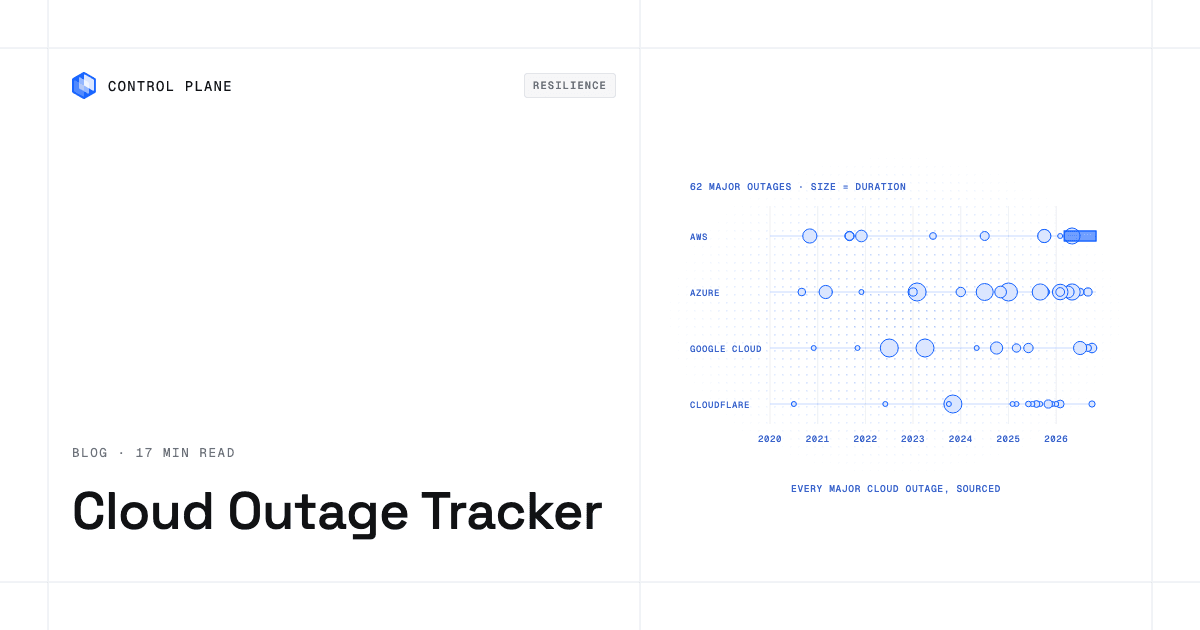
Last updated: October 21, 2026. This tracker lists every major AWS, Microsoft Azure, Google Cloud, and Cloudflare outage since January 2020, with each provider’s own stated duration, root cause, and source. It covers 62 major incidents. The median outage lasted 6h 12m, and the most common cause was a configuration or deployment change (20 of 62, 32%), not hardware failure.
We add new incidents as providers publish their post-incident reports. Control Plane publishes this tracker. Every row links to its source, usually the provider’s own post-mortem or status page, so you can verify it.
Key statistics
- 62 major outages since 2020: AWS 14, Azure 20, Google Cloud 12, and Cloudflare 16.
- Median duration: 6h 12m; mean 10h 01m across 55 completed incidents.
- 32% were caused by configuration or deployment changes, and another 23% by software bugs or automation. Together, changes and code caused 55% of major outages.
- 18% were caused by power or cooling failures, including the October 2026 Google Cloud London outage and the May 2026 AWS us-east-1 thermal event.
- 9 of AWS’s 14 major outages hit us-east-1 (Northern Virginia), its oldest and largest region.
- Two AWS regions have been disrupted since March 2026. Drone strikes damaged facilities in me-central-1 (UAE) and me-south-1 (Bahrain), AWS declared both unable to reliably support customer applications, and it has said some data stored only in those regions cannot be restored.
- The longest completed outage in this tracker was Azure East US 2 in January 2025, at 50 hours 13 minutes.
The longest cloud outages in this tracker
| Provider | Date | Region | Duration |
|---|---|---|---|
| AWS | Mar 2, 2026 | me-south-1 (Bahrain) | Ongoing (233+ days) |
| AWS | Mar 1, 2026 | me-central-1 (UAE) | Ongoing (234+ days) |
| Azure | Jan 8-11, 2025 | East US 2 | 50h 13m |
| Cloudflare | Nov 2-4, 2023 | Hillsboro, Oregon (control plane) | 40h 42m (most control plane back in 6h 14m) |
| Google Cloud | Jul 19-20, 2022 | europe-west2 (London) | 38h 47m |
| Azure | Feb 7-9, 2023 | Southeast Asia, East Asia | 32h 11m |
| Google Cloud | Apr 25-26, 2023 | europe-west9 (Paris) | 27h 14m |
| Azure | Jul 18-19, 2024 | Central US | 24h 20m (storage fixed in 5h 15m) |
| Azure | May 29-30, 2026 | West US 2 | 22h 06m |
| Azure | Sep 26-27, 2025 | Switzerland North | 22h 05m (many customers back in 4h 06m) |
| AWS | May 7-8, 2026 | us-east-1 (N. Virginia), one AZ | 21h 30m to majority recovery |
| Azure | Feb 7-8, 2026 | West US | 20h 26m |
The two AWS Middle East regions are listed first because they have not fully recovered. Durations measure the provider’s full event window, from first customer impact to the last service back to normal; where the core fault cleared earlier, that figure is shown in parentheses.
What causes cloud outages
| Cause | Incidents | Share |
|---|---|---|
| Configuration or deployment change | 20 | 32% |
| Software bug or automation | 14 | 23% |
| Power or cooling | 11 | 18% |
| Network | 4 | 6% |
| Capacity or overload | 4 | 6% |
| Physical damage | 3 | 5% |
| DNS | 3 | 5% |
| Not stated | 2 | 3% |
| Third-party dependency | 1 | 2% |
Most major outages start with a change. A new configuration, a deployment, or an automated system acting on bad input accounts for 55% of the incidents here, including the November 2025 Cloudflare Bot Management failure and the October 2025 Azure Front Door outage. Physical events are rarer but last longer: power and cooling failures and the 2026 drone strikes produced several of the longest outages on record.
Outage duration by provider
| Provider | Major incidents | Median duration | Mean duration |
|---|---|---|---|
| AWS | 14 | 7h 34m | 9h 32m |
| Azure | 20 | 8h 17m | 13h 35m |
| Google Cloud | 12 | 7h 27m | 11h 43m |
| Cloudflare | 16 | 1h 15m | 4h 35m |
Counts reflect what each provider documents publicly, not underlying reliability. Microsoft publishes post-incident reviews for more events than other providers, and AWS publishes post-event summaries only for its largest incidents, so these numbers should not be read as a reliability ranking. Cloudflare’s incidents in this tracker are mostly edge and network events, which here recovered faster than regional compute outages.
Full incident log
Newest first. Every row links to its source: the provider’s official post-mortem where one exists, otherwise its status page or a credible news report.
| Date | Provider | Region | Duration | Root cause | Source |
|---|---|---|---|---|---|
| Oct 19-20, 2026 | Google Cloud | europe-west2 (London) | 7h 52m | Google cites a power event in one London zone; a full analysis has not yet been published. | Status page |
| Oct 19, 2026 | Cloudflare | Global (Cloudflare One) | 3h 12m (status page window) | No post-mortem yet; the status page cites a Gateway traffic issue when identity policies are evaluated. | Status page |
| Sep 30-Oct 1, 2026 | Azure | Multiple regions | 5h 45m | Paused gateway OS updates resumed at once while a recent change slowed config processing, overloading the regional networking control plane. | Post-mortem |
| Sep 1, 2026 | Google Cloud | us-central1 (Iowa) | 4h 11m | A procedural error during a router upgrade unplugged every fiber path in a datacenter, isolating its compute from the network. | Post-mortem |
| Aug 20, 2026 | Google Cloud | us-west1 (Oregon) | 2h 22m | Planned fiber maintenance cut inter-datacenter capacity, rerouting failed, and congestion cascaded into Spanner and metadata latency. | Post-mortem |
| Jul 23, 2026 | Azure | West US | 4h 57m | A defect in automated repair tooling widened one optical-device repair to every optical device leaving a datacenter. | Post-mortem |
| Jul 15-16, 2026 | Google Cloud | europe-west4 (Netherlands) | 14h 55m | A brief utility voltage drop tripped both power feeds, a backup unit failed, and a cooling failure followed. | Post-mortem |
| May 29-30, 2026 | Azure | West US 2 | 22h 06m | Lightning-driven voltage swings locked out cooling systems, and rising heat forced infrastructure shutdowns across two zones. | Post-mortem |
| May 7-8, 2026 | AWS | us-east-1 (N. Virginia), one AZ | 21h 30m to majority recovery | A thermal event in one data center caused power loss, and servers shut down automatically when temperatures passed safe limits. | Status page |
| Apr 24, 2026 | Azure | East US | 11h 52m | Lock contention in one partition of the networking control-plane service spread across zones as demand shifted. | Post-mortem |
| Mar 2, 2026 | AWS | me-south-1 (Bahrain) | Ongoing (233+ days) | A drone strike near an AWS facility caused physical and power damage that later spread across multiple AZs. | Status page |
| Mar 1, 2026 | AWS | me-central-1 (UAE) | Ongoing (234+ days) | Drone strikes hit two AWS facilities, causing structural, power, fire and water damage; AWS says some AZ data cannot be restored. | Status page |
| Feb 20, 2026 | Cloudflare | Global (BYOIP customers) | 5h 07m (Cloudflare’s summary says 6h 07m) | A broken sub-process in an Addressing API release withdrew about 1,100 customer BYOIP prefixes via BGP. | Post-mortem |
| Feb 10, 2026 | AWS | Global (CloudFront edge) | 1h 35m DNS errors (configuration propagation delays to 7h 48m) | A faulty fleet of CloudFront DNS servers returned NXDOMAIN errors until AWS removed it from service. | Status page |
| Feb 7-8, 2026 | Azure | West US | 20h 26m | A transformer failure cut utility power and a control-system fault blocked the generator switch, draining UPS batteries. | Post-mortem |
| Feb 2-3, 2026 | Azure | Multiple regions | ~6h 27m | A policy remediation wrongly disabled anonymous access on Microsoft storage accounts that hold VM extension packages. | Post-mortem |
| Jan 22, 2026 | Cloudflare | Miami (IPv6) | 25m | A routing-policy automation bug on a Miami router leaked peer routes to other peers and providers. | Post-mortem |
| Jan 8, 2026 | Cloudflare | Global (1.1.1.1 resolver) | Not stated | A memory-saving cache change moved CNAME records to the end of DNS answers, breaking clients that expect them first. | Post-mortem |
| Dec 5, 2025 | Cloudflare | Global (about 28% of HTTP traffic) | 25m | A WAF change to mitigate a React vulnerability hit a Lua nil-value bug in the older proxy. | Post-mortem |
| Nov 18, 2025 | Cloudflare | Global | 5h 46m (core traffic restored in 3h 10m) | A database permissions change doubled the Bot Management feature file past a size limit, crashing traffic-routing software network-wide. | Post-mortem |
| Oct 29-30, 2025 | Azure | Global | 8h 24m | Customer config changes across two control-plane versions produced incompatible metadata that crashed Front Door edge servers worldwide. | Post-mortem |
| Oct 28, 2025 | AWS | us-east-1 (N. Virginia) | 13h 43m | AWS did not state a cause; it reported higher EC2 launch latency in one AZ and impaired ECS cells. | Status page |
| Oct 19-20, 2025 | AWS | us-east-1 (N. Virginia) | 14h 32m | A latent race condition in DynamoDB’s automated DNS management left the regional endpoint with an empty DNS record that automation could not repair. | Post-mortem |
| Oct 9, 2025 | Azure | Africa, Europe, APAC, Middle East | 8h 10m (availability restored in 5h 00m) | During a manual cleanup of bad Front Door metadata, engineers bypassed the protection layer and the metadata reached edge servers. | Post-mortem |
| Sep 26-27, 2025 | Azure | Switzerland North | 22h 05m (many customers back in 4h 06m) | A malformed certificate in a load balancer config change was pushed to all zones at once through an expedited path. | Post-mortem |
| Sep 12, 2025 | Cloudflare | Global (control plane) | 1h 15m | A dashboard bug flooded the Tenant Service API during its redeploy, breaking API authorization. | Post-mortem |
| Aug 21, 2025 | Cloudflare | Links to AWS us-east-1 | 3h 51m including lingering latency (core 3h 11m) | One customer’s request surge from AWS us-east-1 saturated Cloudflare’s direct links to that region. | Post-mortem |
| Jul 14, 2025 | Cloudflare | Global (1.1.1.1 resolver) | 1h 02m | A misconfiguration in legacy service-topology systems withdrew the 1.1.1.1 prefixes from the Internet. | Post-mortem |
| Jun 12, 2025 | Google Cloud | Global | 7h 27m (core API errors 3h 00m) | A policy change with blank fields replicated globally and hit an unguarded null-pointer path in new quota code, crash-looping API management. | Post-mortem |
| Jun 12, 2025 | Cloudflare | Global | 2h 36m (Cloudflare’s summary says 2h 28m) | Workers KV’s storage backend, partly hosted on a third-party cloud provider, failed when that provider had an outage. | Post-mortem |
| Mar 29, 2025 | Google Cloud | us-east5 (Columbus) | About 6h (per The Register) | Utility power was lost and UPS batteries failed, so engineers bypassed the UPS to restore generator power. | News report |
| Mar 21, 2025 | Cloudflare | Global | 1h 07m | During a credential rotation, new R2 credentials went to a dev instance and the old ones were deleted. | Post-mortem |
| Feb 6, 2025 | Cloudflare | Global | 59m | While handling a phishing report, an operator disabled the production R2 Gateway service instead of a single bucket. | Post-mortem |
| Jan 8-11, 2025 | Azure | East US 2 | 50h 13m | While enabling a feature, networking PubSub replicas were recycled in parallel, breaking quorum and losing index data. | Post-mortem |
| Nov 13, 2024 | Azure | About 34 regions | 11h 40m | A decommissioning job deleted Traffic Manager profiles for live storage accounts because subscription ownership was misassigned. | Post-mortem |
| Oct 24, 2024 | Google Cloud | europe-west3 (Frankfurt) | 12h 39m | A power failure and cooling problem forced parts of one Frankfurt zone to power down. | News report |
| Jul 30, 2024 | AWS | us-east-1 (N. Virginia) | 6h 52m | A new Kinesis cell-management system mishandled a cell with many low-throughput shards, marking healthy hosts unhealthy and overloading connection provisioning. | Post-mortem |
| Jul 30, 2024 | Azure | Global (multiple regions) | 7h 58m (main impact 2h 13m) | After a DDoS mitigation, a site power issue and latent network misconfiguration routed traffic through congested European scrubbing systems. | Post-mortem |
| Jul 18-19, 2024 | Azure | Central US | 24h 20m (storage fixed in 5h 15m) | An incomplete storage allow list was published region-wide, so storage rejected disk I/O from many VM hosts. | Post-mortem |
| May 2024 | Google Cloud | Australia (single customer, GCVE) | Not stated (about a week, per The Register) | A misconfiguration during provisioning of UniSuper’s private cloud triggered an unknown bug that deleted it, per Google. | News report |
| Jan 21, 2024 | Azure | Multiple regions | 7h 28m | A latent bug in an old Azure Resource Manager preview feature crashed ARM nodes on startup after an internal config change. | Post-mortem |
| Nov 2-4, 2023 | Cloudflare | Hillsboro, Oregon (control plane) | 40h 42m (most control plane back in 6h 14m) | Utility problems, a ground fault and generator failures cut power to a data center hosting control-plane services not in the HA cluster. | Post-mortem |
| Oct 30, 2023 | Cloudflare | Global | 37m | A bug in a new Workers KV deployment tool sent production traffic to a staging build, returning errors to dependent services. | Post-mortem |
| Jun 13, 2023 | AWS | us-east-1 (N. Virginia) | 3h 48m | Lambda Frontend scaling crossed a never-reached capacity threshold in one cell, triggering a latent defect that left execution environments unused. | Post-mortem |
| Apr 25-26, 2023 | Google Cloud | europe-west9 (Paris) | 27h 14m | A cooling water leak flooded a UPS room and started a fire, and the building shutdown took the region’s control plane down. | Post-mortem |
| Feb 7-9, 2023 | Azure | Southeast Asia, East Asia | 32h 11m | A voltage dip tripped chillers in one zone, forcing shutdowns, and regional failover and ARM dependencies also failed. | Post-mortem |
| Jan 25, 2023 | Azure | Global (WAN) | 5h 35m (most regions back in 1h 57m) | An untested router command, on one vendor’s hardware, forced every WAN router to recompute routing at once. | Post-mortem |
| Jul 19-20, 2022 | Google Cloud | europe-west2 (London) | 38h 47m | Redundant cooling systems failed together during record UK heat, so Google powered down part of a zone. | Post-mortem |
| Jun 21, 2022 | Cloudflare | 19 busiest data centers | 1h 15m | A BGP policy change with reordered terms withdrew critical prefixes in the newest data center architecture. | Post-mortem |
| Dec 22, 2021 | AWS | us-east-1 (N. Virginia), one AZ | Not stated (power restored after 1h 04m) | A power outage hit one Availability Zone, and some hardware could not be recovered. | News report |
| Dec 16, 2021 | Azure | Global | 1h 25m | An OS update made a backend Azure AD auth service unresponsive, and a circuit-breaker bug spread the failure. | Post-mortem |
| Dec 15, 2021 | AWS | us-west-1, us-west-2 | 45m | AWS traffic engineering moved too much traffic onto parts of its backbone, congesting links to some ISPs. | News report |
| Dec 7, 2021 | AWS | us-east-1 (N. Virginia) | 11h 10m to last service (core 6h 52m) | An automated scaling activity caused a connection surge that overwhelmed devices linking AWS’s internal network to its main network. | Post-mortem |
| Nov 16, 2021 | Google Cloud | Global | 1h 54m | A latent race-condition bug in the config pipeline pushed a corrupted configuration file to Cloud Load Balancing. | Post-mortem |
| Sep 26-27, 2021 | AWS | us-east-1 (N. Virginia), one AZ | 7h 34m | Resource contention degraded the EBS subsystem that coordinates storage hosts, leaving I/O stuck. | News report |
| Sep 2, 2021 | AWS | ap-northeast-1 (Tokyo) | 6h 12m | A latent network-device OS bug, triggered by a specific customer packet pattern, made devices in one Direct Connect layer fail. | Post-mortem |
| Apr 1, 2021 | Azure | Global | 1h 09m to most services (DNS resolution core 39m) | A global DNS query surge exposed a code defect in Azure DNS edge caches, and client retries added load. | Post-mortem |
| Mar 15-16, 2021 | Azure | Global | 14h 37m (Azure AD fixed in 2h 05m) | Key-cleanup automation ignored a retain flag and removed an Azure AD signing key still in use. | Post-mortem |
| Dec 14, 2020 | Google Cloud | Global | 47m | An automated quota system cut the authentication service’s storage quota to near zero after an incomplete migration reported zero usage. | Post-mortem |
| Nov 25, 2020 | AWS | us-east-1 (N. Virginia) | 17h 08m | Added Kinesis front-end capacity pushed every server past an OS thread limit, so servers could not build shard maps or route requests. | Post-mortem |
| Sep 28-29, 2020 | Azure | Global | About 5h 00m including tail (core about 2h 58m) | A defect in Azure AD’s safe-deployment system sent a crashing update straight to production. | Post-mortem |
| Jul 17, 2020 | Cloudflare | 20 backbone locations | 27m | A one-line router config change in Atlanta leaked BGP routes and pulled all backbone traffic to Atlanta, overloading it. | Post-mortem |
The cost of cloud downtime
Downtime costs vary widely by company size and how much revenue runs through the affected system. These figures come from the publishers’ own reports:
- 57% / 1 in 5: 57% of operators said their most recent major outage cost more than $100,000; for the second consecutive year, 1 in 5 reported costs above $1 million. (Uptime Institute, Annual Outage Analysis 2026 (figures from its 2025 survey), 2026)
- $1.85M per hour: High-impact business outages cost respondents an average of $1.85 million per hour, over $30,000 a minute; the annualized cost of high-impact outages was $73.5M in 2026, down from $76M in 2025. (New Relic, 2026 Observability Forecast, 2026) Respondents skew toward large enterprises.
- $400B a year: Downtime costs Global 2000 companies $400 billion annually, or 9% of profits. (Splunk and Oxford Economics, The Hidden Costs of Downtime, 2024) Covers all downtime, including security incidents (56%), not only cloud outages.
- >$300,000 per hour: One hour of downtime costs more than $300,000 for over 90% of mid-size and large enterprises; 41% put it at $1 million to over $5 million. (ITIC, 2024 Hourly Cost of Downtime, 2024) Self-reported estimates; excludes litigation and penalties.
- $500M to $650M: The October 20, 2025 AWS us-east-1 outage caused an estimated $500 million to $650 million in financial losses for US companies. (Parametrix, 2025) An economic-loss estimate; not comparable with CyberCube’s insured-loss figure below.
- $38M to $581M: Preliminary insured-loss estimate for the October 2025 AWS outage is $38 million to $581 million, with most outcomes expected at the lower end. (CyberCube, 2025) Insurance-loss view, not total economic loss.
- $5.4B: The July 19, 2024 CrowdStrike outage caused an estimated $5.4 billion in direct losses for the US Fortune 500 excluding Microsoft; insured losses $0.54 billion to $1.08 billion. (Parametrix, 2024) A faulty endpoint security update, not a cloud provider outage.
How to estimate your own cost per minute
Cost per minute = (R × A × L) + (S + E) + C
- R: Revenue per minute = annual revenue routed through the affected system ÷ 525,600
- A: Share of revenue affected by the outage (0 to 1)
- L: Share of affected revenue actually lost, not just delayed (0 to 1)
- S: Staff cost per minute = people pulled into the incident × fully loaded hourly cost ÷ 60
- E: Idle-employee cost per minute = employees unable to work × fully loaded hourly cost ÷ 60 × productivity lost (0 to 1)
- C: SLA credits and penalties owed to customers, per minute of breach
Total outage cost = cost per minute × outage minutes + one-time costs (remediation, overtime, customer make-goods, regulatory fines). Use revenue that flows through the affected system, not total company revenue. L matters: some revenue is recovered when customers retry, some is gone. SLA credits are usually a percentage of the monthly bill; convert to a per-minute equivalent or add as a lump sum. Excludes churn, brand damage and stock price impact.
Hypothetical example, for illustration only: A hypothetical SaaS company with $50M annual revenue, all through one production app, during a 180-minute regional cloud outage.
| Input | Value | Per minute |
|---|---|---|
| R: revenue per minute | $50,000,000 ÷ 525,600 | $95.13 |
| A: share of revenue affected | 80% | |
| L: share of affected revenue lost | 50% | |
| Lost revenue (R × A × L) | $95.13 × 0.8 × 0.5 | $38.05 |
| S: response staff | 12 engineers × $120/hr ÷ 60 | $24.00 |
| E: idle employees | 150 staff × $70/hr ÷ 60 × 30% | $52.50 |
| C: SLA credits owed | $30,000 ÷ 180 minutes | $166.67 |
| Cost per minute | $281.22 | |
| Total for 180 minutes | $50,620 |
Far below survey averages because those skew to large enterprises; plug in your own revenue, headcount and contract terms.
How teams stay online when a cloud region fails
The incidents above share a pattern: an application running in one region, or depending on services anchored in one region, goes down with it. Applications that run in more than one location at the same time can move traffic to a healthy location without a manual cutover.
- Run active-active, not warm standby. A standby that never serves real traffic is untested until the outage.
- Find single-region dependencies. Identity, DNS, secrets, CI/CD, and observability often live in one region even when the application does not.
- Plan for the data layer. Choose replication per service based on how much inconsistency it can tolerate.
- Use health-checked global routing instead of manual DNS changes, with safeguards so automation cannot remove too much capacity at once.
During the October 2025 AWS us-east-1 outage, 20% of Control Plane customers had us-east-1 in their Global Virtual Clouds. Their workloads were active and running in healthy locations within 10 seconds, with no customer downtime, according to Control Plane internal incident telemetry. The 99.999% availability SLA applies to workloads running at least two replicas in at least two locations. For a comparison of approaches, see the best multi-cloud and multi-region failover solutions.
Methodology
- Scope: major incidents at AWS, Microsoft Azure, Google Cloud, and Cloudflare from January 1, 2020 to October 21, 2026. Major means multi-hour regional impact, global impact, or broad downstream disruption. For Azure, which documents far more incidents, we include the 20 with the broadest impact.
- Sources: AWS Post-Event Summaries and Health Dashboard history, Azure Post Incident Reviews, Google Cloud incident reports, and Cloudflare post-mortems. Where no provider report exists, the row cites a credible news report and is marked as such.
- Durations are computed from the provider’s own start and end times. Where a provider’s summary and timeline disagree, we use the timeline and note the difference.
- Root causes are paraphrased from the provider’s own report.
- Coverage: recent years are better documented because some status histories only keep a limited window, so year-over-year counts understate earlier years.
- Updates: we add incidents after providers publish reports. Corrections are welcome through the Control Plane team.
FAQ
How often does AWS go down?
This tracker records 14 major AWS outages since January 2020, 9 of them in us-east-1. AWS publishes post-event summaries only for its largest incidents, and smaller regional disruptions happen more often.
What was the longest AWS outage?
The longest is ongoing: AWS’s me-central-1 (UAE) and me-south-1 (Bahrain) regions have been disrupted since March 2026 after drone strikes damaged facilities, and AWS has said both cannot reliably support customer applications. Among completed AWS incidents, the May 7-8, 2026 us-east-1 thermal event ran 21 hours 30 minutes to majority recovery, and the November 25, 2020 Kinesis outage lasted 17 hours 8 minutes.
What caused the October 2025 AWS outage?
AWS says a latent race condition in DynamoDB’s automated DNS management left the us-east-1 regional endpoint with an empty DNS record that automation could not repair. The event ran from 11:48 PM PDT on October 19 to 2:20 PM PDT on October 20, 2025, a total of 14 hours 32 minutes.
What caused the October 2025 Azure outage?
Microsoft says customer configuration changes processed across two control-plane versions produced incompatible metadata that crashed Azure Front Door edge servers worldwide on October 29, 2025. The outage lasted 8 hours 24 minutes and affected Front Door, CDN, the Azure portal, Entra ID, and Microsoft 365.
What happened in the Google Cloud London outage in October 2026?
Google Cloud reported a power event in one europe-west2 (London) zone, with elevated errors for some regional services, for 7 hours 52 minutes, according to its status page. Google had not yet published a full incident report.
What causes most cloud outages?
Changes. In this tracker, 32% of major outages came from configuration or deployment changes and 23% from software bugs or automation, while 18% came from power or cooling failures.
Is us-east-1 less reliable than other AWS regions?
9 of the 14 major AWS outages in this tracker were in us-east-1. It is AWS’s oldest and largest region and hosts some global control-plane functions, so its incidents have wider impact, but region size and traffic also explain part of the count.
How much does cloud downtime cost?
Uptime Institute’s 2026 analysis found 57% of operators said their most recent major outage cost more than $100,000, and New Relic’s 2026 survey put high-impact outages at $1.85 million per hour. Parametrix estimated the October 2025 AWS outage cost US companies $500 million to $650 million.
How can I protect my application from a cloud outage?
Run the application active-active in at least two regions or providers, remove single-region dependencies such as identity and DNS, choose a data replication pattern per service, and use health-checked global routing so traffic moves without a manual cutover.