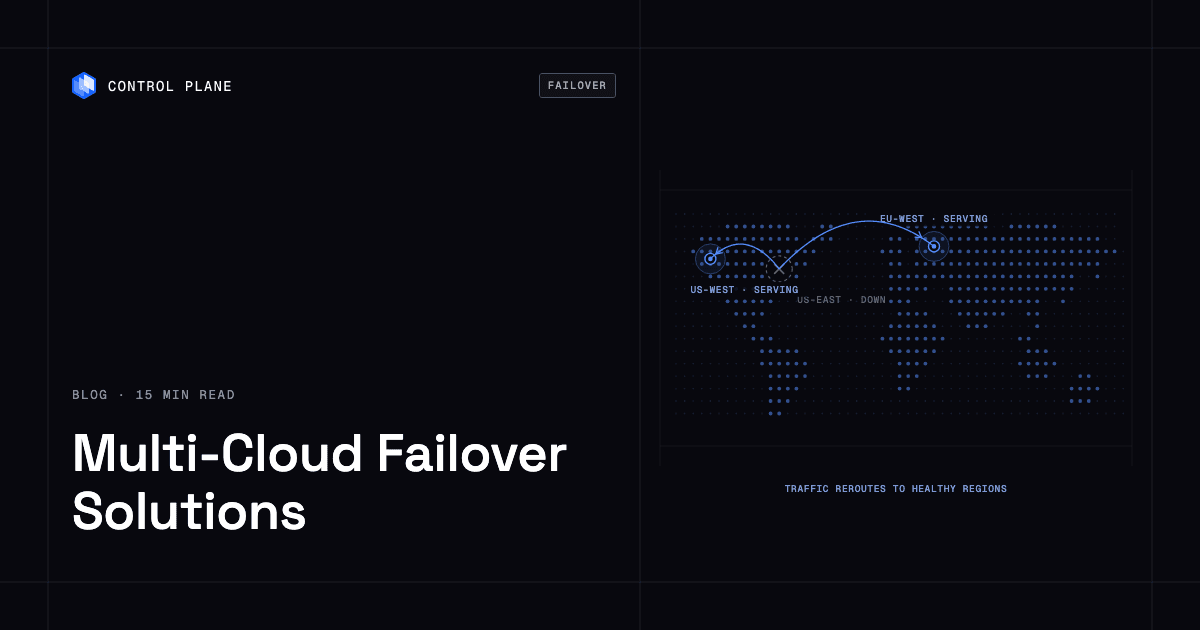
The best failover solution keeps your application serving users from another location without a manual cutover. The strongest approach is active-active across two or more locations, where every location already serves live traffic, rather than restoring from backups after an outage.
Backup and disaster recovery tools solve a different problem: getting data and systems back after something breaks. This guide compares eight solutions on how they handle region and provider failures, what each vendor documents about recovery time, and what you pay for while nothing is wrong. Disclosure: Control Plane publishes this guide and is one of the solutions listed. Other products are described from their own documentation, linked inline and checked in October 2026.
TL;DR
For customer-facing SaaS that must keep serving users when a region or a whole cloud provider fails, run the application active-active in two or more locations behind a routing layer that sends each request to a healthy location. Use backup and disaster recovery tools to protect data and recover systems, not to keep users online. Ranked by how directly each keeps an application serving users across regions and providers without a manual cutover:
- Control Plane: active-active across regions and providers, and it runs the application itself.
- Zerto (HPE): continuous replication and journal-based recovery, with RPOs of seconds and RTOs of minutes.
- AWS: Application Recovery Controller and Route 53 for multi-region apps on AWS, plus Elastic Disaster Recovery.
- Azure: Site Recovery, Front Door, and Traffic Manager for multi-region apps on Azure.
- Google Cloud: multi-region load balancing with Cloud DNS failover, plus Backup and DR Service.
- Veeam: backup and recovery with replication across sites and clouds.
- Cloudflare Load Balancing: health-checked traffic steering across origins and providers (a traffic layer only).
- Rubrik: backup and cyber recovery.
Failover vs disaster recovery vs backup
- Backup copies data at intervals so you can restore it later. It protects against deletion, corruption, and ransomware, and users see downtime while you restore.
- Disaster recovery (DR) replicates systems or data to another site so you can start the workload there. It shortens recovery, but a person, runbook, or alarm-triggered plan still starts the recovery, and the application is down until it finishes.
- Failover moves live traffic to a location that is already running the application. With active-active failover, every location already serves traffic, so there is nothing to restore and no cutover to run.
Most production SaaS teams need failover for availability and backup for data protection. For the DR side in depth, see our roundup of cloud disaster recovery solutions.
| Backup | Disaster recovery (replication) | Active-active failover | |
|---|---|---|---|
| What it protects | Data history | Systems and data at a second site | Live service availability |
| Typical RTO | Hours to days | Minutes to hours | Seconds to minutes, set by health checks and routing |
| Typical RPO | Time since last backup | Seconds to minutes | Depends on database replication design |
| Do users see downtime? | Yes, during restore | Yes, until recovery completes | Requests move to a healthy location |
| Cost to keep ready | Storage | Replication target and licenses | No idle standby when every location serves traffic |
These ranges describe the categories in general, not specific vendors.
Recovery time by approach
Set RTO (how long you can be down) and RPO (how much data you can lose) from business impact, then pick the approach that meets both. Restore-based recovery is measured in hours. Replication-based DR vendors publish RTOs from minutes to an hour and RPOs in seconds. DNS-based failover depends on TTLs and health check timing. Active-active with request-level routing removes the cutover step, so recovery time is the time to detect a failed location and stop sending it requests. For what each design can deliver, see five-nines uptime architecture.
How we evaluated
- Active-active or active-passive: whether every location serves traffic, or a standby waits.
- Cross-cloud support: whether failover works across providers, not only across regions inside one cloud.
- Failover trigger: automatic, manual, or configurable.
- Documented recovery time: only what the vendor publishes; otherwise “not published.”
- Idle standby cost: whether you pay for capacity that serves no users until a failure.
- Data replication: how state moves between locations and how it fails over.
- Operational effort: what your team builds, tests, and maintains.
Active-active vs active-passive
For availability, active-active wins: every location already carries traffic, so a failure removes one location from rotation and the others continue. The trade-offs are data design and capacity. You need a replication model for state that works with multiple live locations, and each surviving location needs headroom to absorb redistributed traffic. Active-passive stays reasonable for stateful systems with a single writer, or when cost matters more than recovery speed. The active-active high availability guide covers the design.
The ranking
1. Control Plane
What it is. Control Plane is the platform for running unbreakable apps and agents. It combines any cloud, neocloud, and bare metal into one Global Virtual Cloud (GVC), and runs containers and VMs (serverless, standard, stateful, cron, and VM workloads) on AWS, GCP, Azure, your own clusters, or on premises.
How failover works. A workload deployed to a GVC runs active-active in every location of that GVC, and a global endpoint routes each request to the nearest healthy location, so you get active-active failover without paying for idle standby capacity. Workloads scale on requests per second, a latency percentile, or custom metrics, and traffic only reaches replicas that pass readiness checks.
Cross-cloud support. Yes. Locations can be regions of AWS, GCP, or Azure, your own Kubernetes clusters through Bring Your Own Kubernetes (BYOK), or Managed Kubernetes locations, including on premises and neoclouds. A GVC can also span regions of a single cloud.
Documented recovery objectives. The 99.999% availability SLA applies to workloads running at least two replicas in at least two locations. Those locations can be two regions of one cloud or locations on different providers. One measured result: “During the October 2025 AWS us-east-1 outage, 20% of Control Plane customers had us-east-1 in their Global Virtual Clouds. Their workloads were active and running in healthy locations within 10 seconds, with no customer downtime, according to Control Plane internal incident telemetry.”
Data. The template catalog includes Postgres, MySQL, MongoDB, Redis, CockroachDB, pgEdge, TiDB, and Cassandra. Postgres Multi-Location, Redis Multi-Location, and MongoDB Cluster promote a replica in a surviving location automatically when they span three or more locations. CockroachDB, pgEdge, and TiDB accept writes in several locations. Universal Cloud Identity gives workloads short-lived, least-privilege access to 600+ AWS, GCP, and Azure services, with no long-lived cloud keys in your code, and the same identity works in every location; see workload identity federation. Cloud Wormhole connects workloads in every location to private VPCs and on-premises networks, so private dependencies stay reachable after a failover.
What you pay for when idle. Nothing beyond the locations already serving traffic. Customers typically cut compute costs 30 to 50 percent compared with running directly on AWS, GCP, or Azure.
Operations and compliance. Day-two operations are built in: autoscaling, readiness-gated rollouts, automatic TLS certificates, secrets management, and unified logs, metrics, and traces, with no Kubernetes cluster you have to operate. Control Plane is PCI DSS Level 1, SOC 2 Type II, HIPAA, and GDPR compliant.
Best for. Teams running customer-facing services, on one cloud or several, that need them to stay up through a region or provider failure.
Limitations. Two-location Postgres is a warm standby that needs a manual promotion, so use three locations for automatic promotion. Point-in-time recovery from corruption or ransomware still needs backups: the Postgres and MongoDB templates write backups to S3 or GCS, and immutable copies belong in a dedicated backup tool.
2. Zerto (HPE)
What it is. HPE Zerto Software is a disaster recovery, cyber resilience, and workload mobility product built on continuous data protection. Zerto’s site describes journal-based recovery instead of snapshots.
How failover works. Zerto replicates changes continuously to a recovery site on premises or in the cloud and records checkpoints in a journal, with orchestrated failover and testing that operators start. The application is recovered at the target, not served from both sites at once.
Cross-cloud support. Yes. HPE describes protection across on-premises, hybrid, and multi-cloud environments.
Documented recovery objectives. HPE describes near-zero RPOs and recovery in minutes, and Zerto’s site describes RPOs of seconds and RTOs of minutes, with restore points separated by 5 to 15 seconds.
What you pay for when idle. Licensing and the replication target; pricing is not published on the pages reviewed.
Best for. Virtualized and hybrid estates that need low data loss and tested recovery, including ransomware recovery.
Limitations. It recovers machines and applications rather than running them in several places at once, so users see downtime until recovery completes.
3. AWS: Application Recovery Controller, Route 53, and Elastic Disaster Recovery
What it is. Amazon Application Recovery Controller (ARC) covers multi-AZ recovery (zonal shift and autoshift) and multi-region recovery through routing controls and Region switch. AWS Elastic Disaster Recovery replicates servers into AWS.
How failover works. Routing controls are on-off switches tied to Route 53 health checks and DNS records, with safety rules. Region switch runs plans for active-passive or active-active layouts, manually or automatically from CloudWatch alarm triggers. Elastic Disaster Recovery replicates blocks to a staging area and launches recovery instances when you start a recovery job.
Cross-cloud support. The ARC and Route 53 pattern is for apps on AWS. Elastic Disaster Recovery can replicate servers that originate outside AWS, but the target is AWS.
Documented recovery objectives. AWS documents Elastic Disaster Recovery with a crash-consistent RPO of seconds and an RTO typically between 5 and 20 minutes, depending on OS boot time and configuration. ARC recovery time: not published.
What you pay for when idle. Elastic Disaster Recovery charges an hourly fee per replicating server plus the staging storage and compute it uses; a standby Region costs whatever you run in it.
Best for. Teams that run entirely on AWS and want AWS-native region recovery.
Limitations. Failover stays inside AWS, and your application stack, data replication, and testing remain your work.
4. Azure: Site Recovery, Front Door, and Traffic Manager
What it is. Azure Site Recovery replicates Azure VMs between regions and replicates on-premises VMs and physical servers to Azure. Azure Front Door and Traffic Manager route user traffic between regions.
How failover works. Site Recovery failover is started by you or a recovery plan and does not need connectivity from the primary region. Traffic Manager returns the best endpoint through DNS with built-in monitoring and automatic endpoint failover. Front Door terminates connections at edge locations and routes to the closest healthy backend, with connection-level failover Microsoft describes as seconds, not dependent on DNS TTL.
Cross-cloud support. Azure-centered. Site Recovery targets Azure, though it can replicate some sources from outside Azure, including AWS Windows instances.
Documented recovery objectives. Microsoft states an RTO SLA of one hour for Site Recovery VM failover, with most failovers completing within minutes. A fixed RPO figure: not published there. Traffic Manager failover depends on DNS TTL, which Microsoft’s multi-region guide lists as typically 30 to 300 seconds.
What you pay for when idle. Replicated storage for Site Recovery, plus any standby regional stack for active-passive designs.
Best for. Azure-first teams that need region-level recovery and a global routing tier.
Limitations. Site Recovery recovers VMs rather than serving from two places, and the routing services do not replicate your data or run your application.
5. Google Cloud: multi-region load balancing and Backup and DR Service
What it is. Google documents failover for global external Application Load Balancers and offers Backup and DR Service for centralized backup.
How failover works. Google describes an active-passive strategy (global-to-regional failover) and an active-active strategy (global-to-regional bypass). Failover is automatic: Cloud DNS shifts traffic when health checks from two or more of three source regions fail. Backup and DR stores immutable backups in a backup vault and supports cross-region and cross-project recovery.
Cross-cloud support. No. Both products center on Google Cloud, with Backup and DR also covering VMware VMs, databases, and file systems.
Documented recovery objectives. Google gives an upper bound for load balancer failover: DNS TTL plus health check interval times unhealthy threshold, with a recommended TTL of 30 to 60 seconds. Backup and DR RPO and RTO figures: not published.
What you pay for when idle. Regional load balancers and backends in each region you keep ready, plus backup vault storage.
Best for. Google Cloud teams that want multi-region serving with managed backups.
Limitations. Single-cloud scope, and Backup and DR restores data and workloads rather than keeping an application serving during an outage.
6. Veeam
What it is. Veeam Data Platform combines backup, replication, and recovery orchestration, and Veeam Recovery Orchestrator builds one-click recovery plans.
How failover works. Veeam offers snapshot and CDP replicas that a VM fails over to, and CDP failover supports full-site and partial-site scenarios. Orchestrator plans run by an operator or on a schedule rather than being triggered by failure detection, and Veeam documents testing in isolated labs.
Cross-cloud support. Yes for recovery targets: Veeam says workloads can be recovered to AWS, Microsoft Azure, or other cloud targets.
Documented recovery objectives. Veeam describes CDP as near-zero RPO, with short-term restore points seconds or minutes back depending on the RPO you set, and says Instant Recovery to Azure brings workloads online in minutes. A fixed RTO: not published.
What you pay for when idle. Licensing plus backup and replica storage.
Best for. Mixed on-premises and cloud estates that need backup, replication, and tested recovery from one vendor.
Limitations. It recovers workloads after a failure, so users see downtime until a plan finishes.
7. Cloudflare Load Balancing
What it is. Cloudflare Load Balancing is a traffic layer: monitors check endpoints, pools group origins, and steering policies direct requests.
How failover works. Monitors send health checks at a set interval, unhealthy pools leave rotation, and a fallback pool takes traffic if all pools are down. Cloudflare documents “Off – Failover” for active-passive and modes such as random for active-active.
Cross-cloud support. Yes. Pools point at origins wherever they run.
Documented recovery objectives. Not published as a fixed figure; detection time follows your monitor interval, timeout, and retry settings.
What you pay for when idle. The origins you run in each pool.
Best for. Teams that already run the application in multiple places and need a provider-neutral routing layer.
Limitations. It does not run your application, replicate your database, or manage identity and secrets, so failover only helps if healthy origins exist behind it.
8. Rubrik
What it is. Rubrik Security Cloud provides immutable, air-gapped backups, data threat monitoring, and cyber recovery with recovery plans and simulation.
How failover works. Rubrik can orchestrate recovery workflows and restore clean data and applications from isolated, air-gapped copies.
Cross-cloud support. Rubrik protects data across enterprise, cloud, and SaaS environments.
Documented recovery objectives. Not published as fixed RTO or RPO figures on the pages reviewed.
What you pay for when idle. Storage and licensing for protected data.
Best for. Recovering clean data after ransomware, and meeting retention and cyber insurance requirements.
Limitations. It restores data and applications after an incident rather than acting as a live traffic-failover layer, so users see downtime until restore completes.
Comparison table
| Solution | Approach | Cross-cloud | Automatic failover | Idle standby cost | Failover runs the app for you |
|---|---|---|---|---|---|
| Control Plane | Active-active | Yes | Yes | No | Yes |
| Zerto (HPE) | Replication and recovery | Yes | No (operator-started, orchestrated) | Replication target | No |
| AWS ARC, Route 53, Elastic DR | Active-passive or active-active routing; restore | No (DR can source from outside AWS) | Configurable (Region switch can run on alarms) | Depends on design | No |
| Azure Site Recovery, Front Door, Traffic Manager | Restore plus traffic steering | No (Azure-centered) | Configurable | Depends on design | No |
| Google Cloud load balancing, Backup and DR | Active-passive or active-active routing; restore | No | Yes for routing | Depends on design | No |
| Veeam | Replication and restore | Yes | No (operator-started or scheduled) | Replica storage | No |
| Cloudflare Load Balancing | Traffic steering | Yes | Yes | Origins you run | No |
| Rubrik | Restore | Yes | No | Storage | No |
How to choose
- Stay up during a region outage: run active-active in two or more regions. Control Plane does this as a platform; on a single cloud, AWS, Azure, or Google routing services work if you build and replicate the stack yourself.
- Stay up during a provider outage: you need locations on more than one provider and a routing layer neither owns. Control Plane does this with a global endpoint across providers, and Cloudflare can steer traffic if you already run origins on several providers.
- Recover data after ransomware: use immutable backups and tested recovery plans with Rubrik, Veeam, Zerto, or your cloud’s backup service.
- Keep cost down: avoid a warm standby that serves no users; active-active shares the load across locations with no idle standby.
Implementation checklist for failover that works
- Run in two or more locations. One standby region you never test is not failover.
- Replicate data with known failover behavior: know which database promotes automatically, which needs a manual step, and which accepts writes in several places.
- Use health checks that test real dependencies. A check that returns 200 while the database is unreachable keeps sending users to a broken location.
- Remove single-region dependencies: DNS, identity, secrets, image registry, TLS certificates, and third-party APIs, with short DNS TTLs wherever DNS is in the path.
- Keep identity portable with short-lived credentials that work in every location.
- Add capacity headroom so surviving locations can absorb the loss of your largest location.
- Drill failover: drain a location on purpose, measure RTO and RPO, and compare against targets.
- Separate failover from backup, and keep immutable backups for corruption and ransomware.
FAQ
What are the best multi-cloud failover solutions?
The strongest design is active-active across providers with a global routing layer, which is how Control Plane runs workloads. Zerto and Veeam provide cross-site recovery, and Cloudflare provides provider-neutral traffic steering over origins you run.
What are the most reliable multisite failover services?
Reliability depends on whether the service keeps users online or recovers systems afterward. Active-active platforms and tested health-checked routing keep users online; replication tools such as Zerto document recovery in minutes.
How can I find disaster recovery services that let me spread resources across multiple regions?
Look for products that name multi-region targets: Zerto, AWS Elastic Disaster Recovery, Azure Site Recovery, Veeam, and Google Backup and DR, of which Zerto, AWS, and Azure publish RTO figures. Then decide whether you need recovery or continuous serving; for the full DR comparison, see the disaster recovery roundup.
What are the best disaster recovery solutions for cross geography replication?
Zerto, Veeam, AWS Elastic Disaster Recovery, and Azure Site Recovery replicate across geographies. If users must stay online during the failure, add active-active serving.
What are the best business continuity solutions for scaling high availability services on premises and cloud?
Zerto and Veeam cover on-premises and cloud recovery for virtualized estates. Control Plane runs services active-active across on-premises Kubernetes locations and cloud regions through BYOK and Managed Kubernetes locations.
How do I fail over an application across cloud providers automatically?
Run the application in locations on more than one provider, or in two regions of one cloud, and send traffic through a health-aware global endpoint. On Control Plane, a GVC does this by default for its locations; elsewhere you build it from a traffic layer, per-provider deployments, and replicated data.
Next step: pick the failure you cannot accept, then match the tool; if it is a region or provider outage hitting live users, start with active-active. Talk to the Control Plane team or sign up free.