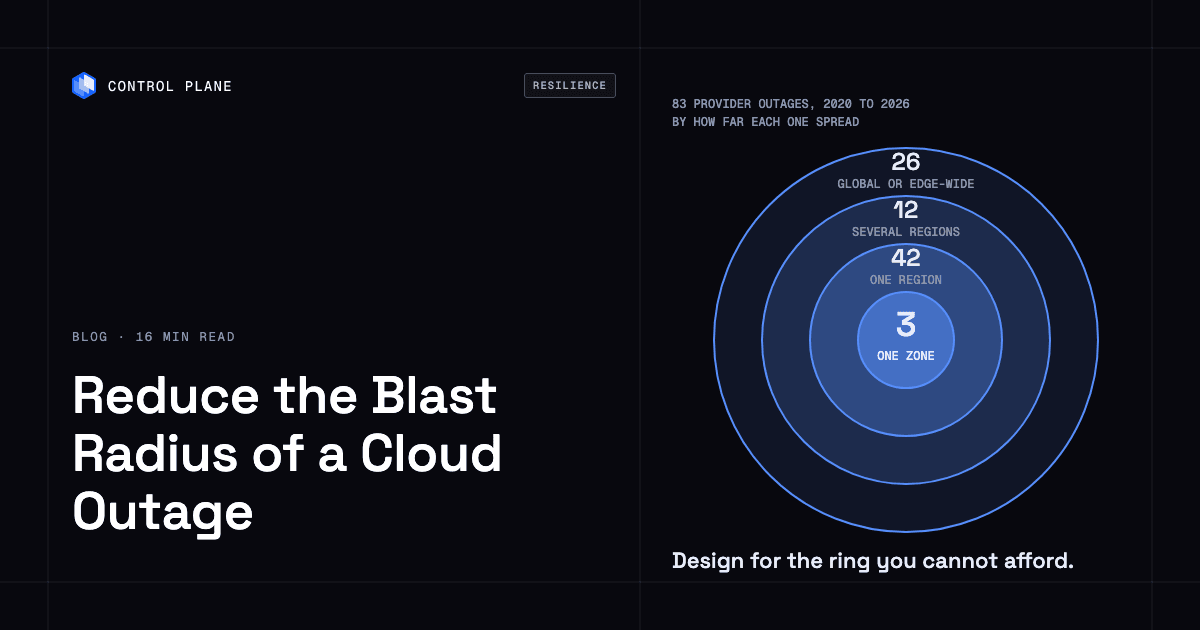
Reduce the blast radius of a cloud provider outage by deciding which failure scope each critical service must survive (a zone, a region, several regions, or a provider’s global layer), running it across that boundary with capacity already in place, and removing the shared dependencies, such as DNS, identity, registries, and pipelines, that can take it down while its servers are healthy. In Control Plane’s tracker of 83 major provider outages since 2020, 3 stayed inside one zone, 42 inside one region, 12 spread across several regions, and 26 were global or edge-wide, so a design that stops at one zone leaves 80 of them uncovered, and one that stops at one region leaves 38 uncovered.
Disclosure: Control Plane publishes this guide.
TL;DR
Five points cover what the outage data shows, which dependencies fail silently, and which controls contain each scope.
- What the outages show. Of 83 major cloud provider outages tracked from 2020 to 2026, only 3 stayed inside a single availability zone. 42 hit one region, 12 spread across several regions, and 26 were global or edge-wide.
- Control Plane. Control Plane handles Day 2 operations for you, including autoscaling, built-in observability, and security, and runs a workload in one region or across several regions and cloud providers. Its Global Virtual Cloud (GVC), a named set of locations, lets a workload run across AWS, GCP, Azure, and Oracle Cloud Infrastructure (OCI) locations in a single configuration. When a location fails, replicas in other locations take over. Control Plane backs this with a 99.999% availability SLA for workloads running at least two replicas across at least two locations.
- Hidden dependencies matter more than compute. DNS, identity providers, container registries, secrets managers, CI/CD pipelines, and status pages can each take your application offline while every server is healthy.
- Controls to add first. Timeouts and retries with jitter, graceful degradation, multi-zone with spare capacity, staged rollouts, a second region with static stability, a second authoritative DNS provider, and locations on more than one cloud provider.
- Test with game days. Run game days that block a zone, a region, DNS, the identity provider, and the registry. Measure time to detect, time to recover, and error rate during failover.
How far do cloud provider outages actually spread?
Of the 83 tracked outages, 80 spread past one zone and 38 spread past one region.
| Scope | Outages (of 83) | What fails | What contains it | On Control Plane |
|---|---|---|---|---|
| One zone | 3 | A facility’s power or cooling, or one zone’s storage subsystem | Spreading across zones with spare capacity | Multi-zone spreads replicas across a location’s zones where supported, and other locations take over |
| One region | 42 | A site’s power, cooling, or physical damage, a regional service, or a region’s network | A second region with static stability | Locations in other regions take over |
| Several regions | 12 | A change or automation bug in half; capacity, DNS, power, network, or other causes in the rest | Locations on a second provider | Locations on two or more providers in one GVC |
| Global or edge-wide | 26 | A change or bug in a shared global layer, such as CDN, DNS, WAN, identity, or a control plane, in 19 of 26; DNS, network, power, or third-party faults in the rest | A second DNS or CDN path and compute on a second provider | Locations on more than one provider, with Control Plane’s geographically distributed DNS routing traffic to healthy ones |
Data from Control Plane’s cloud outage tracker, covering 83 sourced major outages at AWS, Azure, Google Cloud, Oracle Cloud, and Cloudflare from July 2020 to November 2026.
The 38 outages that spread beyond one region called for independence from that provider’s shared layer, whether through a second provider, a second DNS path, or a second CDN. Forty-three percent of all 83 outages were caused by a configuration change, a deployment change, or a software bug. Other causes included power or cooling failures, DNS issues, capacity exhaustion, network problems, and physical damage.
What are the hidden single points of failure in a cloud application?
Your application can go dark even when every compute instance is healthy, because the dependencies it relies on to start, authenticate, resolve, deploy, and observe are often concentrated on a single provider or a single global service.
| Dependency | How it takes you down while your servers are healthy | Fallback | How to test |
|---|---|---|---|
| Authoritative DNS | Users cannot resolve your domain once cached records expire | Serve the zone from two providers using zone transfers or API sync (geo and alias records do not transfer); RFC 2182 says secondaries must be topologically and geographically dispersed | Confirm both providers serve the same zone serial, then block one provider’s name server IPs from a test resolver and confirm resolution continues |
| CDN and WAF | Edge nodes stop serving or start blocking legitimate traffic | Run a second CDN origin path or maintain a direct-to-origin DNS record for failover | Route a percentage of synthetic traffic through the backup path |
| Identity provider and SSO | No user can log in; no token can be refreshed | Cache OIDC JWKS keys so existing tokens validate locally until they expire; keep break-glass admin accounts that sign in directly to each cloud without federating through the identity provider | Block the jwks_uri in a test environment and confirm existing sessions continue |
| Cloud IAM and global-service control planes | Recovery steps that create or change IAM roles, DNS records, or other global resources fail when that service’s control plane is down, even though sign-in and authorization keep working in each region; AWS notes that some global services run their control plane in a single region | Remove control-plane API calls from the recovery path; pre-provision capacity | In a test account, deny IAM and DNS write actions with a deny policy, then run the failover runbook end to end |
| Secrets manager | Applications cannot start or rotate credentials | Replicate secrets to a second region or provider; cache critical secrets locally where safe; Control Plane stores org secrets envelope-encrypted in cloud hardware security modules on multiple providers | Restart a service with the secrets endpoint blocked |
| Container registry | New pods cannot pull images during scale-up or rollout | Use pull-through caches and cross-region replication; Control Plane’s private image registry caches images at each location where a workload runs | Block the registry endpoint and schedule a pod onto a node that does not have the image |
| CI/CD and deploy pipeline | You cannot ship a fix for the outage itself | Keep runbooks, scripts, and pipelines available in more than one region; store artifacts in a second registry | Run a deploy from the backup pipeline to a staging environment |
| Scaling and instance launches | Auto-scaling calls the provider’s control plane, which may be impaired | Pre-provision spare capacity so the system is statically stable | Disable the scaling API and observe whether the service absorbs a traffic spike |
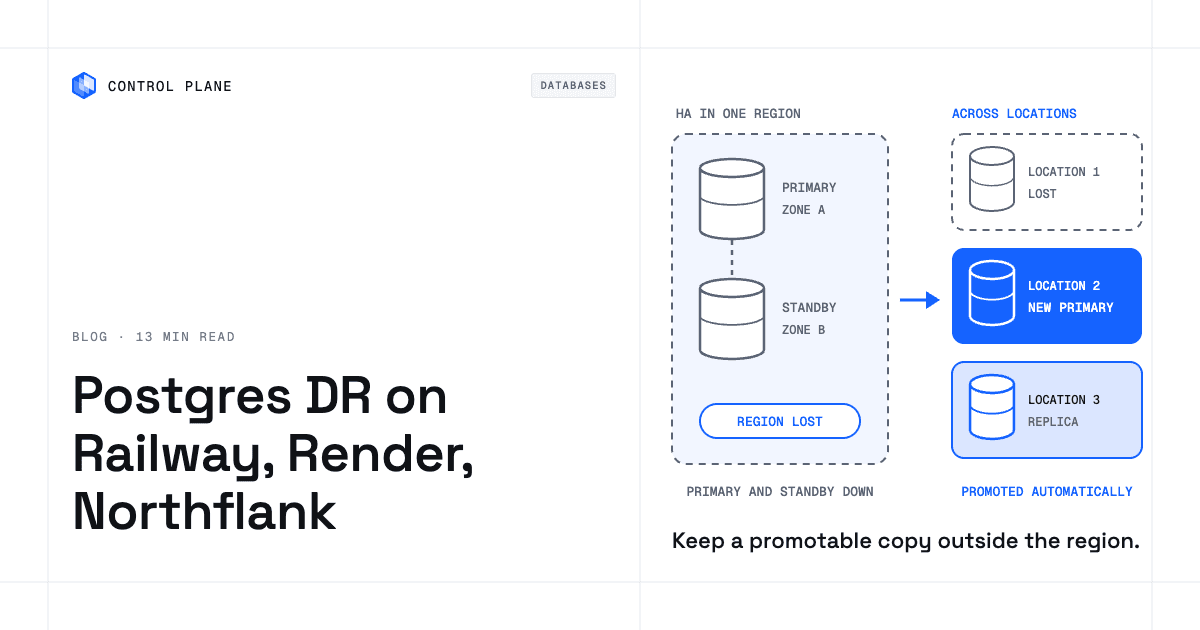
| Primary database | Writes fail or replication lag causes stale reads | Run a replicating database across regions or providers, with a tested promotion step; Control Plane’s Template Catalog includes a Postgres Multi-Location template that fails over automatically with three or more locations | Promote a replica in a secondary region and measure data loss |
| TLS certificates | Renewal fails when the certificate authority or the provider’s certificate service is down, and certificates expire | Renew well before expiry, at about two-thirds of the lifetime, and configure a second ACME certificate authority | Block the primary certificate authority in staging and force a renewal |
| Feature flags and configuration service | Services cannot start or fall back to unsafe defaults when the flag service is unreachable | Keep the last known good configuration and evaluate flags from a local cache | Block the flag service and restart a service |
| Object storage | Assets, backups, or configuration files become unreachable | Replicate critical objects to a second region or a second provider | Block the storage endpoint and confirm the application degrades gracefully |
| Payment processor | Revenue stops even though the product works | Retry with idempotency keys; integrate a secondary processor for critical flows, noting that stored card tokens do not carry over | Inject a timeout on the primary processor’s API in staging |
| Email and SMS provider | Password resets, alerts, and notifications fail silently | Configure a fallback delivery provider with automatic switchover | Disable the primary provider’s credentials and send a test notification |
| Monitoring, alerting, and status page | You lose visibility into the outage and cannot tell customers about it; a status page on the same infrastructure goes down with the product | Host monitoring and the status page on a different provider | Simulate primary monitoring failure and confirm alerts arrive through the backup |
| Incident chat and runbooks | The team cannot coordinate if chat depends on the failed provider | Store runbooks outside the primary cloud; use an out-of-band communication channel | Run a tabletop exercise with the primary chat tool disabled |
| Third-party and AI model APIs | A downstream API outage cascades into your product | Set strict timeouts; return cached or degraded responses; queue requests for retry | Inject latency or errors on the third-party endpoint in staging |
AWS splits most services into a control plane that creates and changes resources and a data plane that provides the service’s primary function, and says data planes are intentionally simpler, with fewer dependencies, which makes them more reliable. When an outage hits a provider’s control plane, recovery steps that call that control plane, such as launching instances, changing DNS records, or rotating secrets, can stall, while data-plane operations such as health-checked DNS failover keep working. Microsoft recommends failure mode analysis that maps internal and external dependencies, identity providers included. Audit every action in your failover runbook and confirm that none of them depend on the very control plane that may be down.
Which architecture controls reduce the blast radius?
Each control limits a different scope of failure, and the right set depends on the RTO and RPO your business requires for each service.
| Control | What it limits | What it costs you |
|---|---|---|
| Timeouts, retries with backoff and jitter | Prevents a slow dependency from cascading into a full outage | Tuning effort; risk of premature timeout if set too aggressively |
| Load shedding and graceful degradation | Keeps part of the service working near overload | Requires defining degraded modes and testing them, because they rarely run in production |
| Multiple zones with spare capacity | Contains a single-facility failure | Extra compute cost for idle capacity in each zone |
| Cells or shuffle sharding | Limits a failure to one cell or one shard; with 10 cells, one failed cell leaves 90% of requests unaffected; with 8 workers and 2 per shard, a problem’s scope of impact drops to about 1/28 | Routing complexity; per-cell operational overhead |
| Staged rollouts of configuration one partition at a time | Catches a bad change before it reaches every region; a global configuration error can become a single point of failure across every geography | Slower deployment velocity; canary infrastructure |
| A second region with static stability | Survives a full regional outage without needing to call the provider’s control plane to scale up | Standby compute in the second region plus cross-region data replication |
| A second authoritative DNS provider | Survives an outage of one authoritative DNS provider | Zone-transfer configuration; TTL management across two providers |
| Locations on more than one cloud provider | Survives a provider-wide or global-edge outage; a Control Plane GVC runs one workload across locations on several providers | Cross-provider networking, credential management, and data replication when built in-house |
Static stability is the principle that a system keeps working with capacity already provisioned when a dependency is impaired, with no scaling or API calls needed during the incident. AWS explains static stability using Availability Zones, and the same principle applies at every scope. Reserve the backup capacity ahead of time, because during a regional outage many customers try to scale into the same neighboring regions. If your failover plan begins with “launch new instances in the backup region,” you are depending on a control plane that may already be impaired. Pre-provision the capacity, keep it warm, and let the data plane route around the failure.
How can my company avoid being taken down by the next major cloud outage?
Work through these eight steps in order, starting with the scope decisions the later steps build on.
- Rank services by business impact and set RTO and RPO. Not every service needs to survive a provider-wide outage. Decide which ones do, and assign each a recovery time objective and a recovery point objective.
- Map every dependency. Walk the table of hidden single points of failure and record which provider, region, and service each dependency runs on. Include DNS, identity, registry, CI/CD, monitoring, status page, and incident chat.
- Choose the scope each service must survive. Use the outage-scope data to inform the decision. A service that must survive a regional outage needs a second region. One that must survive a provider-wide outage needs a second provider or an independent edge path.
- Pre-provision capacity across that boundary. Deploy replicas in the backup region or provider before the outage. Static stability means the capacity is already running.
- Remove control-plane calls from failover. Audit every step in your failover runbook. If a step calls a provider API to launch instances, change DNS records, or rotate secrets, replace it with a data-plane operation or a pre-provisioned resource.
- Add degraded modes. Define what each service does when a dependency is unavailable. Serve cached data, queue writes, disable non-critical features, or return a clear error. Graceful degradation needs regular testing because it rarely runs.
- Move status page, runbooks, and incident chat off the primary provider. Store runbooks where the team can reach them without authenticating through the failed provider.
- Drill. Production drills are the only way to verify RTO and RPO targets. Schedule them quarterly. Measure time to detect, time to recover, and customer-visible error rate.
On Control Plane, a workload runs in every location of its GVC, so capacity is already running in each one, whether the locations are regions of one provider or a GVC with locations on multiple providers spanning AWS, GCP, Azure, and OCI. Each workload gets a canonical endpoint, one HTTPS URL that uses DNS to route traffic to the nearest healthy location.
How do you test that an outage stays contained?
Game days confirm that blast-radius controls work by injecting each failure scope and measuring the result.
Start with the narrowest scope and widen. Simulate a zone loss by blocking that zone’s subnets at the network level, or with the AWS Fault Injection Service zone power-interruption scenario, and confirm that traffic shifts to the remaining zones with an error rate inside your target. Next, simulate a full region loss by withdrawing the region from your load balancer or DNS and measuring how long it takes for traffic to land on the backup region. Measure the error rate during the transition window; some requests will fail briefly, and you need to know how many.
Then test the dependencies that are harder to simulate. Block the identity provider’s JWKS endpoint and confirm that existing sessions continue to validate locally using cached keys. Cut off the upstream registry and schedule a pod onto a fresh node to verify that the pull-through cache serves the last cached image. Disable the primary monitoring provider and confirm that alerts arrive through the backup channel. Run a deploy from the backup CI/CD pipeline to prove you can ship a fix without the primary pipeline.
For each test, record four numbers: time to detect the failure, time to recover to the target error rate, the peak error rate during the transition, and data lost. Compare these to your RTO and RPO. If the numbers exceed the targets, the control is not working and needs to be fixed before the next real outage. Treat every game day as a reversible change with documented rollback and clear ownership.
How Control Plane fits
Control Plane handles Day 2 operations for you, including autoscaling, built-in observability, and security.
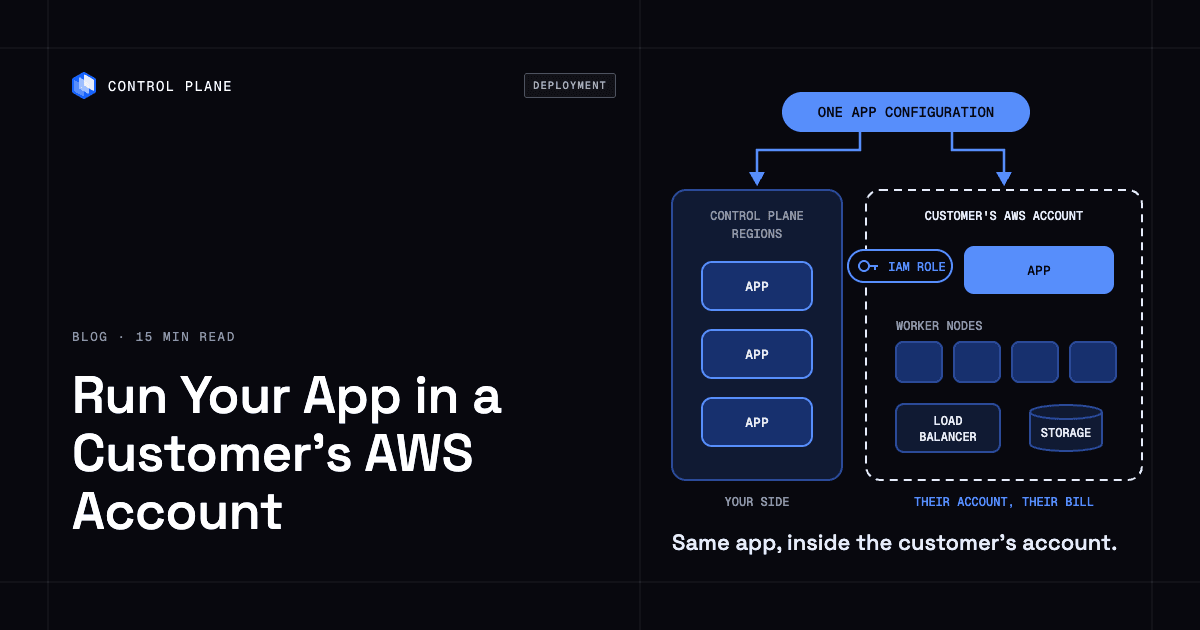
A Global Virtual Cloud (GVC) is Control Plane’s named set of locations. A workload runs in every location of its GVC. Locations can be AWS, GCP, Azure, and Oracle Cloud Infrastructure (OCI) regions where Control Plane manages the compute, plus Kubernetes clusters you run yourself through Control Plane’s Bring Your Own Kubernetes (BYOK) or that Control Plane runs for you through its Managed Kubernetes (MK8s). Each workload gets a canonical endpoint, one HTTPS URL that uses DNS to route traffic to the nearest healthy location. Replicas in other locations take over when a whole location fails.
Custom domains are TLS-secured and DNS geo-routed to the nearest healthy location in the GVC. Control Plane’s location routing options set a routing tier per location and latency offsets, so a lower tier receives traffic only when every higher-tier location is unavailable. A replica whose readiness probe fails is removed from every endpoint; add an HTTP readiness probe to standard and stateful workloads so routing follows application health.
Control Plane offers a 99.999% availability SLA for workloads running at least two replicas across at least two locations, and those locations can be on different providers. According to Control Plane’s internal incident telemetry, when a cloud region that 20 percent of Control Plane customers had in their GVCs became unavailable, their workloads were active and running in healthy locations within 10 seconds, with no customer downtime.
Universal Cloud Identity, Control Plane’s identity for workloads, gives workloads short-lived credentials for AWS, GCP, and Azure with no long-lived cloud keys in code. Org secrets are envelope-encrypted and stored on multiple cloud providers in cloud hardware security modules. Each org’s private image registry caches images at each location where a workload runs, and workloads can also pull from other registries. For data that must survive a location loss, Control Plane’s Template Catalog includes a Postgres Multi-Location template that fails over automatically with three or more locations, pgEdge for active-active Postgres, and CockroachDB, which survives a region loss with three locations. Cloud Wormhole is Control Plane’s agent that lets workloads reach TCP and UDP endpoints in private networks over outbound connections only. Control Plane is PCI DSS Level 1, SOC 2 Type II, HIPAA, and GDPR compliant.
For a deeper walkthrough, read how to survive a cloud provider outage without a runbook and the guide to the most resilient cloud architecture.
FAQ
Answers to the questions engineering leaders ask most about cloud outage resilience.
How do I reduce the blast radius of a cloud provider outage?
Control Plane reduces the blast radius at the zone, region, and provider scope by running one workload across zones, regions, and cloud providers in a single GVC. Beyond platform choice, reduce blast radius by deciding which failure scope each critical service must survive, pre-provisioning capacity across that boundary, removing control-plane API calls from the failover path, and eliminating hidden single points of failure in DNS, identity, registries, and pipelines. Add timeouts, retries with jitter, and graceful degradation in application code, and run across regions and providers for the wider scopes.
What is the fastest way to protect my company from the next major cloud outage?
Control Plane runs a workload in every location of its GVC, across regions of one provider or across several providers, and routes traffic to the nearest healthy location, so capacity is already in place when a zone, region, or provider fails. Beyond the platform, rank services by business impact, map every dependency, choose the scope each service must survive, pre-provision capacity across that boundary, remove control-plane calls from failover, add degraded modes, and drill.
What is blast radius in cloud computing?
Blast radius is the scope and extent of an outage’s impact, as Microsoft defines it. It describes how far a failure spreads across users, services, and regions. A well-isolated architecture confines a failure to a narrow blast radius. A poorly isolated one lets a single misconfiguration or facility failure cascade across every region it runs in.
Is multi-AZ enough to survive a cloud outage?
No. In Control Plane’s tracker of 83 major outages, only 3 stayed inside a single availability zone. Multi-AZ deployment would have contained those 3, but the other 80 spread to a region or wider. Treat multiple zones as the first layer of protection.
Do I need more than one cloud provider to survive a major outage?
Yes, for services that must survive a provider-wide or global-edge outage. Of the 83 outages in Control Plane’s tracker, 38 spread beyond a single region, hitting several regions or a provider’s global layer, so a second region on the same provider could contain at most 45. On Control Plane, going multi-provider is a configuration change: add locations on AWS, GCP, Azure, and OCI to a single GVC, and every workload in it runs in each location with no per-location step and no separate infrastructure stacks to manage.
What is static stability?
Static stability means capacity for a failure is already running, so recovery needs no scaling or provider API calls. AWS explains it using Availability Zones, and the same idea applies to a backup region or a second provider.
What are the most common hidden single points of failure?
The main hidden single points of failure are authoritative DNS, CDN and WAF, identity provider and SSO, cloud IAM and global-service control planes, secrets manager, container registry, CI/CD pipeline, monitoring and alerting, status page, and incident chat. Each of these can take your application offline while every compute instance is healthy.
How do companies stay online when a cloud region goes down?
According to Control Plane’s internal incident telemetry, when a cloud region became unavailable, Control Plane customers with that region in their GVCs had workloads active and running in healthy locations within 10 seconds, with no customer downtime. The general pattern is to run workloads across multiple regions or multiple providers with capacity already provisioned, so health-checked routing sends traffic to healthy locations without waiting for control-plane API calls. A separate guide covers how to keep your app online when an AWS region goes down.
How does Control Plane reduce the blast radius of an outage?
A Control Plane GVC lets a workload run across locations on AWS, GCP, Azure, and OCI in a single configuration. Each workload gets a canonical endpoint that uses DNS to route traffic to the nearest healthy location. When a location fails, replicas in other locations take over. Readiness probes remove unhealthy replicas from every endpoint. Location routing options let you set tiers so backup locations receive traffic only when primary locations are unavailable. Control Plane backs this with a 99.999% availability SLA for workloads running at least two replicas across at least two locations.
Talk to the Control Plane team to see how a GVC reduces your blast radius, or sign up free and deploy your first workload today.