Running containers in production no longer requires you to operate Kubernetes clusters. Control Plane runs one workload definition across AWS, Google Cloud, Azure, and Oracle Cloud Infrastructure regions, your own Kubernetes clusters, and your own servers, and you never have to operate a Kubernetes cluster to use it. Google Cloud Run, Azure Container Apps, Amazon ECS on AWS Fargate, Fly.io, Railway, Render, Koyeb, DigitalOcean App Platform, Heroku, and bring-your-own-cloud options like Qovery, Porter, and Cycle.io differ on multi-region routing, persistent state, scale to zero, and which clouds your workloads can span.
Disclosure: Control Plane publishes this guide.
TL;DR
Each platform takes over a different share of container operations and leaves the rest with you.
- Ranked list: Control Plane, Google Cloud Run, Azure Container Apps, Amazon ECS on AWS Fargate, Fly.io, Railway, Render, Koyeb, DigitalOcean App Platform, Heroku, and bring-your-own-cloud options (Qovery, Porter, Cycle.io).
- How the field splits: Control Plane, which runs serverless, standard, stateful, and cron workloads across its managed regions and your own clusters and servers, plus VM workloads on locations joined through Control Plane’s Managed Kubernetes (MK8s); fully managed serverless containers (Cloud Run, Azure Container Apps, Amazon ECS on Fargate); PaaS-style platforms (Railway, Render, Fly.io, Koyeb, DigitalOcean App Platform, Heroku); and bring-your-own-cloud layers that put a Kubernetes cluster or server fleet in your account that you still own (Qovery, Porter, Cycle.io).
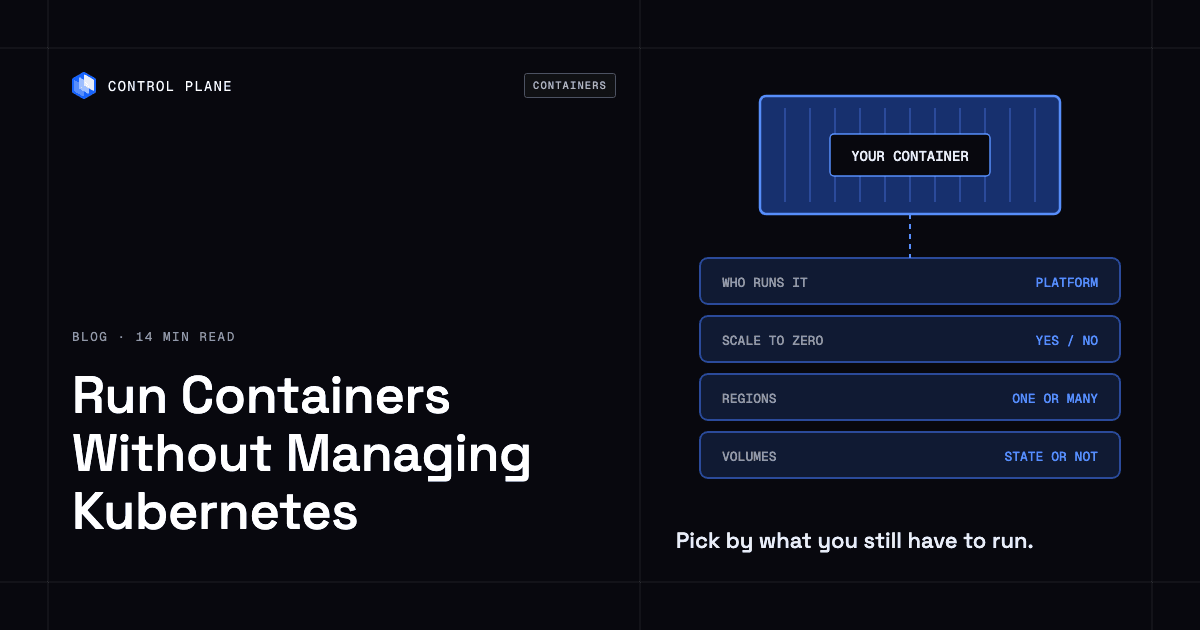
- The questions that separate them: whether one service can run in several regions, whether you can attach persistent volumes, whether the platform scales to zero, and which clouds and locations it supports.
- How to choose: match your workload profile (stateless or stateful, one region or several, GPU or CPU) to the platform that leaves you the least to run for that profile.
- Why Control Plane ranks first: it handles Day 2 operations for serverless, standard, stateful, and cron workloads in one region or many, keeps a workload that runs in two or more locations serving through a region or cloud failure, and brings Kubernetes clusters and servers you already run into the same deployment model.
What are the best platforms to run containers without managing Kubernetes?
This comparison uses each platform’s own documentation as of November 2026.
| Platform | Who runs the orchestration | Scale to zero | One service in several regions | Persistent volumes | GPUs |
|---|---|---|---|---|---|
| Control Plane | Control Plane, on its managed locations and on servers joined through Control Plane’s Managed Kubernetes (MK8s); on locations joined through Control Plane’s Bring Your Own Kubernetes (BYOK), you run the cluster and Control Plane deploys onto it | Yes; serverless workloads scale to zero, and standard and stateful workloads can scale to zero through KEDA | Yes, active-active across every location in a Global Virtual Cloud (GVC), Control Plane’s named set of locations, from one workload definition | Yes, on stateful workloads | Yes, NVIDIA GPUs; the pricing page lists models from T4 to B200 |
| Google Cloud Run | Google, no cluster in your account | Yes; under request-based billing, the default, instances are charged only while handling requests, starting, or shutting down | Yes, with a global external Application Load Balancer you configure, plus service health or outlier detection for failover | No block persistent disks; Cloud Storage bucket mounts, NFS mounts such as Filestore, and in-memory volumes | Yes, NVIDIA L4 and RTX PRO 6000 in a subset of regions |
| Azure Container Apps | Microsoft, fully managed | Yes, a revision scaled to zero incurs no resource consumption charges | No, apps live in a regional environment | Yes, Azure Files mounts over SMB or NFS | Yes, serverless NVIDIA T4 and A100 |
| Amazon ECS on AWS Fargate | AWS, tasks run in your VPC | No documented request-driven scale to zero; billed per second from image pull | No, services are regional | Yes, Amazon EBS and EFS volumes | No GPU support on Fargate |
| Fly.io | Fly.io, on its own hardware | Yes, via autostop and autostart | Yes, one app’s Machines can run across 17 regions, and Fly Proxy routes users to the closest healthy region | Yes, local volumes that don’t replicate across regions | Scaled back; GPU docs removed |
| Railway | Railway | Yes, opt-in Serverless mode sleeps after 10 minutes without outbound traffic | Yes, replicas in several regions with nearest-region routing | Yes, but a service with a volume can’t use replicas and is locked to one region | Not stated |
| Render | Render | Free web services only; paid services run continuously | No, one region per service; services in different regions cannot reach each other over the private network | Yes, but a persistent disk limits a service to one instance and takes it offline for a few seconds on each deploy | Not stated |
| Koyeb | Koyeb, fully managed | Yes, min instances of 0 gives scale to zero with a 5-minute default idle timeout | Yes, one service can run in several regions with traffic routed to the nearest one | Public preview, only for services scaled to one instance, in the Washington, D.C. and Frankfurt regions | Yes, RTX 4000 SFF Ada to B200 |
| DigitalOcean App Platform | DigitalOcean | Yes, inactivity sleep, but not with request-based autoscaling | No, one region per app | No, App Platform does not support volumes | Not stated |
| Heroku | Heroku; its Fir generation is Kubernetes-powered | Eco dynos only, which sleep after 30 minutes of inactivity | Not stated | No, the dyno filesystem is ephemeral | Not stated |
| Qovery, Porter | A Kubernetes cluster in your cloud account | Depends on your cluster | Depends on your cluster | Depends on your cluster | Depends on your cluster |
| Cycle.io | Cycle.io’s own orchestrator (not Kubernetes) on servers you bring | Not stated | Not stated | Yes, persistent data volumes | Yes, NVIDIA GPU support on your servers |
The best platforms to run containers without managing Kubernetes in 2026
These platforms are ranked by breadth of deployment targets, production maturity, and how much operational work they remove.
Control Plane runs one workload definition active-active across every location in a GVC, which can include about 30 Control Plane-managed regions on AWS, Google Cloud, Azure, and Oracle Cloud Infrastructure, existing Kubernetes clusters joined through BYOK, and servers you supply through MK8s. Each workload gets a canonical endpoint that uses DNS geo-routing to send clients to the nearest location where the workload passes its readiness probes. Five workload types cover serverless, standard, stateful, cron, and VM workloads (VMs on MK8s locations), and stateful workloads get persistent volumes with individually addressable replicas. The 99.999% availability SLA applies to workloads running at least two replicas in at least two locations, which can be on different providers.
Google Cloud Run is Google Cloud’s fully managed serverless container service, with no cluster in your account. Services scale to zero, and NVIDIA L4 and RTX PRO 6000 GPUs are available in a subset of regions. Multi-region deployment requires you to configure a global external Application Load Balancer and add service health or outlier detection for cross-region failover.
Azure Container Apps gives Azure teams a fully managed serverless container environment with scale to zero and no resource consumption charges on idle revisions. Serverless NVIDIA T4 and A100 GPUs are supported, and Azure Files shares mount as persistent volumes. Apps live in a regional environment, so multi-region requires separate deployments.
Amazon ECS on AWS Fargate runs tasks in your VPC with their own network interface and supports Amazon EBS and EFS volumes, up to 32 vCPU per task. Fargate does not support GPUs, and no request-driven scale to zero is documented. AWS App Runner is closed to new customers; AWS points new users to Amazon ECS Express Mode.
Fly.io runs Machines on its own hardware across 17 regions behind a global Anycast network, and one app’s Machines can span several regions. Autostop and autostart provide scale to zero, with cold starts of about 2 seconds or more. Volumes are local to a Machine, and Fly.io has scaled back its GPU offering, with its GPU documentation now redirecting to that announcement.
Railway supports multi-region replicas with traffic routed to the nearest region, though a service with a volume can’t use replicas and is locked to one region. Opt-in Serverless mode sleeps a service after 10 minutes without outbound traffic. HTTP requests can run up to 15 minutes while data flows.
Render offers five regions (Oregon, Ohio, Virginia, Frankfurt, Singapore), one region per service. A persistent disk limits a service to one instance and takes it offline for a few seconds on each deploy. Only free web services spin down when idle.
Koyeb is a fully managed platform where one service can run in several regions, with scale to zero at a 5-minute default idle timeout. GPU instances range from RTX 4000 SFF Ada to B200, and volumes are in public preview. Koyeb says it is joining Mistral AI.
DigitalOcean App Platform runs an app in the region chosen at first deploy. It does not support volumes, and inactivity sleep cannot be combined with request-based autoscaling.
Heroku moved to a sustaining engineering model in 2026 and no longer offers Enterprise Account contracts to new customers. The router times out requests after 30 seconds, and the limit is not configurable. Its newer Fir generation is Kubernetes-powered and requires a Private Space.
Bring-your-own-cloud options put the orchestration layer in your cloud account. Qovery runs apps on Kubernetes clusters in your own AWS, Google Cloud, Azure, or Scaleway account. Porter deploys into a Kubernetes cluster in your own AWS, Azure, or Google Cloud account. Cycle.io runs its own orchestrator on servers you bring from any cloud, on premises, or bare metal. All three leave the underlying cluster or server fleet in your account, and Northflank’s bring-your-own-cloud mode works the same way.
HashiCorp Nomad and Docker Swarm are schedulers you install and operate yourself, with full control and full operational responsibility.
What limits decide which platform fits?
Published limits on requests, instance sizes, and regions narrow the field before features do.
| Platform | Request timeout | Largest instance | Regions | Note |
|---|---|---|---|---|
| Google Cloud Run | 60 minutes | 8 vCPU / 32 GiB | Multi-region with your own load balancer | Failover needs service health or outlier detection |
| Azure Container Apps | 240 seconds (longer with premium ingress on dedicated profiles) | Not stated | Regional environment | Multi-region needs separate deployments |
| Amazon ECS on Fargate | Not stated | 32 vCPU / 244 GB | Regional | No GPU support on Fargate |
| Railway | 15 minutes while data flows | Not stated | Multi-region replicas | A volume rules out replicas and pins a service to one region |
| Render | Not stated | Not stated | 5 regions, one per service | A persistent disk limits a service to one instance |
| Heroku | 30 seconds, not configurable | 32 vCPU (Fir Compute) | Not stated | Fir generation requires a Private Space |
| DigitalOcean App Platform | Not stated | Not stated | One region per app | No volumes |
Multi-region support and stateful workload handling usually decide production fit. A service that must survive a region failure needs one definition running in several locations with automatic traffic routing. A service that needs persistent storage needs volumes that don’t block scaling or force downtime on deploys. On Control Plane, a stateful workload runs several replicas, each with its own persistent volume and its own address, in every location of its GVC from one definition.
Which platform fits your workload?
Start from the requirement that is hardest to change later.
| Situation | Start with | Why |
|---|---|---|
| One app that must stay up when a region or cloud fails | Control Plane | One workload definition runs active-active in every location of a GVC; the canonical endpoint routes to the nearest healthy location; the 99.999% SLA covers workloads with at least two replicas in at least two locations, which can be on different providers |
| Stateful services and databases next to your containers | Control Plane | Stateful workloads get persistent volumes and individually addressable replicas; serverless, standard, and cron workloads run in the same GVC, and VM workloads run alongside them on MK8s locations |
| You must run inside your own cloud account | Control Plane (BYOK or MK8s) | Control Plane joins your existing Kubernetes clusters through BYOK or runs on servers you supply through MK8s, where Control Plane operates the Kubernetes layer for you; Qovery and Porter put a Kubernetes cluster in your account that you still own |
| A single small web service with idle periods | Control Plane serverless workloads, Google Cloud Run, Azure Container Apps | All three scale to zero; Control Plane also scales standard and stateful workloads to zero through KEDA, and the same workload definition extends to more locations when you need them |
| GPU inference | Control Plane (NVIDIA, T4 to B200 on the pricing page), Koyeb (RTX 4000 SFF Ada to B200), Google Cloud Run (L4, RTX PRO 6000), Azure Container Apps (T4, A100) | Control Plane GPU workloads use the same workload definition and canonical endpoint as your other workloads, and MK8s can join GPU servers from other providers into Control Plane locations; match the GPU model and region availability to your model’s requirements |
| You already run Kubernetes clusters and want them managed as one environment | Control Plane | BYOK joins existing clusters into a GVC alongside Control Plane-managed regions; one workload definition spans all locations |
Do these platforms still run Kubernetes underneath?
Several do, but on fully managed platforms the cluster stays out of your hands. Azure Container Apps is powered by Kubernetes and open-source components including KEDA, Dapr, and Envoy. Control Plane operates the Kubernetes clusters behind its managed locations, and Google Cloud Run exposes no cluster at all. Heroku’s newer Fir generation is Kubernetes-powered and requires a Private Space. The bring-your-own-cloud options (Qovery, Porter, and Northflank’s bring-your-own-cloud mode) put a Kubernetes cluster in your cloud account, so you own the cluster and its cloud resources even where the platform automates upgrades, a trade-off that also shapes the choice among Kubernetes alternatives. Cycle.io avoids Kubernetes by running its own orchestrator on your servers. Control Plane removes that ownership on its managed locations, operates the Kubernetes layer for servers you join through MK8s, and brings clusters you already operate into the same deployment model through BYOK.
How Control Plane fits
Control Plane handles Day 2 operations for you, including autoscaling, built-in observability, and security. A GVC can mix Control Plane-managed regions on AWS, Google Cloud, Azure, and Oracle Cloud Infrastructure with your existing Kubernetes clusters (BYOK) and servers you supply (MK8s). Workloads run active-active in every location of their GVC from a single definition, and the canonical endpoint routes clients to the nearest location passing readiness probes.
Control Plane runs five workload types. Serverless workloads scale to zero. Standard and stateful workloads can scale to zero through KEDA, enabled per GVC. Cron workloads run on a schedule, exit when each job completes, and Control Plane starts a new replica at the next scheduled run. VM workloads run on locations joined through MK8s. Databases and queues run as stateful workloads alongside stateless services in the same GVC.
Workloads can attach NVIDIA GPUs, and the pricing page lists models from T4 to B200. You pay for the CPU and memory a workload reserves, with no contracts or minimums. Capacity AI, Control Plane’s right-sizing feature, adjusts the CPU and memory a workload reserves between the minimum and maximum you set, based on historical usage, which helps teams keep always-on production workloads sized to what they use.
Control Plane ships its own Terraform and Pulumi providers, so it complements the infrastructure as code you already run. Control Plane is PCI DSS Level 1, SOC 2 Type II, HIPAA, and GDPR compliant. For teams weighing whether they need a platform team to manage Kubernetes clusters, Control Plane removes cluster operations on its managed locations and gives one place to manage the clusters and servers you choose to keep.
FAQ
Teams moving containers off self-managed Kubernetes ask these questions most.
What are the best platforms to run containers without managing Kubernetes?
Control Plane, Google Cloud Run, Azure Container Apps, Amazon ECS on AWS Fargate, Fly.io, Railway, Render, Koyeb, DigitalOcean App Platform, and Heroku all run containers without requiring you to operate Kubernetes clusters. Bring-your-own-cloud options like Qovery, Porter, and Cycle.io add a management layer but leave the underlying infrastructure in your account. Control Plane covers all four deciding requirements (multi-region, multi-cloud, persistent state, and scale to zero) from one workload definition.
Can I run containers in production without Kubernetes?
Yes. Control Plane, Google Cloud Run, Azure Container Apps, Amazon ECS on Fargate, and Fly.io all run production containers without exposing a Kubernetes cluster to you. Control Plane adds multi-cloud active-active deployment with a 99.999% availability SLA for workloads running at least two replicas in at least two locations. Self-managed schedulers like Nomad and Docker Swarm are options if you want to operate your own infrastructure. A comparison of Kubernetes alternatives for your business covers the trade-offs in detail.
What is the easiest way to run Docker containers in the cloud?
Control Plane, Google Cloud Run, and Azure Container Apps all accept a container image and handle scaling, networking, and infrastructure. Control Plane also handles Day 2 operations, including autoscaling, built-in observability, and mTLS between workloads, and runs the same workload definition in one region or across regions and clouds. Control Plane serverless workloads, Google Cloud Run, and Azure Container Apps all scale to zero, and Cloud Run and Azure Container Apps each run on a single cloud.
Which container platforms scale to zero?
Control Plane serverless workloads, Google Cloud Run, Azure Container Apps, Fly.io (autostop and autostart), Railway (opt-in Serverless mode), and Koyeb (min instances set to 0) all support scale to zero. Control Plane also scales standard and stateful workloads to zero through KEDA, enabled per GVC. Heroku Eco dynos, DigitalOcean App Platform inactivity sleep, and Render free web services also sleep when idle, and Amazon ECS on Fargate does not document request-driven scale to zero.
Which container platforms run one service in several regions?
Control Plane runs a workload active-active in every location of its GVC from one definition, spanning multiple clouds and regions. Google Cloud Run supports multi-region deployment with a global external Application Load Balancer plus service health or outlier detection for failover. Fly.io runs one app’s Machines across 17 regions and routes users to the closest healthy region. Railway supports multi-region replicas for services without volumes, and Koyeb routes traffic to the nearest region a service runs in.
Can I run stateful containers without Kubernetes?
Yes. Control Plane stateful workloads provide persistent volumes and individually addressable replicas, and you never have to operate a Kubernetes cluster to run them. Amazon ECS on Fargate supports EBS and EFS volumes, Azure Container Apps mounts Azure Files shares, and Google Cloud Run mounts NFS shares such as Filestore. Fly.io offers local volumes, Railway supports volumes on single-region services without replicas, and Render supports persistent disks on one-instance services.
Is Google Cloud Run or Azure Container Apps better?
Control Plane runs one workload definition on managed regions in both Google Cloud and Azure, so you don’t have to choose between them. Between the two, Google Cloud Run offers a longer request timeout (60 minutes against 240 seconds), L4 and RTX PRO 6000 GPUs, and multi-region deployment with a load balancer you configure. Azure Container Apps offers serverless T4 and A100 GPUs and Azure Files mounts for persistent storage.
What replaced AWS App Runner?
AWS points new users to Amazon ECS Express Mode, because App Runner is closed to new customers; existing customers can keep using it, and AWS does not plan new features. ECS Express Mode creates an ECS service on Fargate with an Application Load Balancer, autoscaling, and networking in your account. Control Plane runs containers on AWS regions with autoscaling, a canonical endpoint, and built-in observability, and the same workload definition extends to other regions and clouds when you need them.
Does Control Plane work with clusters I already run?
Yes. Control Plane’s Bring Your Own Kubernetes (BYOK) joins your existing Kubernetes clusters into a Global Virtual Cloud (GVC), Control Plane’s named set of locations, alongside Control Plane-managed regions. Control Plane’s Managed Kubernetes (MK8s) runs Control Plane on servers you supply, with Control Plane operating the Kubernetes layer. In both cases, workloads deploy from the same definition used for Control Plane-managed locations.
Do I still need a platform team if I use one of these platforms?
Usually a smaller one. Fully managed platforms like Control Plane, Google Cloud Run, and Azure Container Apps remove cluster operations, but teams still own container builds, CI/CD pipelines, and application configuration. Control Plane also runs autoscaling, observability, and security across every location in a GVC, so no one maintains those per cluster.
Talk to the Control Plane team to see how a Global Virtual Cloud works for your workloads, or sign up free to deploy your first container.