The best multi-cloud management platform for an enterprise depends on the job you need done: provisioning and catalog, cost optimization, infrastructure-as-code (IaC) governance, Kubernetes fleet management, or running the applications themselves across clouds. Once you identify the job, the shortlist should be filtered on enterprise controls, because that is where vendors differ most. All 14 platforms compared here support SSO, but SCIM provisioning, exportable audit logs, published uptime commitments, and certification scope vary sharply. Control Plane is the platform that runs and routes applications across regions and clouds, including on premises, with a published 99.999% availability SLA for workloads that run at least two replicas in at least two locations.
Disclosure: Control Plane publishes this guide.
TL;DR
Enterprise buyers should pick a multi-cloud management platform by the job first, then filter on enterprise controls.
- Pick by job. Catalog and provisioning, cost, IaC governance, Kubernetes fleet, and application runtime across clouds are five distinct jobs served by different platforms.
- Filter on enterprise controls. Every platform supports SSO. SCIM, audit log export, certification scope, self-hosting, and SLA terms are where they differ.
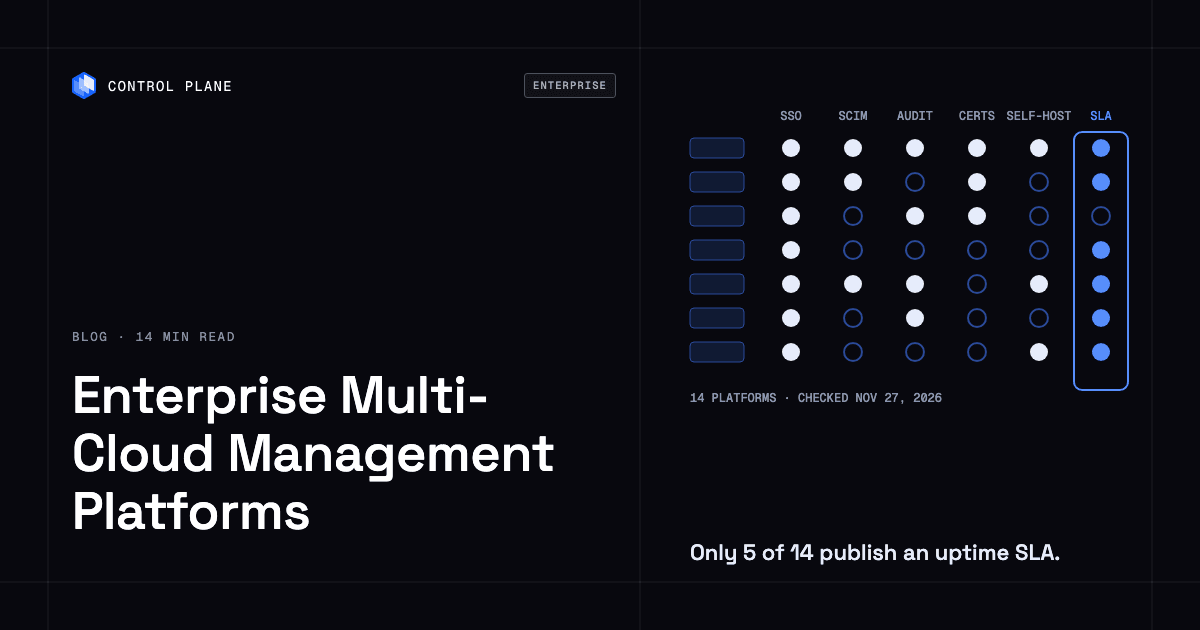
- Only five of 14 platforms publish an uptime commitment on their own current pages. Five publish SCIM support.
- Certifications are scoped. A vendor’s certification may apply only to a specific product, edition, or government environment. Read the scope before adding it to an RFP scorecard.
- Run a proof of concept on deprovisioning, audit export, and SLA terms. These are the controls where vendor pages say the least.
- Control Plane runs the applications across regions and clouds, including on premises, with a published 99.999% availability SLA for workloads with at least two replicas in at least two locations.
What are the best multi-cloud management platforms for enterprises?
The best enterprise multi-cloud management platform is the one whose primary job matches your requirement and whose SSO, SCIM, access control, audit logging, certifications, self-hosting, and uptime terms pass your checks, compared here for 14 platforms against each vendor’s own pages on November 27, 2026.
| Platform | What it manages | SSO | SCIM | Access control | Audit log | Certifications (as the vendor scopes them) | Self-hosted option | Published uptime commitment |
|---|---|---|---|---|---|---|---|---|
| Control Plane | Runs and routes applications across regions and clouds, including on premises | Google, GitHub, Microsoft, SAML | Not published | Users, groups, service accounts and workload identities bound by policies | Tamper-proof audit trail across every interface, queryable through the audit API | SOC 2 Type II, PCI DSS Level 1, HIPAA, GDPR | Workloads on your own Kubernetes clusters or servers, or on clusters Control Plane runs for you through Managed Kubernetes; management layer is SaaS | 99.999% availability SLA for workloads with at least two replicas in at least two locations |
| CloudBolt CMP | Catalog, provisioning, governance | SAML2 with Okta, OneLogin, Google, plus Active Directory | Not published | RBAC, granular permissions, approval workflows, quotas | Audit trails stated; export not published | Not published | Downloadable, self-hosted | Not published |
| HPE Morpheus Software | Catalog, provisioning, governance | Active Directory, Azure AD SAML, Okta, OneLogin, JumpCloud, generic SAML | Not published | Tenant, user, multi-tenant roles; Policies in Enterprise tier | Object History and Syslog | Not published | Single node or three-node HA appliance | Not published |
| ServiceNow Cloud Services Catalog | Catalog, provisioning, governance | SAML 2.0 and OIDC | SCIM v2 plugin | Role-based ACLs | Table auditing with configurable retention | FedRAMP High and DoD IL4 (GovCommunityCloud only); check ServiceNow’s trust site for commercial scope | Self-hosted, including Private Stack for sovereign and air-gapped environments | Not published |
| Flexera One | FinOps and cost | SAML, IdP- and SP-initiated, can be enforced | SCIM with Microsoft Entra ID | Roles plus Policy Template code | Not published | ISO 27001:2022, SOC 2 (report under NDA), TISAX for two entities, TX-RAMP Level 1 | Not published | 99.5% monthly uptime threshold, with service credits when uptime falls short |
| CloudHealth by Broadcom | FinOps and cost | SAML through Broadcom AuthHub with Okta, OneLogin, ADFS, Azure AD, Google Workspace | Vendor states CloudHealth does not support SCIM; uses just-in-time provisioning | FlexOrgs with default and custom roles | Not published | ISO 27001, SOC 2 Type II | Not published | Not published on current pages; a May 2024 VMware-era SaaS Listing stated 99.5% |
| CloudZero | FinOps and cost | Okta, Microsoft Entra ID, OIDC, SAML 2.0 | Not published | Roles plus namespace access control (preview) | Not published | SOC 1 Type 2, SOC 2 Type 2 | Not published | Not published |
| IBM Turbonomic | FinOps and cost | SAML 2.0 (documented for self-hosted), Active Directory | Not published | Predefined and custom roles with scoped users | Not published | FedRAMP Authorized (Turbonomic For Government Standard only) | Self-hosted on premises | Not published |
| IBM Cloudability | FinOps and cost | SAML 2.0, SP- and IdP-initiated | Not published | Standard and custom roles with IdP role mapping | Not published | Apptio-wide SOC 2 Type II, SOC 3, ISO 27001:2013, CSA STAR Level One; FedRAMP JAB P-ATO for IBM Cloudability for US Federal | Not published | Not published |
| Spacelift | IaC governance | SAML 2.0 (Enterprise), OIDC (all plans) | SCIM 2.0 (Enterprise) | System and custom roles plus policy-as-code engine | Audit trail with 30-day retention and webhook export (Enterprise) | SOC 2 Type II; FedRAMP Moderate in a separate FedRAMP environment | Self-hosted including air-gapped | 99.8% monthly SaaS uptime target, third-party failures excluded |
| env zero | IaC governance | SAML 2.0, Entra ID | SCIM 2.0 with Okta and Entra ID | Default and custom roles at organization, project, and environment, plus OPA plugin | Audit logs with API access and forwarding to Datadog, Splunk, and others | SOC 2 Type II (report issued November 2025) | Agent only (hybrid) | 99.9% monthly uptime on paid plans, third-party failures excluded |
| Red Hat OpenShift with Advanced Cluster Management | Kubernetes and server fleet | OIDC, LDAP, GitHub, GitLab, Google, and other identity providers | Not published | Kubernetes RBAC plus ACM governance policy framework | API server audit log and ROSA log forwarding | Per managed offering: ROSA (FedRAMP High, SOC 2 Type 2, ISO 27001, HIPAA, PCI DSS); Azure Red Hat OpenShift (PCI DSS, HITRUST, FedRAMP High, SOC 2, DoD IL5); OpenShift Dedicated (HIPAA, ISO 27001, PCI DSS, SOC 2 Type 2) | Self-managed including disconnected installs | 99.95% for ROSA and OpenShift Dedicated |
| Microsoft Azure Arc | Kubernetes and server fleet | Microsoft Entra ID | Not published | Azure RBAC and Azure Policy | Azure activity logs | FedRAMP High and DoD IL2 for Arc-enabled servers, Kubernetes, and SQL Server | Local management of Arc-enabled servers and Kubernetes through disconnected operations for Azure Local (2602 or later) | Not published |
| SUSE Rancher Prime | Kubernetes and server fleet | Entra ID, Okta SAML, PingIdentity SAML, AD FS, generic OIDC, and other providers | SCIM in Tech Preview in Rancher Prime v2.14 with Okta | Global, cluster, project, and custom roles | API audit log | SOC 2 Type 2 (Rancher Prime Hosted only); SUSE corporate ISO 27001:2022 | Self-hosted including air-gapped | Not published |
This matrix was built by Control Plane from each vendor’s own pages on November 27, 2026. “Not published” means the vendor’s pages did not state the capability on that date.
Read the matrix by job first. Identify which category your problem falls into, then compare the enterprise controls columns for the platforms in that category. Most gaps appear in SCIM, audit log export, and published SLAs. Each platform’s strengths are described in the 10 best multi-cloud management platforms in 2026.
What does the matrix show?
The matrix shows that SCIM, audit log export, and published uptime commitments are published by fewer than half of the 14 platforms.
| Finding | Count | Platforms |
|---|---|---|
| Publishes an uptime commitment on its own current pages | 5 | Control Plane (99.999% availability SLA for workloads with at least two replicas in at least two locations), Red Hat ROSA and OpenShift Dedicated (99.95%), env zero (99.9% on paid plans), Spacelift (99.8% target), Flexera One (99.5% with service credits) |
| Publishes SCIM support | 5 | ServiceNow, Flexera One (Entra ID), Spacelift (Enterprise), env zero, SUSE Rancher Prime (Tech Preview) |
| States it has no SCIM | 1 | CloudHealth by Broadcom |
| FedRAMP in some scope | 6 | ServiceNow (GovCommunityCloud), IBM Turbonomic (For Government Standard), IBM Cloudability (for US Federal), Spacelift, Red Hat (ROSA and Azure Red Hat OpenShift), Azure Arc |
| Offers a self-hosted or air-gapped install of the platform | 8 | CloudBolt, HPE Morpheus, ServiceNow, IBM Turbonomic, Spacelift, Red Hat OpenShift, SUSE Rancher Prime, Azure Arc (through disconnected operations for Azure Local). Not counted: Control Plane, which runs workloads on your own clusters and servers with a SaaS management layer. |
SCIM matters because it automates deprovisioning. Without it, the platform keeps the account, and any open sessions or API tokens that user created, until someone removes them by hand. At enterprise scale with hundreds of engineers, that gap creates compliance risk. Audit log export matters because PCI DSS Requirement 10 calls for audit logs kept at least 12 months with the latest three months immediately available, and SOC 2 auditors sample log evidence, so records need to land in a SIEM or store you control. A published SLA matters because it gives you a contractual remedy when the platform goes down. If the vendor does not publish one, your contract negotiation starts from zero. The remedy is usually a capped service credit, so read the exclusions.
Which platform fits which enterprise job?
The five jobs rarely overlap, so an enterprise often runs one platform per job.
- Catalog and provisioning. CloudBolt CMP, HPE Morpheus Software, and ServiceNow Cloud Services Catalog provide self-service catalogs, approval workflows, and provisioning governance across clouds.
- Cost optimization. Flexera One, CloudHealth by Broadcom, CloudZero, IBM Turbonomic, and IBM Cloudability handle cloud spend visibility, rightsizing recommendations, commitment management, and chargeback.
- IaC governance. Spacelift and env zero orchestrate Terraform, OpenTofu, and Pulumi runs with policy-as-code, drift detection, and approval gates.
- Kubernetes and server fleet. Red Hat OpenShift with Advanced Cluster Management, Microsoft Azure Arc, and SUSE Rancher Prime manage clusters, servers, and governance policies across clouds and on-premises locations.
- Running applications across clouds. Control Plane runs each workload across a set of locations on AWS, GCP, Azure, Oracle Cloud Infrastructure, and your own clusters or servers from one definition.
Enterprises that consolidate multiple clouds onto one platform for application runtime can reduce the number of tools their platform team operates while keeping specialized tools for cost and governance.
How do you run an enterprise proof of concept?
A proof of concept should test the enterprise controls that matter most in production as well as the provisioning workflow.
| Test | How to run it | Pass condition |
|---|---|---|
| SSO with your IdP | Configure SAML or OIDC with your production identity provider and attempt login with an authorized and an unauthorized user | Authorized user logs in; unauthorized user is denied |
| Deprovisioning | Disable a user in the IdP while that user has an open console session and an API token, then check the console, CLI, and API | New logins fail, the open session ends, and the user’s tokens stop working within the expected interval without manual intervention |
| SSO enforcement and break-glass | Turn on SSO enforcement, confirm password login is disabled, then test the documented break-glass path with the IdP unavailable | Only SSO logins succeed, and the break-glass path works and is recorded in the audit log |
| Least-privilege roles for a project team | Create a role scoped to one project or environment and verify the user cannot access resources outside that scope | No access to out-of-scope resources |
| Audit export to your SIEM | Configure log forwarding to Splunk, Datadog, or your SIEM and trigger administrative actions | Events appear in the SIEM with correct timestamps and actor identity, including denied actions and token-based API calls |
| Policy enforcement on a blocked change | Submit a change that violates a policy (wrong region, missing tag, oversized instance) and confirm it is blocked | The platform denies the change and logs the denial |
| Coverage of your actual clouds and on-premises estate | Connect every cloud account and on-premises environment you plan to manage, including Oracle Cloud Infrastructure if you run it | All environments are visible and manageable |
| Data residency of the vendor’s SaaS | Ask the vendor where the management layer stores your data and confirm it meets your regulatory requirements | Written confirmation of data residency |
| SLA terms in the contract | Review the measurement window, what is measured (management layer, workloads, or both), exclusions, claim deadline, and credit cap | Terms are documented and acceptable to your legal team |
| Exit | Export configuration and audit data from the platform | Data is complete, machine-readable, and usable without the vendor’s tools |
What does a multi-cloud management platform cost over three years?
Total cost of ownership for a multi-cloud management platform extends well beyond the subscription line.
| Cost line | What drives it | Where to find it |
|---|---|---|
| License or subscription | Per resource, per user, per cloud spend, per server, or custom quote | Vendor pricing page or sales quote; the multi-cloud management platform pricing guide |
| Implementation and integration | ServiceNow workflows, Terraform provider setup, SIEM integration, IdP configuration | Statement of work from vendor or systems integrator |
| People to run the platform | Platform engineers, cloud architects, and security staff needed for day-to-day operations | Internal headcount plan |
| Cloud costs it changes | Rightsizing savings, commitment discounts, egress between clouds | FinOps tool reports and cloud billing consoles |
| Hosting the management layer | Compute, high-availability nodes, backups, and upgrade labor for self-hosted platforms | Vendor install guide and internal infrastructure plan |
| Edition uplift | SSO, SCIM, audit export, or policy features limited to Enterprise tiers | Vendor pricing and edition comparison pages |
| Support tier | Standard, premium, or dedicated support with defined response times | Vendor support page or contract |
| Renewal terms and price protection | Annual escalation caps, multi-year discounts, and data export rights | Master service agreement |
Pricing models vary so widely that direct vendor-to-vendor comparison requires normalizing to your actual environment. A platform priced per managed server looks cheap at 50 servers and expensive at 5,000. A platform priced as a percentage of cloud spend scales differently depending on whether your spend is growing or shrinking. Build the three-year model before signing.
What changed for enterprise buyers in 2025 and 2026?
Several platforms changed names, editions, certifications, or pricing models in the past two years, and buyers running an RFP should verify current state.
| Platform | Change | Date |
|---|---|---|
| Flexera One | TX-RAMP Level 1 certification | July 25, 2025 |
| env zero | SOC 2 Type II report issued | November 2025 |
| ServiceNow | Private Stack self-hosted deployment announced | April 30, 2026 |
| SUSE Rancher Prime | SCIM Tech Preview in v2.14.0 | March 26, 2026 |
| HPE Morpheus Software | Advanced tier added in 9.1.0 | October 15, 2026 |
| Red Hat | OpenShift 5 announced | November 9, 2026 |
| CloudBolt | CMP free for up to 50 resources | In vendor pages as of November 27, 2026 |
| CloudHealth | Sold as CloudHealth by Broadcom; SSO moved to Broadcom AuthHub | In vendor pages as of November 27, 2026 |
| ServiceNow | Cloud Provisioning and Governance being prepared for deprecation | In vendor pages as of November 27, 2026 |
| env0 | Renamed to env zero | In vendor pages as of November 27, 2026 |
Before issuing an RFP, recheck vendor names, product editions, and certification scope. A certification earned by the parent company or a different product line does not cover the platform you are evaluating. An edition change may move a feature you need into a higher tier. Use the changes table as a starting point and read each vendor’s current pages.
How Control Plane fits
Control Plane handles Day 2 operations for you, including autoscaling, built-in observability, and security. Capacity AI, Control Plane’s optional right-sizing, adjusts a workload’s CPU and memory between a configured minimum and maximum based on historical usage. A Global Virtual Cloud (GVC) is Control Plane’s named set of locations. One GVC can span locations on AWS, GCP, Azure, and Oracle Cloud Infrastructure, plus Kubernetes clusters or servers you run, including on premises. Control Plane runs each workload in every location of its GVC from one definition, and it works across regions of one cloud as well as across clouds.
Console single sign-on supports Google, GitHub, Microsoft, and SAML, with service account tokens for CI/CD. Access is granted by policies that bind users, groups, service accounts, and workload identities to permissions on specific resources. Built-in policies are protected and cannot be modified or deleted.
A tamper-proof audit trail records actions from every interface, because the CLI, console, Terraform and Pulumi providers, and the Control Plane MCP server all work through the same Control Plane API. The Control Plane audit API exposes the same records programmatically, and custom workloads can write their own events to the trail. Logs can be shipped to up to four destinations at once, including Amazon S3, CloudWatch, Datadog, Elastic, Syslog, Loki, and OpenTelemetry. Workload logs are queried with LogQL and kept 30 days by default, configurable up to 730 days.
Control Plane is SOC 2 Type II and PCI DSS Level 1 certified, and HIPAA and GDPR compliant.
Universal Cloud Identity, Control Plane’s cloud access for workloads, lets workloads call AWS, GCP, and Azure services through an IAM role or service-account grant, with no long-lived cloud keys in your code. Each workload has a canonical endpoint that routes clients to the nearest location where the workload passes its readiness probes.
Control Plane offers a 99.999% SLA for workloads that run at least two replicas in at least two locations. Enterprises that unify identity, billing, and deployment across multiple clouds can use Control Plane as the application runtime layer while keeping specialized tools for cost management and infrastructure provisioning.
FAQ
Answers to the questions enterprise buyers ask most often when evaluating multi-cloud management platforms.
What are the best multi-cloud management platforms for enterprises?
The best platform depends on the job: catalog and provisioning, cost, IaC governance, Kubernetes fleet, or application runtime across clouds. Control Plane is the platform that runs the applications themselves across regions and clouds with a published 99.999% availability SLA for workloads with at least two replicas in at least two locations. CloudBolt CMP, HPE Morpheus, and ServiceNow serve catalog and provisioning. Flexera One, CloudHealth, CloudZero, IBM Turbonomic, and IBM Cloudability serve cost. Spacelift and env zero serve IaC governance. Red Hat OpenShift with ACM, Azure Arc, and SUSE Rancher Prime serve Kubernetes and server fleet management.
Which multi-cloud management platforms support SCIM?
Five platforms publish SCIM support: ServiceNow (SCIM v2 plugin), Flexera One (SCIM with Microsoft Entra ID), Spacelift (SCIM 2.0 on Enterprise), env zero (SCIM 2.0 with Okta and Entra ID), and SUSE Rancher Prime (SCIM in Tech Preview in v2.14 with Okta). CloudHealth by Broadcom states it does not support SCIM and uses just-in-time provisioning. The remaining platforms did not publish SCIM support on their pages as of November 27, 2026.
Which multi-cloud management platforms publish an uptime SLA?
Five platforms publish an uptime commitment on their own current pages. Control Plane publishes a 99.999% availability SLA for workloads that run at least two replicas in at least two locations. Red Hat publishes a 99.95% SLA for ROSA and OpenShift Dedicated. env zero publishes 99.9% monthly uptime on paid plans, with third-party failures excluded. Spacelift publishes a 99.8% monthly SaaS uptime target, with third-party failures excluded. Flexera One publishes a 99.5% monthly uptime threshold, with service credits when uptime falls short. The other 9 platforms did not publish a current uptime commitment on their pages as of November 27, 2026. CloudHealth’s last SaaS Listing, dated May 2024 under VMware, stated 99.5%, and no current Broadcom listing was published.
Which multi-cloud management platforms are FedRAMP authorized?
Six platforms hold FedRAMP authorization in some scope: ServiceNow (FedRAMP High and DoD IL4 for GovCommunityCloud only), IBM Turbonomic (FedRAMP Authorized for Turbonomic For Government Standard), IBM Cloudability (FedRAMP JAB P-ATO for IBM Cloudability for US Federal), Spacelift (FedRAMP Moderate in a separate FedRAMP environment), Red Hat (FedRAMP High for ROSA and Azure Red Hat OpenShift), and Azure Arc (FedRAMP High for Arc-enabled servers, Kubernetes, and SQL Server). Scope limits matter. A FedRAMP authorization for one product or environment does not extend to the vendor’s other offerings.
Can I self-host a multi-cloud management platform?
Yes, for eight of the 14 platforms. CloudBolt CMP (downloadable), HPE Morpheus (single node or three-node HA appliance), ServiceNow (including Private Stack), IBM Turbonomic (on premises), Spacelift (including air-gapped), Red Hat OpenShift (including disconnected installs), SUSE Rancher Prime (including air-gapped), and Azure Arc (through disconnected operations for Azure Local) offer a self-hosted install of the management layer. Self-hosting keeps that layer inside your own network and adds operational work for upgrades, backups, and high availability. With Control Plane, your workloads run on your own Kubernetes clusters or servers, including on premises, or on clusters Control Plane runs for you through Managed Kubernetes, and Control Plane operates the management layer as a service, so your team does not run upgrades, backups, or high availability for it.
What should an enterprise test in a proof of concept?
Test SSO integration with your production identity provider, SSO enforcement and break-glass access, user deprovisioning that ends open sessions and API tokens, least-privilege role scoping, audit log export to your SIEM, policy enforcement on a change that should be blocked, coverage of your actual cloud accounts and on-premises estate, data residency of the vendor’s SaaS, SLA terms in the contract, and the ability to export configuration and audit data on exit.
Do I need more than one multi-cloud management platform?
Usually, yes, because each platform covers one job. A cost platform does not run your provisioning pipeline. An IaC governance tool does not operate a Kubernetes fleet day to day. An application runtime platform does not replace a FinOps dashboard. The integration boundaries between tools, especially around identity, audit, and policy, warrant careful evaluation during the proof of concept.
How does Control Plane fit in an enterprise multi-cloud stack?
Control Plane fills the application runtime job. It runs each workload in every location of its Global Virtual Cloud, which can span AWS, GCP, Azure, Oracle Cloud Infrastructure, and your own Kubernetes clusters or servers. It works alongside catalog, FinOps, and IaC governance tools. Its tamper-proof audit trail, SOC 2 Type II, PCI DSS Level 1, HIPAA, and GDPR compliance, and 99.999% availability SLA for workloads with at least two replicas in at least two locations give regulated teams the audit evidence, certifications, and availability terms their reviews ask for.