Regulated cloud consolidation in finance and healthcare involves four roles: a target platform or cloud (hyperscaler industry clouds, hybrid platforms such as Red Hat OpenShift or Nutanix, or a multi-cloud runtime such as Control Plane), a systems integrator for planning and migration (IBM Consulting, Kyndryl, Accenture, Deloitte), a compliance-focused managed service provider for ongoing operations (Rackspace Technology, Cloudticity, RapidScale), and your own compliance team that owns the evidence. Map where your regulated data must live, choose the platform by those regions and how many clouds you will keep, then pick partners whose attestations cover the exact services and regions you will use.
Disclosure: Control Plane publishes this guide.
TL;DR
Know which vendor type does each job and what proof to demand from each one.
- A regulated consolidation has four roles: target platform, systems integrator, managed service provider, and your internal compliance team.
- Choose the target platform by data residency requirements and the number of clouds you intend to keep.
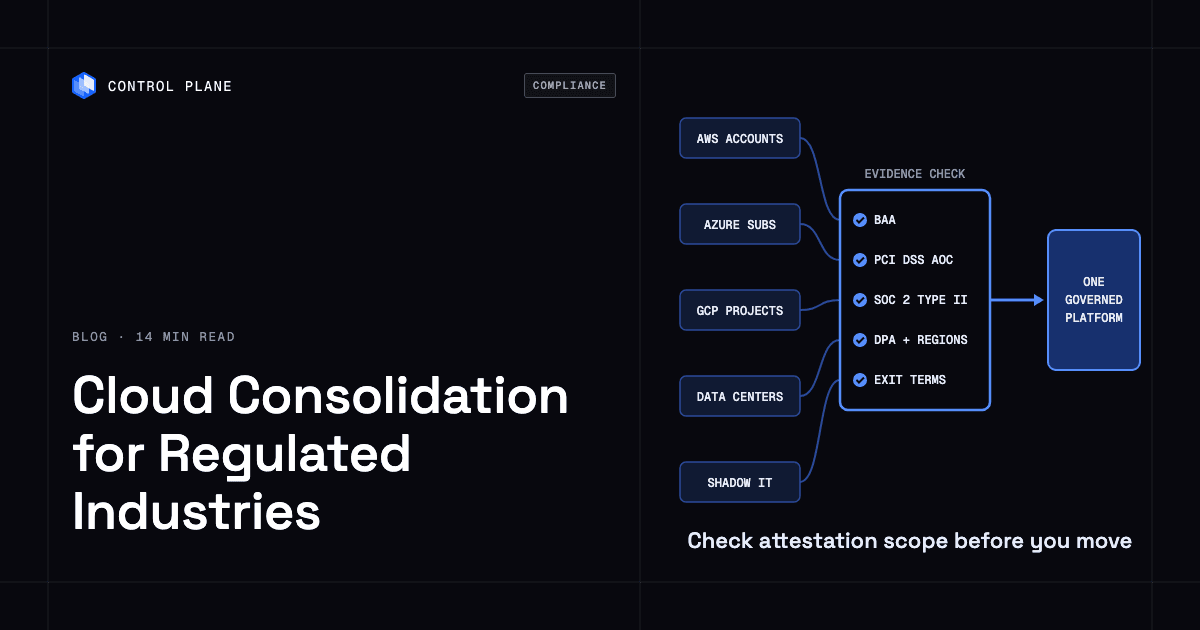
- Check every vendor’s attestation scope by individual service and region, because attestation reports and certifications cover a listed subset of a provider’s services and regions.
- Systems integrators plan and execute migrations. Managed service providers operate workloads after migration.
- Keep audit evidence continuous during migration, because a gap between the old and new environments creates audit risk.
- Plan exit terms early, especially for EU DORA and similar rules that require documented exit strategies for ICT services that support critical or important functions.
- Control Plane is a runtime platform that runs workloads across AWS, GCP, Azure, and Oracle Cloud Infrastructure regions and your own Kubernetes clusters, including on premises, under a single operating model, fitting into the target-platform tier alongside hyperscaler industry clouds and hybrid platforms.
Which vendors specialize in enterprise cloud consolidation for regulated industries like finance and healthcare?
Six vendor types fill those roles: three compete to be the target platform, systems integrators and managed service providers fill one role each, and governance tools support your compliance team.
Hyperscaler industry clouds and compliance programs provide the target infrastructure. Microsoft offers Microsoft for Financial Services and Microsoft for Healthcare, which combine Azure, Dynamics 365, Microsoft 365, and Power Platform capabilities with compliance guidance and industry data models. AWS maintains a broad list of HIPAA-eligible services. Google Cloud provides Assured Workloads, which enforces data residency and personnel controls for regulated environments, along with healthcare interoperability APIs supporting FHIR, HL7v2, and DICOM. IBM Cloud for Financial Services is built on the IBM Cloud Framework for Financial Services, an industry-informed set of security and compliance controls. Oracle Cloud Infrastructure serves financial institutions and healthcare organizations with database-centric workloads and dedicated region deployments.
Hybrid and private cloud platforms serve organizations that must keep certain workloads on premises or in private data centers. Red Hat OpenShift provides a Kubernetes-based application platform that runs consistently across on-premises, edge, and public cloud environments. Nutanix delivers hyperconverged infrastructure that unifies private and public cloud operations under a single management plane.
Multi-cloud runtime platforms address organizations that need to operate across several clouds with one set of controls. Control Plane runs workloads across AWS, GCP, Azure, and Oracle Cloud Infrastructure regions and your own Kubernetes clusters with one identity, policy, and audit model, which is how teams consolidate multiple clouds and accounts into one platform. Control Plane is PCI DSS Level 1, SOC 2 Type II, HIPAA, and GDPR compliant.
Global systems integrators plan and execute the consolidation itself. IBM Consulting focuses on hybrid-cloud modernization, particularly for banks with mainframe estates and healthcare organizations modernizing clinical systems. Kyndryl manages large-scale infrastructure transformations and ongoing operations for regulated clients. Accenture leads multi-cloud and healthcare and life sciences modernization programs. Deloitte emphasizes governance, risk, and compliance operating models that intersect with cloud transformation. Capgemini and DXC Technology provide similar transformation and migration services with regulated-industry practices.
Compliance-focused managed service providers operate cloud environments after migration. Rackspace Technology manages cloud operations across platforms with specific practices for financial regulatory compliance, including support for DORA, FCA, and PRA requirements. Cloudticity specializes in HIPAA-compliant and HITRUST-certified managed cloud operations for healthcare. RapidScale (which absorbed Logicworks) provides managed cloud across AWS, Azure, and Google Cloud with healthcare and financial services practices. FNTS offers managed IT and cloud services for regulated industries including banking and healthcare.
Governance and compliance tools support the compliance team. Microsoft Purview Compliance Manager provides compliance assessments and control mapping across Microsoft 365 and multicloud environments. AWS Config conformance packs deploy and monitor controls against prebuilt templates for frameworks such as PCI DSS and HIPAA. Google Cloud Security Command Center centralizes security and compliance findings across Google Cloud assets. These tools automate evidence gathering for your compliance team.
What does each vendor type do in a regulated consolidation?
Each vendor type does some jobs and leaves others to the rest of the program.
| Vendor type | Examples | What they do in a consolidation | What they do not do | Best when |
|---|---|---|---|---|
| Hyperscaler industry clouds and compliance programs | Microsoft for Financial Services, Microsoft for Healthcare, AWS, Google Cloud with Assured Workloads, IBM Cloud for Financial Services, Oracle Cloud Infrastructure | Provide compute, storage, networking, identity, encryption, and compliance-enabling services as the target environment. Maintain their own SOC 2 and PCI DSS attestations and sign HIPAA BAAs for eligible services. | Do not migrate your workloads, operate your applications, or guarantee your compliance. Their attestations cover their infrastructure and leave your configurations to you. | You are consolidating onto one primary cloud and your workloads fit that provider’s service portfolio and region footprint. |
| Hybrid and private cloud platforms | Red Hat OpenShift, Nutanix | Provide a consistent application or infrastructure platform across on-premises data centers and public clouds. Enable workload portability and unified management. | Do not plan your migration, staff your operations team, or provide compliance attestations for your application layer. | Regulated data must stay on premises or in private data centers, or you need a consistent platform spanning private and public environments. |
| Multi-cloud runtime platforms | Control Plane | Run workloads across multiple cloud providers under a single operating model with unified identity, policy, and audit controls. | Do not perform migration consulting, replace your systems integrator or managed service provider, or handle your application-level compliance work. | You want one operating model for deployment, identity, and audit across regions, clouds, or your own clusters. |
| Global systems integrators | IBM Consulting, Kyndryl, Accenture, Deloitte, Capgemini, DXC Technology | Assess your current estate, design the target architecture, plan migration waves, execute the migration, and stand up governance frameworks. | Do not operate your environment long-term (unless contracted separately), provide the target cloud infrastructure, or own your compliance posture. | You need large-scale planning, legacy modernization, or mainframe integration expertise. |
| Compliance-focused managed service providers | Rackspace Technology, Cloudticity, RapidScale, FNTS | Operate your cloud environment day to day, including monitoring, patching, backup, disaster recovery, and continuous compliance operations. | Do not design your migration strategy, provide the underlying cloud infrastructure, or replace your internal compliance and audit functions. | You lack the internal team to operate regulated cloud environments 24/7 and need a partner with relevant attestations. |
| Governance and compliance tools | Microsoft Purview Compliance Manager, AWS Config conformance packs, Google Cloud Security Command Center | Automate evidence collection, compliance scoring, and security posture monitoring. | Do not make architectural decisions, migrate workloads, or interpret regulations for your specific context. | You need to scale evidence collection and continuous monitoring across a large cloud estate. |
What evidence should regulated buyers demand from cloud vendors?
Before you sign, ask each vendor for documented evidence that matches the regulations covering your data.
| Regulation or standard | Applies to | Evidence to request | Who usually provides it |
|---|---|---|---|
| HIPAA | Organizations handling protected health information (PHI) in the United States | Signed Business Associate Agreement (BAA), list of HIPAA-eligible services, documentation of PHI encryption, logging, retention, and deletion controls | Hyperscaler (BAA and eligible service list), managed service provider (BAA and operational controls), multi-cloud runtime (HIPAA compliance documentation; confirm BAA terms with the vendor), your own team (application-level controls) |
| PCI DSS | Organizations that store, process, or transmit cardholder data | Attestation of Compliance (AOC) for the service provider, responsibility matrix showing which controls the provider owns and which you own | Hyperscaler (AOC and responsibility matrix), managed service provider (AOC), multi-cloud runtime (AOC and responsibility matrix), payment processor |
| SOC 2 Type II | Any organization whose customers require assurance over security, availability, processing integrity, confidentiality, or privacy | Current SOC 2 Type II report provided under NDA, bridge letter covering any gap between the report period end date and today | Every vendor type in your supply chain; request reports from each |
| GLBA and FFIEC guidance | US financial institutions and their service providers | Third-party risk management documentation, information security program documentation, business continuity and disaster recovery plans | Systems integrator (risk assessment), managed service provider (operational documentation), hyperscaler (security program documentation) |
| EU DORA | EU financial entities and their ICT third-party service providers | ICT third-party contract terms meeting DORA Article 30 requirements, documented exit strategy, incident reporting support aligned with DORA timelines | Hyperscaler (contract terms and exit strategy), managed service provider (incident reporting and exit support), multi-cloud runtime (contract terms; confirm Article 30 coverage with the vendor) |
| GDPR and data residency laws | Organizations processing personal data of EU residents, plus similar laws in other jurisdictions | Data processing agreement, list of regions where data is stored and processed, subprocessor list with locations and notification periods for changes | Every vendor type; each must disclose where data goes and who touches it |
| HITRUST | Healthcare organizations and their partners, where the buyer requires HITRUST certification | Current HITRUST certification letter specifying the assessed scope | Managed service provider (if HITRUST-certified for their managed services), hyperscaler (if HITRUST-certified for specific services) |
How do you consolidate regulated workloads without breaking compliance?
A consolidation that disrupts audit evidence or moves data into non-compliant regions can trigger regulatory findings, so the sequence matters.
| Step | What to do | Evidence produced |
|---|---|---|
| 1. Inventory and classify data by regulation | Catalog every application, data store, and data flow. Tag each with the regulations that apply: HIPAA, PCI DSS, GLBA, GDPR, DORA, or others. Identify data owners and processing purposes. | Data inventory register, regulatory classification matrix, data flow diagrams |
| 2. Map each workload to target regions that satisfy residency | For each classified workload, identify which cloud regions satisfy data residency and sovereignty requirements. Account for backups, replicas, disaster recovery sites, and logging destinations. | Region mapping document, residency justification for each workload |
| 3. Pick the target platform and confirm attestation scope | Select the hyperscaler, hybrid platform, or multi-cloud runtime that fits your workload types and region needs. Confirm that the provider’s attestations cover the specific services and regions you will use. | Attestation scope confirmation, vendor due diligence report |
| 4. Build the landing zone with identity, logging, and encryption controls | Stand up the target environment with centralized identity and access management, audit logging, encryption at rest and in transit, network segmentation, and policy enforcement. | Landing zone architecture document, control mapping to regulatory requirements, configuration baselines |
| 5. Migrate in waves, lowest-risk workloads first, with rollback | Move non-critical workloads first to validate the landing zone controls and migration process. Maintain rollback capability for each wave. | Migration runbook, wave completion reports, rollback test results |
| 6. Run parallel evidence collection for auditors | During migration, collect audit evidence from both the old and new environments. Ensure no gap in logging, access reviews, or control monitoring between cutover and decommission. | Audit log exports from both environments, control effectiveness reports, parallel-run attestation |
| 7. Decommission legacy environments and update the register of third parties | After each wave is validated and evidence is continuous, decommission the old environment. Remove access, delete data according to retention policies, and update your register of third-party providers and subprocessors. | Decommission confirmation, data deletion certificates, updated third-party register |
What are the common mistakes in regulated cloud consolidation?
Five mistakes come up repeatedly.
Assuming a provider’s certification covers every service. A hyperscaler may hold SOC 2 Type II and PCI DSS attestations, but those attestations cover a defined list of services and regions. If you deploy a workload on a service outside the attested scope, the provider’s report is not evidence for that workload. Request the scope document and compare it against your architecture.
Moving data before completing residency mapping. Migrating a database to a new region before confirming that the region satisfies GDPR, DORA, or local data residency laws can create a compliance violation. Finish residency mapping before any data moves.
Losing audit trails during cutover. The period between turning off logging in the old environment and turning it on in the new one is an evidence gap. Auditors can ask what happened during that window. Run both environments in parallel and collect evidence from both until the old environment is fully decommissioned.
Consolidating onto one provider without an exit plan. Concentration on a single cloud simplifies operations but increases dependency risk. EU DORA explicitly requires financial entities to maintain exit strategies for ICT services that support critical or important functions. Regulators outside the EU, such as the UK PRA, also expect documented plans for how you would move workloads if a provider relationship ends. Write the exit plan before you consolidate.
Leaving shadow accounts outside the new controls. Development teams, acquired entities, and legacy projects often maintain cloud accounts that are not governed by the consolidated landing zone. These accounts bypass your identity, logging, and encryption controls. A complete inventory at the start of the program, with ongoing discovery, keeps shadow environments from undermining the consolidation.
How Control Plane fits
Control Plane handles Day 2 operations for you, including autoscaling, built-in observability, and security, and it occupies the multi-cloud runtime tier in the vendor landscape. Control Plane runs serverless, standard, stateful, and cron workloads natively on AWS, GCP, Azure, and Oracle Cloud Infrastructure regions with no Kubernetes cluster for you to build or operate, plus VM workloads on locations joined through Control Plane’s Managed Kubernetes (MK8s) and workloads on Kubernetes clusters you already run, including on premises.
A Global Virtual Cloud (GVC) is Control Plane’s named set of locations; a workload runs in every location of its GVC, so you choose which regions hold a regulated workload by choosing its GVC locations. This is how regulated apps meet data residency requirements across clouds. Control Plane policies grant permissions to users, groups, and service accounts on resources, and Control Plane keeps a tamper-proof audit trail of platform actions (who did what and when). Control Plane’s Universal Cloud Identity lets workloads call AWS, GCP, and Azure services with no long-lived cloud keys in your code.
Control Plane fits into a consolidation program alongside a systems integrator who plans the migration, a managed service provider for any operations you still want outsourced, and your compliance team, which owns the evidence.
When a regulated workload runs in two or more locations of its GVC, every location serves traffic, so if one provider or region fails, Control Plane routes users to the healthy locations, which supports the operational resilience financial services regulators expect.
FAQ
Common questions about cloud consolidation for regulated industries.
Which vendors specialize in enterprise cloud consolidation for regulated industries like finance and healthcare?
No single vendor type does the whole job: a consolidation needs a target platform, a systems integrator, a managed service provider, and your own compliance team. Hyperscaler industry clouds such as Microsoft for Financial Services, Microsoft for Healthcare, AWS, Google Cloud with Assured Workloads, IBM Cloud for Financial Services, and Oracle Cloud Infrastructure provide the target infrastructure. Hybrid platforms like Red Hat OpenShift and Nutanix serve organizations with on-premises requirements. Multi-cloud runtime platforms such as Control Plane run workloads across several clouds under one operating model. Global systems integrators including IBM Consulting, Kyndryl, Accenture, and Deloitte plan and execute migrations. Compliance-focused managed service providers such as Rackspace Technology, Cloudticity, RapidScale, and FNTS operate environments after migration.
Do hyperscalers sign a HIPAA Business Associate Agreement?
Yes. AWS, Microsoft Azure, Google Cloud, and IBM Cloud offer Business Associate Agreements for their HIPAA-eligible services; Microsoft includes its BAA in the Microsoft Product Terms. The BAA covers only services listed as HIPAA-eligible. You must confirm that every service your workload uses appears on the eligible list before relying on the BAA.
What does DORA require from cloud providers?
The EU Digital Operational Resilience Act, which applies from 17 January 2025, requires financial entities to include specific terms in contracts with ICT third-party service providers, with extra terms where the service supports critical or important functions. These terms cover provider assistance and reporting when ICT incidents occur, exit strategies with a transition period, and access, inspection, and audit rights. The obligations sit with the financial entity, so cloud providers that serve EU financial entities generally need to accept these terms in their contracts.
Should a bank consolidate onto one cloud or several?
It depends on how the bank weighs simplicity against concentration risk. Consolidating onto one cloud simplifies identity, governance, procurement, and skills development but increases concentration risk. A deliberate two-cloud model can mitigate the impact of a single provider’s service disruption and may satisfy regulatory expectations around operational resilience. The decision depends on the bank’s workload portfolio, data residency requirements, existing technology investments, and regulatory guidance from bodies such as the FFIEC member agencies or the EBA.
What is the role of a systems integrator in cloud consolidation?
A systems integrator assesses your current application and infrastructure estate, designs the target architecture, plans migration waves, executes the migration, and helps stand up governance frameworks. In regulated industries, the integrator also maps controls from your current environment to the target environment and integrates or modernizes legacy systems such as mainframes. The integrator typically does not operate the environment long-term or own your compliance posture.
How do I keep audit evidence during a migration?
Run the old and new environments in parallel during each migration wave. Collect audit logs, access reviews, and control effectiveness evidence from both environments simultaneously. Do not decommission the old environment until the new environment’s evidence collection is validated and continuous. Document the parallel-run period explicitly for auditors so they can see unbroken evidence coverage across the transition.
What is attestation scope?
Attestation scope defines exactly which services, regions, and controls are covered by a vendor’s compliance certification or audit report. A provider’s SOC 2 Type II report applies only to the services and regions listed in it. If you deploy a workload on a service or in a region outside the attested scope, the provider’s report does not cover your workload. Request the scope document and compare it to your planned architecture before you deploy.
What compliance certifications does Control Plane hold?
Control Plane is PCI DSS Level 1, SOC 2 Type II, HIPAA, and GDPR compliant. Control Plane-managed compute runs in AWS, GCP, Azure, and Oracle Cloud Infrastructure regions. As with any provider, your own applications running on Control Plane still need their own compliance work, and you should confirm that the specific regions and services you use fall within the attested scope.
Can a compliant cloud make my organization compliant?
No. Compliance is a shared responsibility. The cloud provider secures the infrastructure and platform services within its attested scope. Your organization is responsible for application configurations, access controls, data handling, encryption key management, and the evidence that demonstrates your controls are effective.
How long does a regulated cloud consolidation take?
It depends on the number of applications, the complexity of legacy integrations, the number of regulations involved, and organizational readiness. Large programs with hundreds of applications usually run in waves over multiple years. Rushing the process increases the risk of evidence gaps and compliance findings.
Talk to the Control Plane team about running regulated workloads across clouds under one identity, policy, and audit model, or sign up free to start.