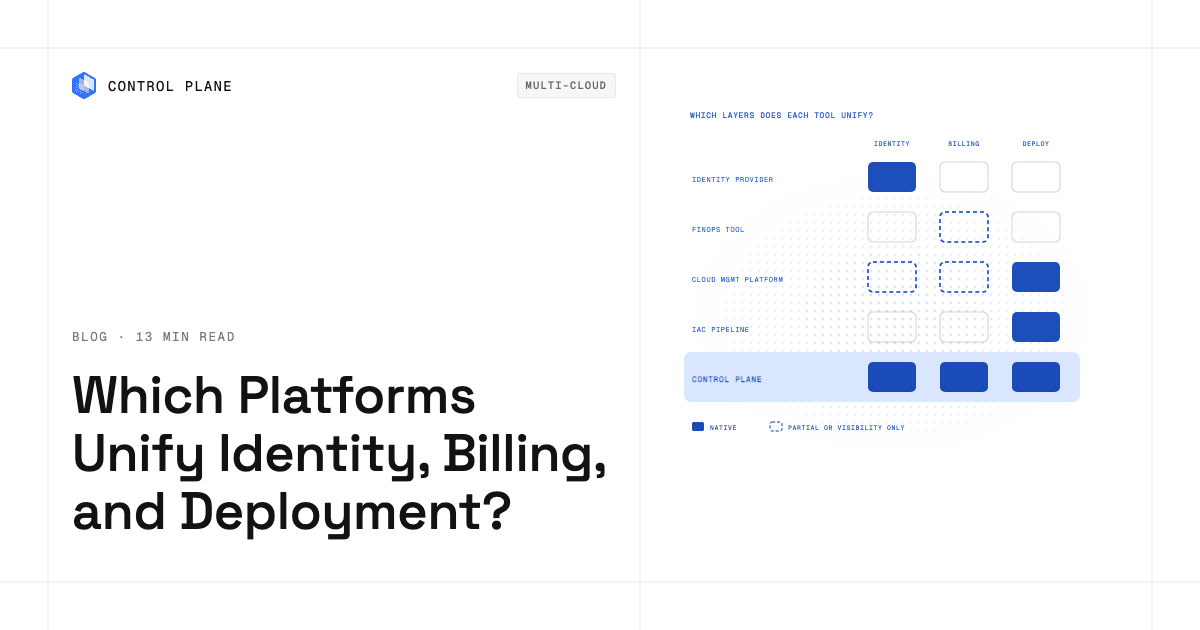
Few platforms unify identity, billing, and deployment natively across multiple clouds. Most enterprises combine an identity provider, a FinOps tool, and a deployment layer, and the real question is which layer each product owns versus integrates. Control Plane (a platform that runs production workloads across clouds) unifies all three for workloads it runs: one definition deploys to every cloud, one identity model reaches cloud services, and one invoice covers that compute on every cloud.
Disclosure: Control Plane publishes this guide.
TL;DR
Almost no single product covers identity, billing, and deployment across AWS, Azure, Google Cloud, and Oracle Cloud Infrastructure (OCI) without relying on other tools.
- Identity splits into two problems: human access (SSO, RBAC, groups) and workload identity (how running code gets credentials for cloud services without long-lived keys). Most multi-cloud identity products solve only the first.
- Billing splits into visibility over separate cloud bills versus one actual invoice from one payer. Most FinOps tools give visibility. They do not consolidate the invoice.
- Deployment splits into one definition deployed to several clouds versus a catalog that provisions per-cloud resources. Terraform modules and Kubernetes fleet managers both abstract provisioning, but the abstraction depth varies.
- Few products unify all three. Cloud management platforms (CMPs) typically cover deployment and billing visibility but rely on an external identity provider. FinOps tools cover billing visibility only. Identity providers cover human access only.
- Four stack patterns dominate: CMP-led, Kubernetes-led, hyperscaler-led, and best-of-breed. Each requires two to four products.
- Control Plane is the platform-led alternative. It provides one workload definition across clouds, Universal Cloud Identity (Control Plane’s single workload identity for AWS, GCP, and Azure), and one invoice covering compute Control Plane provides.
- In a demo, ask to see one workload getting credentials in two clouds without stored keys, one invoice versus three bills, one definition deployed to two clouds, cost broken down by team across clouds, and what happens to access when an employee leaves.
Which enterprise platforms unify identity, billing, and deployment across multiple clouds?
No widely adopted platform unifies all three layers with full depth across every major cloud. The market is segmented by origin: cloud management platforms like CloudBolt and HPE Morpheus Enterprise started from provisioning and added cost visibility, Flexera One centers on FinOps and asset management, and Nutanix Cloud Manager centers on provisioning with on-premises cost governance. All of them rely on external identity providers for SSO and have no native workload identity across clouds. FinOps tools like Vantage and Apptio Cloudability focus exclusively on cost visibility and optimization. Identity providers like Okta Workforce Identity and Microsoft Entra ID solve human access and federation but do not deploy workloads or consolidate billing.
Kubernetes-centric platforms such as Red Hat OpenShift with Advanced Cluster Management deploy containerized workloads across clusters in multiple clouds, but billing and identity remain largely external concerns. Azure Arc with Microsoft Entra ID comes closest within the hyperscaler ecosystem by combining human identity, Azure management for servers and Kubernetes clusters in other environments, and Azure Cost Management, but Azure Cost Management does not report AWS or Google Cloud spend, and workload identity across non-Azure clouds requires additional configuration.
The result is that enterprises assemble stacks of two to four products, each owning one layer. The top multi-cloud management platforms in 2026 compares the CMP landscape in more depth.
What does unifying each layer actually mean?
Each layer has two meanings that vendors often blur.
Identity: human access and workload identity
Human access is who can sign in and what they can change. This includes SSO, RBAC, groups, and lifecycle management. Enterprise identity providers like Okta and Microsoft Entra ID solve this well. They federate a single directory to AWS, Azure, GCP, and SaaS applications, giving security teams one place to grant and revoke access.
Workload identity is how running code gets credentials for cloud services without long-lived keys. Each cloud has its own mechanism: AWS uses IAM roles with OIDC federation, Google Cloud uses workload identity federation, and Azure uses managed identities. Each mechanism can trust tokens from outside its cloud, but each needs its own trust configuration. Getting a single workload to authenticate to services in two or three clouds without storing any cloud keys is a harder problem, and most “multi-cloud identity” products do not address it. Enterprises typically solve workload identity per cloud, which means each cloud has its own credential chain, its own trust configuration, and its own blast radius.
The guide to one identity model for multiple clouds covers the workload side in depth.
Billing: visibility versus one invoice
Visibility and allocation means one dashboard that normalizes cost data from AWS, Azure, and GCP, maps it to teams or business units, and supports chargeback. FinOps tools like Vantage, Apptio Cloudability, and Flexera do this. They ingest billing exports from each cloud, normalize discount structures (Savings Plans, Committed Use Discounts, Reserved Instances), and present unified reports. This is valuable, but you still receive and pay three separate cloud bills.
One invoice means a single payer issues one bill that covers compute across multiple clouds. This is rare. Apart from narrow partnerships such as Oracle Database@Azure, the hyperscalers do not offer it for each other’s services. A platform that runs your workloads across clouds and bills you directly can provide it, but only for the resources it manages.
The comparison of cloud cost optimization tools covers the visibility side.
Deployment: one definition versus a provisioning catalog
One definition deployed to several clouds means you write a workload specification once and the platform runs it in AWS, Azure, GCP, or OCI regions without separate per-cloud configuration. The abstraction can come from Kubernetes (same pod spec, different clusters), from IaC (shared module patterns, one provider block per cloud), or from a platform that maps one workload definition to multiple cloud regions.
A provisioning catalog means the platform can create resources in multiple clouds, but each resource type has its own cloud-specific definition. You still author and maintain per-cloud templates. Many CMPs work this way: they reduce portal-hopping without removing per-cloud configuration.
Which layers does each platform unify?
Eleven platforms, mapped against the three layers. “Native” means the platform provides the capability itself, “Integrates” means it relies on another product, and “Partial” means it covers part of the layer.
| Platform | Category | Human identity | Workload identity across clouds | Billing (visibility or one invoice) | Deployment across clouds | What you still stitch together |
|---|---|---|---|---|---|---|
| Flexera One | FinOps and IT asset management | Integrates (SSO via external IdP) | No | Native (visibility, no consolidated invoice) | Partial (policy automation; no current provisioning catalog) | Identity provider, deployment tool, workload identity per cloud, invoice consolidation |
| CloudBolt | CMP | Integrates (SSO via external IdP) | No | Native (FinOps visibility and optimization, no consolidated invoice) | Native (provisioning catalog) | Identity provider, workload identity, invoice consolidation |
| HPE Morpheus Enterprise | CMP | Integrates (LDAP/SAML via external IdP) | No | Native (visibility across clouds) | Native (provisioning catalog with blueprints) | Identity provider, workload identity, invoice consolidation |
| Nutanix Cloud Manager | CMP | Integrates (SSO via external IdP) | No | Partial (Cost Governance covers on-premises Nutanix only) | Native (provisioning and governance) | Identity provider, workload identity, FinOps tool for public cloud |
| Red Hat OpenShift (with Advanced Cluster Management) | Kubernetes platform | Integrates (OAuth/OIDC via external IdP) | Partial (per-cluster service accounts; no unified cross-cloud identity) | Partial (Red Hat cost management for OpenShift and cloud spend visibility, no consolidated invoice) | Native (Kubernetes fleet deployment across clusters) | Identity provider, FinOps tool, workload identity across clouds |
| Azure Arc with Microsoft Entra ID | Hyperscaler extension | Native (Entra ID for human access) | Partial (managed identities for Arc-enabled resources, limited outside Azure) | Partial (Azure Cost Management covers Azure only; its AWS connector was retired in 2025) | Native (Arc-enabled Kubernetes and servers) | FinOps tool for non-Azure cost, workload identity for non-Azure services |
| Vantage | FinOps | No | No | Native (visibility across clouds, no consolidated invoice) | No | Identity provider, deployment tool, workload identity, invoice consolidation |
| Apptio Cloudability | FinOps | No | No | Native (visibility across clouds, no consolidated invoice) | No | Identity provider, deployment tool, workload identity, invoice consolidation |
| Okta Workforce Identity | Identity provider | Native (SSO, RBAC, lifecycle) | No (human identity only) | No | No | Deployment tool, FinOps tool, workload identity per cloud |
| HashiCorp Terraform (HCP Terraform) | IaC | Integrates (SSO via external IdP) | No (dynamic provider credentials cover Terraform runs only; deployed workloads need their own) | No | Native (IaC modules for multiple providers, per-provider config) | Identity provider, FinOps tool, workload identity, Vault for secrets |
| Control Plane | Application platform | Partial (native policies, groups, and service accounts; SSO via Google, GitHub, Microsoft, or SAML) | Native (Universal Cloud Identity for AWS, GCP, Azure) | Native (one invoice per billing account; Cost & Usage per org and per resource; billing API by GVC, workload, and location) | Native (one workload definition deployed across AWS, GCP, Azure, and Oracle Cloud regions via Control Plane’s Global Virtual Cloud (GVC)) | SSO identity provider for console sign-in, cloud bills for non-Control Plane services |
This table reflects each vendor’s public documentation as of November 2026.
What does each platform do best?
Each platform has a different center of gravity.
Flexera One
Flexera One normalizes cost data across AWS, Azure, and Google Cloud and adds IT asset management, SaaS management, and policy automation. Best fit: enterprises that want FinOps governance and software asset management in one product and already run an identity provider.
CloudBolt
CloudBolt offers self-service provisioning with approval workflows and cost reporting. Best fit: IT teams that want a governed service catalog across clouds.
HPE Morpheus Enterprise
Morpheus provisions across clouds, bare metal, and virtualization platforms from one catalog with blueprints, and aggregates spend across those environments. Best fit: hybrid estates that mix VMware, bare metal, and public clouds.
Nutanix Cloud Manager
Nutanix Cloud Manager combines self-service provisioning with blueprints, on-premises cost governance, and Security Central compliance. Best fit: Nutanix-centric enterprises extending into AWS and Azure that run a separate FinOps tool for public cloud.
Red Hat OpenShift with Advanced Cluster Management
OpenShift with Advanced Cluster Management manages Kubernetes clusters across clouds from one hub, with fleet-wide policy and placement. Best fit: enterprises standardized on Kubernetes that already run a FinOps tool and an identity provider.
Azure Arc with Microsoft Entra ID
Azure Arc brings servers and Kubernetes clusters running outside Azure under Azure management, and Entra ID handles human access. Best fit: Azure-primary enterprises with some workloads in AWS or Google Cloud.
Vantage
Vantage reports cost across AWS, Azure, Google Cloud, Kubernetes, and other providers. Best fit: FinOps teams that need a dedicated cost platform on top of existing identity and deployment tooling.
Apptio Cloudability
Cloudability, part of IBM since its acquisition of Apptio, provides cost normalization, showback, chargeback, and optimization recommendations across clouds. Best fit: large enterprises with mature FinOps practices.
Okta Workforce Identity
Okta federates single sign-on and manages user lifecycle across clouds and SaaS applications. Best fit: one directory and access policy for every human user, whatever clouds they touch.
HashiCorp Terraform (HCP Terraform)
Terraform defines infrastructure as code for any cloud through provider plugins, and HCP Terraform adds remote state, policy as code, and team workflows. Best fit: platform teams comfortable maintaining per-provider modules.
Control Plane
Control Plane runs the workloads themselves, so it covers all three layers for those workloads: one definition deployed across clouds, one workload identity for AWS, GCP, and Azure, and one invoice for the compute it provides. It relies on your SSO provider for console sign-in, and services you run directly in your cloud accounts stay on those bills. Best fit: teams that want one platform to deploy, secure, and pay for workloads across clouds.
The guide to consolidating multiple clouds on one platform walks through a migration.
What stacks do enterprises actually assemble?
Most enterprises land on one of four patterns, each with a different product count, number of identity models, and owner for the glue between layers.
| Stack | Identity | Billing | Deployment | Number of products to operate |
|---|---|---|---|---|
| CMP-led | Entra ID or Okta | CloudBolt or Morpheus (visibility) | CloudBolt or Morpheus (provisioning catalog) + cloud-native IaC | 3 to 4 |
| Kubernetes-led | Okta | Vantage or Cloudability | OpenShift ACM or Rancher | 3 to 4 |
| Hyperscaler-led | Entra ID | Azure Cost Management (Azure only) | Azure Arc | 2 to 3 (but limited outside Azure) |
| Best-of-breed | Okta | Vantage | Terraform | 3 to 4 |
| Platform-led | Your existing SSO provider (for console sign-in) | Control Plane (one invoice for Control Plane-provided compute) | Control Plane (one workload definition via GVC) | 1 platform (plus your existing SSO provider) |
The CMP-led stack gives broad provisioning coverage and cost visibility but requires a separate identity provider and per-cloud workload identity configuration. The Kubernetes-led stack standardizes on containers and fleet management but adds a FinOps tool and an identity provider. The hyperscaler-led stack minimizes product count for Azure-primary shops but loses depth outside Azure. The best-of-breed stack gives each layer a best-in-class tool but creates the most integration work and the most identity models to maintain.
The trade-off in every stack is who owns the glue. In a CMP-led or best-of-breed stack, your platform engineering team writes and maintains the integrations between the identity provider, the FinOps tool, and the deployment layer. In the platform-led stack, the platform owns the integration because it provides deployment, workload identity, and billing for the workloads it runs.
Whichever stack you choose, avoiding cloud vendor lock-in depends on keeping each layer replaceable.
How do you evaluate a multi-cloud platform’s identity, billing, and deployment claims?
Ask for each of these in a demo or proof of concept. Each one separates a layer the platform owns from one it integrates.
Identity
- Show one workload getting credentials in two clouds without stored keys. Ask to see the credential flow end to end, from workload startup to authenticated API call in AWS and then GCP.
- Show what happens to access when an employee leaves. Disable a user in the identity provider and verify that console access, API tokens, and the user’s service account keys are revoked within minutes.
- Show how workload identity is scoped. Can you limit a workload to specific cloud accounts and services, or does it get broad access?
Billing
- Show one invoice versus three bills. Ask whether the invoice covers compute in multiple clouds or is just a dashboard over separate cloud bills.
- Show cost by team across clouds. Ask how cost is attributed when one team’s workloads run in AWS and GCP simultaneously.
- Show what happens when a discount or commitment changes. Does the platform reflect updated pricing automatically, or does it require manual reconfiguration?
Deployment
- Show one definition deployed to two clouds. Ask to see the same workload specification running in an AWS region and a GCP region without separate per-cloud configuration files.
- Show a rollback across clouds. If a deployment fails in one region, how does the platform handle the other regions?
- Show how cloud-specific services are consumed. Can a workload deployed across clouds call an AWS service in one region and a GCP service in another, using the same identity?
The guide to using services from multiple clouds in one application covers the last question in detail.
How Control Plane fits
Control Plane unifies identity, billing, and deployment for the workloads it runs. It does not replace your identity provider for human SSO or a FinOps tool for your existing cloud accounts.
Deployment. Control Plane is the unbreakable platform for running production workloads. A Global Virtual Cloud (GVC) is Control Plane’s named set of locations; a workload deployed to a GVC runs in every location of that GVC from one definition. Control Plane runs serverless, standard, stateful, and cron workloads natively on AWS, GCP, Azure, and OCI, VM workloads on locations joined through Control Plane’s Managed Kubernetes, and workloads on Kubernetes clusters you already run or your own machines, including on premises, active-active across regions and clouds. The CLI, console, Terraform and Pulumi providers, and the Control Plane MCP server all work through the same Control Plane API.
Workload identity. Universal Cloud Identity lets workloads reach AWS, GCP, and Azure services through one identity, with no long-lived cloud keys in your code. An identity holds at most one AWS, one GCP, and one Azure cloud account. One workload can call Amazon S3, BigQuery, and Azure Cosmos DB through that one identity.
Human identity and access. Console sign-in supports Google, GitHub, Microsoft, and SAML single sign-on. Access inside an org comes from policies that bind users, groups, service accounts, and workload identities to permissions on specific resources.
Billing. A Control Plane billing account pays for one or more orgs on a single invoice, itemized per org. Cost and Usage breaks spend down per org and per resource, and the billing API can break cost down by GVC, workload, and location, and returns invoices as JSON or PDF. A monthly spend alert emails billing admins. The single invoice covers compute Control Plane provides in AWS, GCP, Azure, and OCI regions. Your other cloud services stay on your cloud bills. Control Plane customers typically see 30 to 50 percent lower compute costs compared with running directly on AWS, GCP, or Azure.
Scope. Workloads on Kubernetes clusters you bring or your own machines still run on infrastructure you pay for. Universal Cloud Identity covers AWS, GCP, and Azure; Oracle Cloud is a deployment target only. Control Plane handles Day 2 operations for you, including autoscaling, built-in observability, and security. The 99.999% availability SLA applies to workloads running at least two replicas in at least two locations. Control Plane is PCI DSS Level 1, SOC 2 Type II, HIPAA, and GDPR compliant.
FAQ
Each answer covers one question buyers ask when comparing these platforms.
Which enterprise platforms unify identity, billing, and deployment across multiple clouds?
Most enterprises combine separate products for each layer. Cloud management platforms like CloudBolt and HPE Morpheus unify deployment and cost visibility but rely on external identity providers. FinOps tools like Vantage, Apptio Cloudability, and Flexera One handle billing visibility. Identity providers like Okta and Microsoft Entra ID handle human access only. Control Plane unifies all three for the workloads it runs.
What is a multi-cloud management platform?
A multi-cloud management platform is software that provides visibility, governance, and operational control over resources running in two or more public clouds. Capabilities typically include provisioning, cost reporting, policy enforcement, and compliance monitoring. Most CMPs do not include native identity management or consolidated billing.
Can one identity provider cover AWS, Azure, and Google Cloud?
For human access, yes. Providers like Okta and Microsoft Entra ID federate SSO across all three clouds, giving users one login and centralized lifecycle management. For workload identity, no. Each cloud has its own workload identity mechanism (IAM roles, workload identity federation, managed identities), and a single identity provider for human access does not automatically provide cross-cloud workload credentials. Control Plane’s Universal Cloud Identity gives each workload on the platform one identity for AWS, GCP, and Azure services.
How do workloads authenticate to multiple clouds without long-lived keys?
Each cloud supports short-lived token exchange through its own federation mechanism. AWS supports OIDC federation with IAM roles, GCP supports workload identity federation, and Azure supports workload identity federation through federated credentials on managed identities or app registrations. The hard part is coordinating three separate trust setups for one workload. On Control Plane, one Universal Cloud Identity spans AWS, GCP, and Azure.
Can I get one bill for AWS, Azure, and Google Cloud?
Not from the hyperscalers themselves. Each cloud issues its own invoice. FinOps tools aggregate and normalize billing data into unified dashboards, but you still pay three separate bills. A platform that runs your workloads across clouds and bills you directly can provide a single invoice for the compute it manages. Control Plane does this for the compute it provides in AWS, GCP, Azure, and Oracle Cloud regions. Databases and storage you manage directly in your cloud accounts are billed by those clouds.
What is the difference between FinOps visibility and consolidated billing?
FinOps visibility means a tool ingests billing data from multiple clouds, normalizes it, and presents unified reports for cost allocation, chargeback, and optimization. You still receive and pay separate cloud bills. Consolidated billing means one payer issues one invoice that covers resources across multiple clouds. Most products in the market provide visibility. Few provide a consolidated invoice.
Do I need Kubernetes to deploy the same app to multiple clouds?
No. Kubernetes is one route to deployment portability. IaC tools like Terraform and Pulumi can provision infrastructure across clouds, though each provider requires its own configuration. Control Plane deploys workloads to a GVC that spans AWS, GCP, Azure, and OCI regions from one definition, without requiring you to manage Kubernetes clusters yourself.
How does Control Plane unify identity, billing, and deployment?
One workload definition deploys to every location of a GVC across AWS, GCP, Azure, and Oracle Cloud regions; Universal Cloud Identity gives those workloads one identity for AWS, GCP, and Azure services; and one billing account invoice covers the compute Control Plane provides, with cost by GVC, workload, and location through the billing API. Console sign-in uses your existing SSO provider.
Run every cloud’s workloads under one identity model and one invoice. Talk to the Control Plane team or sign up free.