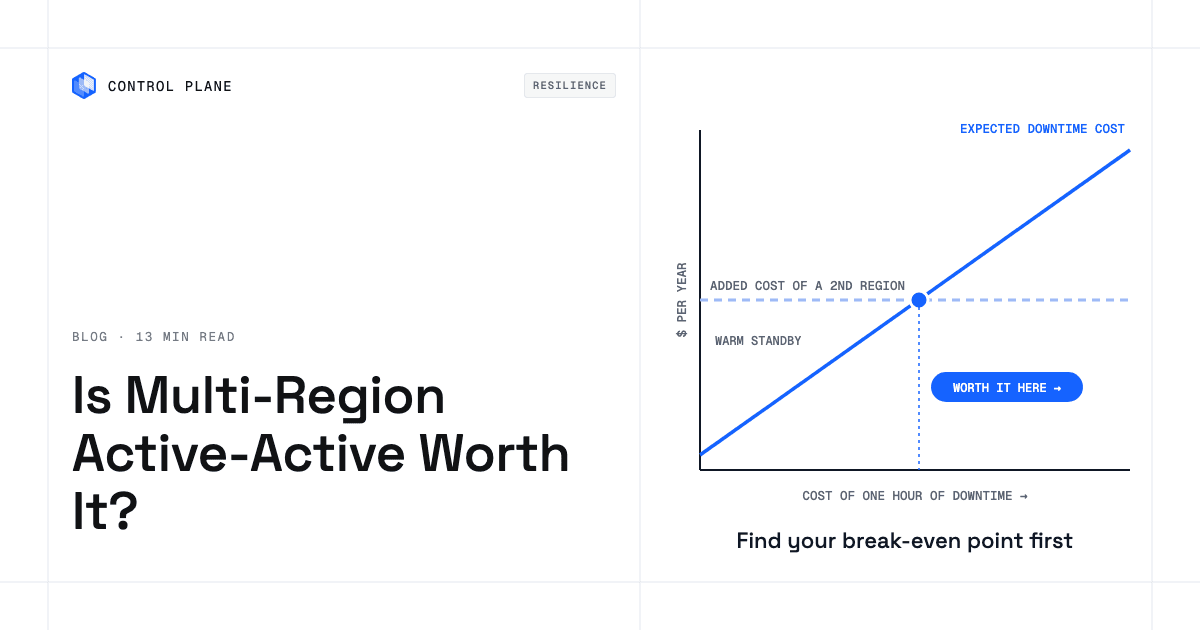
Multi-region active-active is worth it for a growing SaaS company when the expected yearly cost of regional downtime (outage hours per year multiplied by cost per hour, plus churn) exceeds the yearly added cost of the second region and the engineering time to run it, or when contracts, latency requirements, or data residency laws require it. Most teams should climb a staged path: multi-AZ first, then backups in a second region, then warm standby, then active-active for stateless tiers before tackling the data layer. Platforms that run a workload in several regions from one configuration lower the added-cost side of the equation, which moves the break-even point earlier.
Disclosure: Control Plane publishes this guide.
TL;DR
Multi-region active-active is worth the cost when the money you lose from regional downtime exceeds the money you spend to prevent it, or when a contract, latency target, or residency law leaves you no choice.
- Compare your expected annual downtime cost (outage hours times cost per hour, plus churn) against the added cost of a second region, the engineering time, and the tooling.
- Enterprise contracts with multi-region uptime commitments, customers on two continents with latency-sensitive traffic, or data residency in two jurisdictions can force the answer to yes regardless of the formula.
- Zonal failures happen more often than full regional outages, and deploying across multiple Availability Zones in one region covers them at low cost.
- Go active-active for stateless services first while keeping the database active-passive. This removes application-tier failover without distributed writes.
- Data consistency is the hard part. Write conflicts, replication lag, and conflict resolution logic are where the real engineering cost lives.
- On Control Plane, a workload runs in every location of its Global Virtual Cloud (GVC), so adding a region is a configuration change, and each workload’s canonical endpoint routes clients to the nearest healthy location, reducing the infrastructure and engineering overhead of multi-region.
Is multi-region active-active worth the cost for a growing SaaS company?
For most growing SaaS companies, the answer today is not yet, but the answer changes as specific triggers appear.
Active-active deployments run production workloads concurrently in two or more cloud regions. Every region serves live traffic. If one region fails, the others absorb the load with little failover delay, provided each region has spare capacity. Infrastructure spend can roughly double compared to a single-region baseline, since each region needs enough capacity to absorb the other’s traffic, and engineering overhead rises because you must handle distributed data consistency, capacity headroom in every region, cross-region networking, duplicated observability, and coordinated deployments.
The useful question is whether the cost of not having it exceeds the cost of running it, and that has a quantifiable answer.
A growing SaaS company with customers on one continent, moderate downtime tolerance, and a small platform team will usually get more resilience per dollar from multi-AZ deployments and a warm standby region than from jumping straight to active-active. A staged path lets you build toward active-active incrementally, adding cost and complexity only when the business justifies it.
The answer flips to yes early for companies selling to enterprises with contractual multi-region uptime commitments, companies with latency-sensitive users on two continents, and companies subject to data residency rules in multiple jurisdictions.
How do you calculate the break-even point?
The break-even point is the moment when the cost of regional downtime you expect to experience exceeds the cost of preventing it with a second active region.
| Input | What it means | How to measure it | Formula role |
|---|---|---|---|
| Expected regional outage hours per year | How many hours per year you expect your primary region to be unavailable | Review your cloud provider’s public incident history for the past three years, or choose a planning assumption you can defend | Multiplied by cost per hour |
| Cost per hour of downtime | The revenue, refunds, and labor you lose for every hour your product is down | Sum revenue you cannot bill or must refund for the hour (usage, transactions, SLA credits) plus incident response labor. Do not count both prorated ARR and the SLA credits that refund it, since that counts the same dollars twice | Multiplied by outage hours |
| Churn from a major outage | The contract value of customers who leave or fail to renew after a significant outage | Estimate from past incidents and renewal conversations; express as a single annual dollar figure | Added to the downtime cost side |
| Added infrastructure cost for a second region | Compute headroom, data replication, cross-region data transfer, and storage duplication | Price a mirror of your production footprint in a second region, including reserved capacity for failover absorption and egress fees | Added to the cost side |
| Added engineering time | Hours your team spends building, testing, and operating the second region | Estimate the share of fully loaded engineer time per year for deployment pipelines, runbooks, failure rehearsals, and on-call coverage | Added to the cost side |
| Added tooling cost | Global load balancing, enhanced observability, conflict resolution infrastructure, and any platform fees | Sum annual fees for global traffic management, distributed tracing, and any platform that simplifies multi-region operation | Added to the cost side |
The formula in prose: multi-region active-active is worth it when (expected regional outage hours per year multiplied by cost per hour of downtime) plus churn cost from a major outage is greater than added infrastructure cost plus added engineering time plus added tooling cost.
Worked example with labeled hypothetical inputs. Suppose a SaaS company estimates 4 hours of regional outage per year based on provider history. Its cost per hour of downtime is $50,000, combining $25,000 in lost usage and transaction revenue, $20,000 in SLA credits, and $5,000 in incident response labor. It estimates $40,000 in annual churn risk from a major outage. The downtime cost side totals (4 × $50,000) + $40,000 = $240,000 per year.
On the cost side, a second region adds $120,000 per year in infrastructure, $80,000 in engineering time (about 40 percent of one fully loaded engineer), and $15,000 in tooling. The added cost side totals $215,000 per year.
Because $240,000 exceeds $215,000, a second active region pays for itself against a single-region baseline for this hypothetical company. The model assumes active-active removes all regional outage hours. Run the same formula for warm standby, keeping its failover minutes in the outage hours, and choose the option with the larger net saving. The $25,000 margin is thin, so a small change in outage hours or engineering cost flips the result. The cost comparison is broken down in active-active vs. active-passive cost analysis.
When does active-active become worth it?
Certain triggers change the answer from “not yet” to “now,” independent of or in addition to the break-even formula.
| Trigger | Why it changes the answer | How to check |
|---|---|---|
| Enterprise contract requires a multi-region uptime commitment | A contractual uptime commitment with financial penalties can be hard to meet with a single region and a failover delay. The contract makes the cost of not having active-active concrete. | Review your largest contracts and prospect RFPs for uptime language, penalty clauses, and architecture questionnaires, and compare them with what enterprise SaaS uptime SLAs require. |
| Customers on two continents with latency-sensitive traffic | Cross-continent round trips add latency that interactive applications feel. Serving reads from a local region removes this penalty for reads. Writes need a home-region or multi-writer database design. | Measure P95 latency from your largest customer cohorts to your current region. If it exceeds your product’s latency budget, local serving is the fix for reads. |
| Data residency requirements in two jurisdictions | GDPR transfer rules, sector regulations, or national localization laws may require certain data to stay in one jurisdiction. That forces at least two regions, often as separate per-jurisdiction deployments. | Map your customer base by jurisdiction and review applicable data protection laws. If two jurisdictions require local storage, you need two regions. |
| Downtime cost per hour exceeds your threshold | When your cost-per-hour figure makes even a short outage painful, the break-even formula favors active-active. | Multiply expected outage hours by cost per hour, add churn, and compare the total with your annual active-active premium. |
| A single-region outage already cost a deal or a renewal | A real incident that caused measurable business loss is the strongest signal. Past losses are no longer hypothetical. | Review post-incident reports and sales pipeline notes for deals lost or renewals at risk due to downtime. |
| The stateless tier can run active-active while the database stays active-passive | The application tier stops depending on failover, and distributed writes, the most expensive part of active-active, can wait. | Identify which services are stateless (API gateways, web servers, compute workers) and confirm they can run independently in two regions with a shared or replicated data source. |
What is the staged path from one region to active-active?
A staged approach lets you buy resilience incrementally, matching cost and complexity to your actual risk profile at each phase.
| Stage | What it survives | What it does not survive | Relative cost vs. single region | Main engineering work |
|---|---|---|---|---|
| Single region, multi-AZ | Single AZ failure, individual host failure, most hardware faults | Full regional outage, region-wide networking failure | Low | Deploy across AZs, use managed multi-AZ databases, set up health checks and autoscaling |
| Backups and IaC in a second region | Data loss from a regional disaster (recovery possible, not instant) | A regional outage without extended downtime; recovery means rebuilding the environment (hours to days) | Low | Automate backups to a second region, maintain infrastructure as code that can stand up a full environment |
| Pilot light | Regional outage with moderate recovery time (tens of minutes to hours) | A regional outage without hours of downtime; core services must start and scale first | Low to medium | Keep minimal infrastructure running in the second region (DNS, networking, small database replica), automate scale-up |
| Warm standby | Regional outage with short recovery time (minutes) | A regional outage without a failover gap; expect minutes while DNS shifts and capacity scales | Medium | Run reduced-capacity copies of stateless services, maintain a read replica, automate DNS failover |
| Active-active for stateless services, active-passive database | Regional outage with near-instant recovery for the application tier; database failover may add minutes | A regional outage without a database failover gap; write availability depends on how fast a replica is promoted | Medium to high | Deploy stateless services in both regions, route traffic by geography, replicate the database asynchronously, automate promotion |
| Full active-active including data | Regional outage with near-instant recovery for all tiers, including writes | Correlated multi-region failure, split-brain without proper conflict resolution, global routing failure | High | Implement a distributed or multi-writer database, build conflict resolution logic, run regular failure rehearsals, maintain capacity headroom in every region |
Each stage builds on the one before it. You can stop at any stage where the resilience matches your business requirements. Multi-AZ plus warm standby covers most growing SaaS companies until a trigger appears. The jump to active-active for stateless services is the highest-value next step, because it removes failover delay for reads and stateless requests without requiring distributed writes. Earlier-stage companies can start from cost-effective high availability for startups.
Why is the database the hard part?
Stateless services are straightforward to run in multiple regions because each instance is interchangeable and holds no local state, so the database is where active-active gets difficult.
The core challenge is that data written in one region must be visible in every other region, and two users in different regions might try to write to the same record at the same time. Asynchronous replication introduces lag, often under a second across continents and longer under heavy write load. During that window, each region has a slightly different view of the data. If both regions accept conflicting writes, you need a conflict resolution strategy: last-writer-wins, application-level merge logic, or conflict-free replicated data types (CRDTs).
The simplest pattern that works for most SaaS applications is a single-writer architecture with regional read replicas. All writes go to one primary region. Read replicas in other regions serve read traffic locally with low latency. If the primary fails, a replica is promoted. This is active-passive for writes and active-active for reads. It avoids write conflicts, though writes not yet replicated when the primary fails can be lost.
When true multi-region writes are required, several database options exist. Google Cloud Spanner provides strongly consistent distributed SQL across regions at a price premium. CockroachDB offers a similar distributed SQL model that you can self-host or use as a managed service, under the CockroachDB Software License. Amazon Aurora Global Database replicates across regions with typical lag under one second, using a single writer; AWS says a secondary region can be promoted in under a minute, though its documentation describes recovery time in minutes. DynamoDB global tables allow multi-region writes, using last-writer-wins conflict resolution by default, with an optional multi-Region strong consistency mode that requires exactly three Regions. Each option makes a different trade-off between consistency, latency, cost, and operational complexity.
A practical middle ground is to route writes to a “home region” for each customer or tenant. If a customer’s data lives in eu-west-1, all their writes go there regardless of which region serves their read traffic. The routing logic lives in the application tier and adds modest complexity.
No matter which pattern you choose, the data layer requires its own replication and failover plan.
How does Control Plane change the cost of active-active?
Control Plane reduces the added-cost side of the break-even equation by removing much of the infrastructure and engineering work required to run an application in multiple regions.
Control Plane handles Day 2 operations for you, including autoscaling, built-in observability, and security. A Global Virtual Cloud (GVC) is Control Plane’s named set of locations; a workload runs in every location of its GVC, so adding a region is a configuration change. You never have to build or operate a Kubernetes cluster. Control Plane runs serverless, standard, stateful, and cron workloads natively on AWS, GCP, Azure, and Oracle Cloud Infrastructure regions, VM workloads on locations joined through Control Plane’s Managed Kubernetes (MK8s), and workloads on Kubernetes clusters you already run or your own machines, including on premises.
Each workload’s canonical endpoint routes clients to the nearest location where the workload passes its readiness probes, so traffic moves away from a failed location automatically. During the October 20, 2025 AWS us-east-1 outage, Control Plane customer workloads with us-east-1 in their GVC were “active and running in healthy locations within 10 seconds” according to Control Plane internal incident telemetry.
Control Plane’s Capacity AI right-sizes CPU and memory reservations based on historical usage, which reduces idle headroom. Capacity AI is not available for GPU workloads or workloads that autoscale on CPU utilization or multiple metrics. Control Plane customers typically see 30 to 50 percent lower compute costs compared with running directly on AWS, GCP, or Azure. You pay for the CPU and memory a workload reserves, plus egress, storage, observability, dedicated load balancers, and GPUs as listed on the pricing page.
Control Plane is PCI DSS Level 1, SOC 2 Type II, HIPAA, and GDPR compliant.
On Control Plane, the application tier runs in every location of the GVC from one configuration; the database still needs its own replication and failover design, such as a single writer with regional read replicas or a home-region write model.
By lowering the infrastructure, engineering, and tooling inputs in the break-even formula, Control Plane moves the break-even point earlier, so multi-region can pay off sooner. The build steps are covered in how to build active-active high availability across regions and clouds, and the cost side in cutting cloud costs while keeping multi-region redundancy.
FAQ
Common questions about multi-region active-active cost and architecture for growing SaaS companies.
Is multi-region active-active worth the cost for a growing SaaS company?
Not yet, for most. It is worth it when your expected annual cost of regional downtime (outage hours times cost per hour, plus churn) exceeds the annual cost of a second region, including infrastructure, engineering time, and tooling. Contracts, latency targets, or residency laws can force the decision sooner.
How much more does active-active cost than a single region?
Active-active infrastructure can approach double a single-region baseline, before engineering and tooling, because each region needs capacity to absorb the other’s traffic; platforms like Control Plane can reduce the infrastructure and engineering components.
Is active-passive enough for most SaaS companies?
Usually yes; active-passive or warm standby gives strong protection against regional outages at lower cost and complexity, and it is sufficient unless you need near-zero recovery time, low-latency writes across continents, or you have already lost deals to an outage.
What is the difference between multi-AZ and multi-region?
Multi-AZ protects against zone-level failures inside a single region and is low cost, while multi-region protects against full regional failure at much higher cost and operational complexity.
How do I calculate the cost of downtime?
Add the usage or transaction revenue you lose, the SLA credits you owe, and the incident response labor for one hour of downtime. Multiply that by expected outage hours per year. Then add expected annual churn from a major outage as a separate line.
Can I run active-active for only part of my app?
Yes. Run stateless services active-active in multiple regions while keeping the database active-passive with regional read replicas, which removes application-tier failover without distributed writes.
Do I need a distributed database for active-active?
Not always. Most SaaS apps can use a single-writer database with regional read replicas; a distributed or multi-writer database is needed only if you need low-latency writes on several continents, strong multi-region write consistency, or cannot route writes to a home region.
How does Control Plane run an app in several regions?
Control Plane uses a Global Virtual Cloud (GVC), Control Plane’s named set of cloud locations. A workload runs in every location of its GVC, so adding a region is a configuration change. Each workload’s canonical endpoint routes traffic to the nearest healthy location that passes readiness probes. Control Plane-managed compute runs in AWS, GCP, Azure, and Oracle Cloud Infrastructure regions, and you never have to build or operate a Kubernetes cluster.
What should I do first if I am in a single region today?
Deploy across multiple Availability Zones within your current region, use managed multi-AZ databases, set up health checks, and rehearse recovery procedures to handle common failures at minimal added cost.
Does multi-cloud make active-active harder?
Yes, when you build it yourself: multi-cloud active-active adds work in networking, identity, deployment tooling, and observability. On Control Plane, one GVC can include locations on different clouds, so the same workload definition runs across providers behind one endpoint with one set of built-in observability.
Talk to the Control Plane team about running your app in several regions from one configuration, or sign up free.