Kubernetes has become a standard foundation for modern containerized applications, but operating clusters still requires significant engineering work. In the CNCF’s 2025 annual cloud native survey, published in January 2026, 82% of container users reported running Kubernetes in production. As adoption matures, the question for many teams is no longer whether to use Kubernetes, but how much of the operational burden they want to own.
The term “Kubernetes SaaS hosting” is used loosely. In practice, teams compare managed Kubernetes services, SaaS-managed Kubernetes platforms, and higher-level cloud platforms that reduce the work of provisioning, upgrading, scaling, securing, and observing clusters. This article uses the term in that practical sense and calls out where the management boundary differs between providers.
What Managed Kubernetes Is
Managed Kubernetes is a cloud-hosted service in which a provider takes responsibility for at least the Kubernetes control plane and often parts of the data plane and cluster lifecycle. Depending on the service, the provider may handle control plane availability, version upgrades, patching, node provisioning, autoscaling, networking integrations, and observability.
Self-managed Kubernetes gives you more control, but your team must operate the API server, etcd, scheduler, worker nodes, upgrades, security patches, and supporting infrastructure. A managed service shifts part of that responsibility to the provider. The tradeoff is usually less low-level flexibility in exchange for lower operational overhead.
This comparison uses “Kubernetes SaaS hosting” as an umbrella term rather than a strict product category. EKS, GKE, AKS, OKE, IBM Cloud Kubernetes Service, and DigitalOcean Kubernetes are cloud-managed Kubernetes services. Platform9 uses a SaaS management plane to operate Kubernetes across infrastructure you choose. OpenShift Kubernetes Engine and VMware Tanzu Kubernetes Grid are enterprise Kubernetes platforms, not hosted SaaS services, but enterprises commonly evaluate them alongside managed Kubernetes when standardizing application platforms. Control Plane sits at a higher abstraction layer and provides a consistent operating model across multiple infrastructure providers and existing Kubernetes clusters.
How to Choose a Kubernetes Hosting Service
The best option depends less on a generic feature checklist than on where you want the operational boundary to sit. Compare providers across the areas below before standardizing on one platform.
- Management boundary: identify who owns control plane operations, worker nodes, upgrades, networking, and day-two maintenance.
- Cloud and infrastructure fit: a hyperscaler-native service is usually the simplest option when most workloads already live in one cloud. Multi-cloud and hybrid teams should evaluate portability and management consistency across environments.
- Scaling model: compare cluster autoscaling, managed node provisioning, serverless or pod-based compute, scale-to-zero behavior, and GPU availability where relevant.
- Reliability and networking: review control plane SLAs, multi-zone and multi-region options, load balancing, failover, DNS, and traffic routing.
- Security and governance: verify IAM integration, RBAC, workload identity, network isolation, encryption, audit logging, secrets management, and policy controls.
- Compliance: distinguish audited certifications such as SOC 2 or PCI DSS from regulatory frameworks such as HIPAA and GDPR, and verify that the provider’s scope covers the services and regions you plan to use.
- Observability and operations: compare built-in logs, metrics, tracing, upgrade automation, backup options, and support for incident response.
- Cost model: include control plane fees, worker compute, storage, networking, egress, support, management premiums, and the cost of engineering time required to operate the platform.
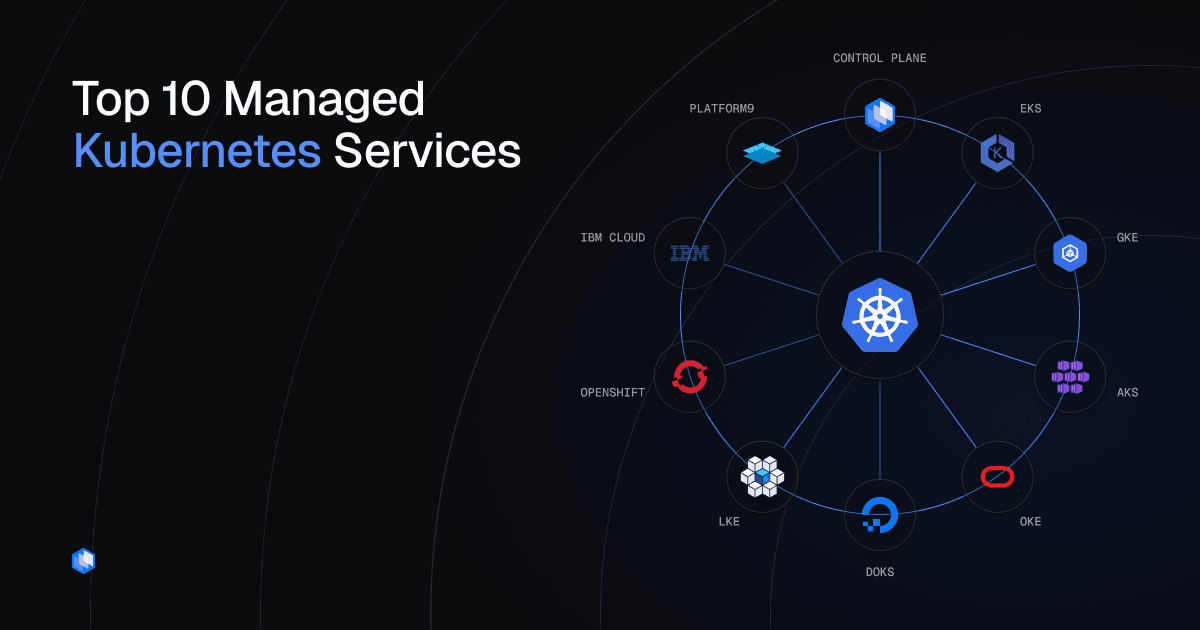
Top 10 Kubernetes SaaS Hosting Services
The services below cover the main operating models teams encounter when evaluating hosted or managed Kubernetes in 2026. The numbering is for navigation only and does not indicate quality or rank. Because enterprise buyers often compare adjacent platform categories, the list retains OpenShift Kubernetes Engine and VMware Tanzu Kubernetes Grid even though they are enterprise Kubernetes platforms rather than hosted SaaS services; their sections call out that distinction.
Control Plane
Control Plane is a cloud virtualization platform that composes infrastructure from AWS, GCP, Azure, OCI, bare metal, data centers, and edge locations into a consistent application environment. Rather than treating each infrastructure provider or Kubernetes cluster as a separate platform, Control Plane exposes higher-level workload, networking, identity, policy, and observability abstractions across them.
That distinction matters for teams that want the portability of Kubernetes without turning cluster operations into an internal platform project. Existing Kubernetes clusters can be connected as Control Plane locations through Bring Your Own Kubernetes (BYOK), so teams can keep workloads on infrastructure they already control while using the same deployment and governance model.
Main Features
- Capacity AI continuously right-sizes workloads and can scale idle workloads to zero. Control Plane reports typical cloud-spend reductions of 30 to 50 percent for customers using its managed capacity and optimization model.
- Built-in service mesh, workload firewall, observability, secrets, audit trails, autoscaling, TLS, load balancing, and geo-routing to the nearest healthy location, backed by a 99.999% uptime SLA for enterprise workloads.
- Security and compliance capabilities that include SOC 2 Type II and PCI DSS Level 1, plus support for HIPAA and GDPR requirements.
- AI and automation support includes an MCP Server for AI agents, with agent actions passing through the same identity, policy, and audit controls used for human operators, plus pay-as-you-go GPU compute across a broad NVIDIA range including B200, H200, H100, A100, V100, A10, A6000, A40, L40S, A5000, A4000, L4, and T4, subject to availability.
- BYOK for registering existing Kubernetes clusters as locations in the Control Plane platform.
Best for teams that need a consistent application platform across multiple clouds, regions, existing Kubernetes clusters, or private infrastructure and want to reduce the amount of Kubernetes lifecycle management their developers handle directly.
Price. Public Control Plane pricing is usage-based, with CPU, memory, storage, observability, egress, and GPU rates published in the pricing estimator. The public pricing page states that there are no contracts, minimums, or lock-ins for the self-service model.
Review: “What I value most is how easy it is to manage our infrastructure.” (G2)
Oracle Cloud Infrastructure Kubernetes Engine
Oracle Cloud Infrastructure Kubernetes Engine (OKE) is Oracle’s fully managed Kubernetes service. It supports managed nodes, fully managed virtual nodes, and self-managed nodes, letting teams choose how much responsibility they want for the worker layer.
Main Features
- Managed Kubernetes control plane integrated with OCI networking, IAM, storage, and compute.
- Virtual nodes provide a serverless Kubernetes option with pod-level elasticity and pay-per-use compute.
- Managed and self-managed node options support workloads that need more infrastructure control, including specialized compute.
- Enhanced clusters support large-scale deployments and additional Kubernetes features.
Best for organizations already standardized on Oracle Cloud Infrastructure or teams that want a choice between traditional worker nodes and serverless Kubernetes compute.
Price. Basic OKE clusters have no Kubernetes Engine cluster fee. Enhanced clusters cost $0.10 per cluster per hour, capped at $74.40 per month for the control plane, and include the financially backed control plane SLA. Virtual nodes are available with enhanced clusters and add $0.015 per virtual node per hour, while compute, storage, and networking are billed separately. See OKE pricing for current rates.
Review: “OKE offers a user-friendly interface and simplified workflows for deploying and managing Kubernetes clusters.” (G2)
IBM Cloud Kubernetes Service
IBM Cloud Kubernetes Service is a certified managed Kubernetes service for running containerized applications on IBM Cloud. IBM manages the Kubernetes control plane components and integrates the service with IBM Cloud infrastructure and security services.
Main Features
- Managed Kubernetes control plane with automated Kubernetes version management.
- Integration with IBM Cloud networking, identity, storage, and observability services.
- Native Kubernetes APIs and tooling for teams that want a standard Kubernetes experience.
- Security controls for isolating compute resources and governing cluster access.
Best for organizations already using IBM Cloud or enterprises that want Kubernetes integrated with IBM’s cloud services.
Price. Pricing depends on the worker infrastructure and other IBM Cloud services attached to the cluster. Use the IBM Cloud pricing tools for a workload-specific estimate.
Review: “Fully secure and easy to automate and monitor your apps.” (G2)
Google Kubernetes Engine
Google Kubernetes Engine (GKE) is Google Cloud’s managed Kubernetes service. It offers Standard mode for teams that want more node-level control and Autopilot mode for teams that want Google to manage more of the underlying compute infrastructure.
Main Features
- Standard and Autopilot operating modes.
- Automated cluster lifecycle management, pod and cluster autoscaling, and multi-cluster management features.
- Integration with Google Cloud networking, IAM, observability, security, and AI infrastructure.
- Regional and zonal cluster options with financially backed control plane SLAs.
Best for teams centered on Google Cloud, especially those that want a choice between conventional managed Kubernetes and a more automated Autopilot model.
Price. GKE charges a $0.10 per-cluster hourly management fee, with monthly free-tier credits available for eligible zonal and Autopilot clusters. Compute is billed separately, while Autopilot pricing depends on the resources requested by workloads. See GKE pricing.
Review: “GKE makes it easy to scale our containerized applications, whether we need to handle increased traffic or optimize resource usage during quieter periods.” (G2)
Azure Kubernetes Service
Azure Kubernetes Service (AKS) is Microsoft’s managed Kubernetes service. It combines a managed control plane with Azure identity, networking, policy, monitoring, and developer tooling.
Main Features
- Integration with Microsoft Entra ID, Azure Policy, Azure Monitor, and Azure networking.
- Cluster and workload autoscaling with managed upgrade capabilities.
- Free, Standard, and Premium tiers for different support and SLA requirements.
- AKS Automatic for more automated node provisioning, scaling, upgrades, and network configuration.
Best for organizations already invested in Azure, Microsoft identity, and Azure developer and operations tooling.
Price. The Free tier charges for underlying resources but not Kubernetes cluster management. Standard and Premium add paid management capabilities and SLAs. See AKS pricing for current rates.
Review: “Azure has custom-made monitoring to monitor Kubernetes cluster health and nodes monitoring.” (G2)
Amazon Elastic Kubernetes Service
Amazon Elastic Kubernetes Service (EKS) is AWS’s managed Kubernetes service. AWS operates the Kubernetes control plane while teams can choose among self-managed nodes, managed node groups, Fargate, EKS Auto Mode, and hybrid node options depending on how much infrastructure management they want to retain.
Main Features
- Integration with AWS IAM, VPC networking, Elastic Load Balancing, CloudWatch, and other AWS services.
- EKS Auto Mode can automate node provisioning, scaling, load balancing, storage integration, and node lifecycle management.
- Managed node groups and hybrid node options support more customized operating models.
- Availability-zone-aware architecture for production clusters.
Best for teams whose applications and security model are already centered on AWS.
Price. Standard Kubernetes version support costs $0.10 per cluster per hour. Clusters running a Kubernetes version in extended support cost $0.60 per cluster per hour. Features such as EKS Auto Mode add separate charges, and worker compute, storage, networking, and other AWS resources are billed independently. See Amazon EKS pricing.
Review: “Using Amazon EKS you have much less to worry about underlying infrastructure, so you can focus more on getting your features and services deployed.” (Capterra)
Red Hat OpenShift Kubernetes Engine
Red Hat OpenShift Kubernetes Engine is a subscription offering based on OpenShift Container Platform. Unlike EKS, GKE, or AKS, it is not itself a hosted Kubernetes SaaS control plane. It is included here because enterprises often evaluate OpenShift alongside managed Kubernetes services when deciding how to standardize application platforms.
Main Features
- Enterprise Kubernetes distribution with Red Hat support and OpenShift lifecycle tooling.
- Role-based access controls, security controls, monitoring, autoscaling, and over-the-air update capabilities.
- Operator Lifecycle Manager for installing and managing Kubernetes-native applications and services.
- Consistent OpenShift experience across supported infrastructure choices.
Best for enterprises standardizing on OpenShift that want a supported Kubernetes platform while retaining more control over where and how clusters run.
Price. OpenShift Kubernetes Engine is subscription-priced. See Red Hat OpenShift pricing or contact Red Hat for a deployment-specific quote.
Review: “It provides you with a centralized environment to orchestrate or scale up your applications.” (G2)
Akamai Linode Kubernetes Engine
Linode Kubernetes Engine (LKE) is Akamai’s managed Kubernetes service, formerly Linode’s, and part of Akamai Cloud since the 2022 acquisition. Akamai manages the control plane while teams provision worker nodes as standard Linode instances, which keeps the operating model simple for teams already familiar with the platform. LKE is CNCF-certified for Kubernetes conformance.
Main Features
- Fully managed Kubernetes control plane, with clusters provisioned through Cloud Manager, the Linode CLI, the API, or Terraform.
- Optional high-availability control plane that replicates the API server, etcd, scheduler, and controller managers for production clusters.
- LKE Enterprise tier adds a dedicated HA control plane, private networking, control plane ACLs, and an SLA-backed reliability commitment for larger workloads.
- Integration with NodeBalancers for load balancing, Block Storage for persistent volumes, and Shared, Dedicated, High Memory, and GPU node types.
Best for startups and platform teams that want predictable pricing, free ingress, and a managed control plane without hyperscaler complexity, or organizations already running on Akamai’s edge and CDN footprint.
Price. The standard control plane is included at no cost, and clusters are billed only for the compute, NodeBalancers, storage, and egress they consume. The high-availability control plane upgrade starts at $60 per cluster per month, and LKE Enterprise is $300 per cluster per month for approved customers. See LKE pricing for current rates.
Review: “It is easy to deploy and manage Kubernetes clusters without too much complexity.” (Gartner)
DigitalOcean Kubernetes
DigitalOcean Kubernetes (DOKS) is a managed Kubernetes service designed around a simpler cloud operating model. DigitalOcean manages the control plane and integrates clusters with its load balancers, storage, CPU and GPU Droplets, API, and CLI.
Main Features
- Fully managed Kubernetes control plane with automated updates and autoscaling.
- Optional highly available control plane for production workloads.
- Integration with DigitalOcean load balancers, volumes, container registry, CPU nodes, and GPU nodes.
- Standard Kubernetes tooling without a large proprietary platform layer.
Best for startups, smaller platform teams, and organizations that want managed Kubernetes with straightforward infrastructure and pricing.
Price. The control plane is included at no additional cost. Basic worker nodes start at $12 per month per node, and control plane high availability costs $40 per month. See DigitalOcean Kubernetes pricing for current node and GPU rates.
Review: “We use DigitalOcean Kubernetes to manage all of our public-facing API and async job worker deployments for a SaaS application.” (TrustRadius)
Platform9 Managed Kubernetes
Platform9 Managed Kubernetes (PMK) uses a SaaS management plane to operate Kubernetes across infrastructure that the customer chooses. Unlike a hyperscaler-native service, PMK is designed to manage Kubernetes across on-premises infrastructure, public clouds, and edge environments from a central service.
Main Features
- SaaS-managed Kubernetes across public cloud, private infrastructure, and edge locations.
- Centralized cluster management, monitoring, upgrades, and day-two operations.
- Remote monitoring, optimization, and remediation backed by 24/7 Platform9 support.
- Upstream Kubernetes model intended to reduce infrastructure lock-in.
Best for organizations that need centrally managed Kubernetes across hybrid or distributed infrastructure without tying cluster operations to one hyperscaler.
Price. Pricing is available by inquiry from Platform9.
Review: “Easy to deploy, manage, monitor, and automate with built-in WebUI tools and others such as Argo CD and Ansible.” (G2)
Frequently Asked Questions
Managed Kubernetes transfers control plane operations and, depending on the service, some worker-node and lifecycle tasks to a provider. Self-managed Kubernetes gives your team direct control over the entire stack but also makes your team responsible for control plane availability, upgrades, patching, node lifecycle, networking, and supporting services.
Start with your existing infrastructure and the management boundary you want. If most workloads already run on AWS, Google Cloud, Azure, Oracle Cloud, IBM Cloud, or DigitalOcean, the provider’s native Kubernetes service often offers the cleanest integration. If you need one operating model across multiple clouds, on-premises infrastructure, or existing clusters, compare platforms such as Platform9 and Control Plane that are designed to span environments.
There is no single pricing model. EKS and GKE charge cluster management fees in addition to workload infrastructure. AKS has a Free tier as well as paid tiers. DigitalOcean includes its standard control plane and bills worker infrastructure separately. Other platforms use subscription or usage-based pricing. Model the full cost of control planes, worker compute, storage, networking, egress, support, management add-ons, and the engineering time needed to operate what the provider does not manage.
Yes, but GPU models, availability, provisioning, and pricing vary by provider. The CNCF’s 2025 annual cloud native survey, published in January 2026, reported that 66% of organizations hosting generative AI models use Kubernetes to manage some or all inference workloads. Major managed Kubernetes services support accelerator-backed nodes, while Control Plane publishes pay-as-you-go access to multiple NVIDIA GPU types through its platform.
Start with IAM, RBAC, workload identity, network isolation, encryption, secrets handling, audit logging, and policy enforcement. For regulated workloads, verify the exact scope of independent attestations and certifications such as SOC 2 Type II and PCI DSS. Treat HIPAA and GDPR as regulatory requirements rather than certifications, and confirm how the provider supports your obligations for the services and regions you plan to use.
These models reduce node-level work in different ways. GKE Autopilot provisions capacity around workload requirements. OKE virtual nodes provide pod-level serverless compute. EKS Auto Mode automates more node, scaling, storage, and load-balancing operations while still running workloads on AWS infrastructure. Higher-level platforms such as Control Plane abstract the cluster further and can scale workloads down to zero. Compare the operational model and pricing rather than assuming every “serverless Kubernetes” feature works the same way.
BYOK connects an existing Kubernetes cluster to a higher-level management platform instead of requiring workload migration to a new cluster. In Control Plane, a BYOK cluster registers as a location, allowing workloads to be managed through the Control Plane API while continuing to run in the customer’s own cloud account or data center.
At a minimum, look for strong identity integration, RBAC, network controls, encryption at rest and in transit, secrets management, audit logging, and a supported upgrade process. Production teams should also evaluate vulnerability management, workload isolation, policy enforcement, incident response, and how responsibilities are divided between the provider and customer.
Kubernetes Workload Optimization Without Cluster Overhead
Managed Kubernetes can remove a large portion of cluster administration, but the amount of work retained by your team varies widely. Hyperscaler services are usually the strongest fit when one cloud already dominates your architecture. SaaS-managed and higher-level platforms become more attractive when applications need to span clouds, regions, edge environments, or infrastructure you already own.
Control Plane takes the second approach. It provides one deployment and operations layer across multiple infrastructure providers and existing Kubernetes environments, with built-in networking, security, observability, autoscaling, and cost optimization. Request a Control Plane demo if your goal is to run Kubernetes-backed workloads without operating each cluster and cloud as a separate platform.