
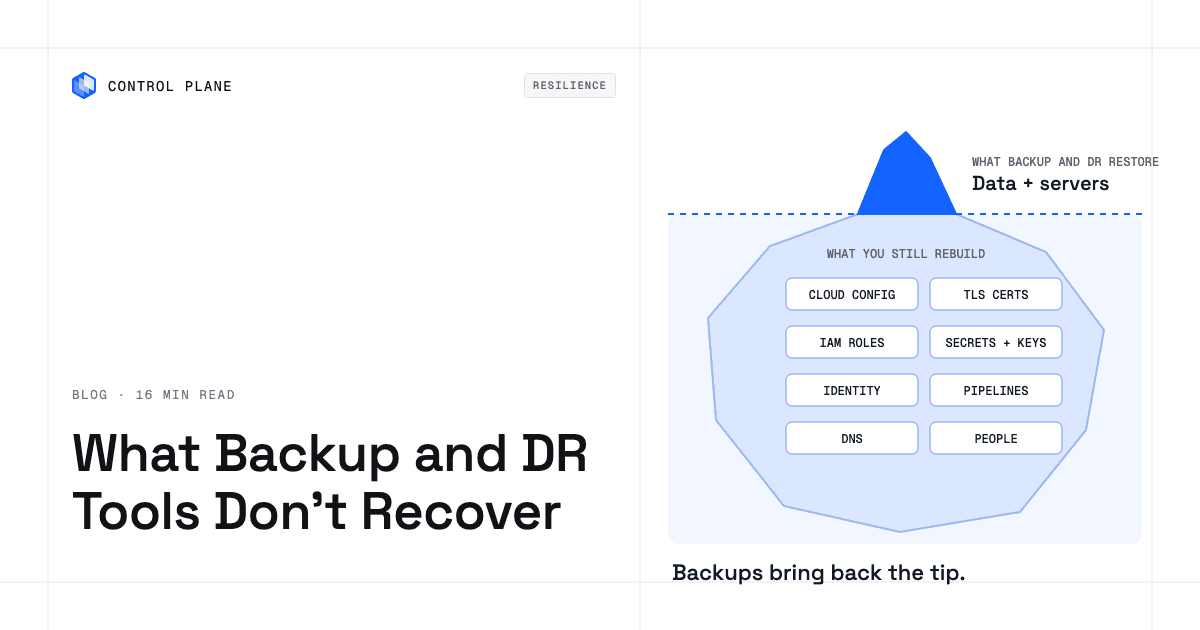
Backup and disaster recovery tools recover data and servers, but a business also needs its cloud configuration, identity, DNS, certificates, secrets, pipelines, and people working again before customers can use the service. The best cloud operations setup for business continuity and disaster recovery combines a platform such as Control Plane that keeps the application running in more than one location, a data protection tool for backups, configuration kept as code, and a tested recovery order for everything else. This guide maps eleven recovery layers against what the vendors’ own documentation says their tools restore, and sets out the order in which services should come back.
Disclosure: Control Plane publishes this guide.
TL;DR
Backup and DR products restore data and server images and leave most of the operating environment to you.
- Most backup and DR products leave cloud IAM, DNS records, TLS certificates, encryption keys, and CI/CD pipelines to you.
- A complete business continuity posture covers eleven layers, from volumes and VMs through people and communication.
- Recovery order decides whether restored data is reachable. Identity and DNS come before compute.
- Every recovery path must be timed and tested, including configuration, identity, and user access in the recovery environment.
- Control Plane keeps the application tier running across multiple locations and clouds so that a location failure needs no recovery launch, and its declarative resources make configuration exportable and re-appliable.
What is the difference between business continuity and disaster recovery?
Business continuity, disaster recovery, and high availability solve related problems at different scopes, and confusing them leads to plans that protect servers but leave the business offline.
| Term | What it keeps running | Typical scope | Owner |
|---|---|---|---|
| High availability | A single system or service, through redundant components and automatic failover | One application, usually across zones in a region, sometimes across regions | Engineering and platform teams |
| Disaster recovery | Information systems after a major, usually physical disruption, by relocating to an alternate site | The information systems at an affected site | IT operations and infrastructure |
| Business continuity | The organization’s business processes during and after a disruption, including people, communication, and third-party dependencies | The entire organization | Executive leadership, with IT, legal, and operations |
NIST SP 800-34 Rev. 1 draws the continuity and recovery lines explicitly. A business continuity plan sustains business processes during and after a disruption, a disaster recovery plan covers major disruptions that require relocating information systems to an alternate site, and an information system contingency plan recovers a single system. The same publication defines a business impact analysis as the process that maps a system to the business processes it supports, including interdependencies, and characterizes the consequences of a disruption. Without that mapping, a team can restore every database and still miss the payment gateway dependency that keeps revenue at zero.
What do backup and disaster recovery tools actually recover?
Backup and DR products are engineered for data and compute, and the vendors’ own documentation shows where each layer is left to you.
| Layer | What usually recovers it | What it leaves to you |
|---|---|---|
| Data and volumes | AWS Backup, Azure Backup, Google Cloud Backup and DR, Veeam, Commvault, Druva | Verifying data integrity and application-level consistency after restore |
| Servers and VMs | AWS Elastic Disaster Recovery (block-level replication), Azure Site Recovery, restore from backup products | Post-failover steps such as public IP assignment, load balancer attachment, and connection-string updates |
| Cloud network configuration (VPCs, subnets, security groups, load balancers) | AWS Elastic Disaster Recovery network replication (VPC-level configuration, in-AWS networks only, through a CloudFormation stack), Azure Site Recovery network mapping, Commvault Cloud Rewind, infrastructure as code | Public IPs, network security groups, and load balancers, which Azure Site Recovery leaves to recovery-plan scripts or manual steps; keeping definitions as code and checking parity between regions |
| Cloud IAM roles and policies | Infrastructure as code, if the roles were codified; IAM is not on AWS Backup’s supported list | Keeping role and policy definitions as code and testing them in the recovery account |
| Workforce identity (Entra ID, Active Directory, IAM Identity Center) | Microsoft Entra Backup and Recovery, Commvault IDRecover (Active Directory, Entra ID, Okta), Veeam Data Cloud for Microsoft Entra ID | Hard-deleted and on-premises Active Directory-sourced objects when relying on Entra Backup and Recovery alone, Active Directory forest recovery when relying on Microsoft’s own process, and IAM Identity Center’s fixed primary Region |
| DNS records and failover | Exported zone files or infrastructure as code; Route 53 hosted zones are not on AWS Backup’s supported list | Failover through data-plane health checks, short TTLs on failover records, and restoring DNS before applications |
| TLS certificates | Re-issuance or certificates provisioned in advance in the recovery region | Provisioning each recovery region ahead of time, since AWS Certificate Manager certificates cannot be copied between Regions |
| Secrets and encryption keys | Multi-Region replication you set up per secret or key, or vault backups | Creating multi-Region KMS keys yourself; Azure Key Vault restores only within the same subscription and geography |
| Application configuration and deploy pipelines | Infrastructure as code repositories and CI/CD definitions in version control | Predeploying pipelines in every region and replicating DR plans, credentials, certificates, and scripts |
| Third-party dependencies (payments, email, SaaS APIs) | Nothing in the backup stack | Documenting API keys, OAuth tokens, webhooks, service principals, and partner allowlists of your egress IPs, and testing integrations from the recovery environment |
| People and communication | Nothing in the backup stack | Out-of-band communication channels, phone bridges, runbook distribution, and role assignments |
AWS states that in addition to data, you must redeploy the infrastructure, configuration, and application code in the recovery Region, and AWS Backup’s saved EC2 metadata, such as instance type, VPC, security group, and IAM role, is only used when restoring to the same Region. Generating infrastructure as code from existing resources after the fact is unreliable. Microsoft says exporting an ARM template from the portal is not a reliable way to turn pre-existing resources into templates usable in production, and exported templates can miss password parameters and stop at 200 resources per resource group. Terraform’s configuration generation for imports is labeled experimental and produces a best guess. Google’s Terraform export of existing resources is Pre-GA, and some resource types are not supported. The AWS CloudFormation IaC generator works only for resource types the Cloud Control API supports and models up to 500 resources per template. Configuration that is not in code before the disaster has to be rebuilt by hand under pressure. The tools that keep it in code are compared in CI/CD and IaC tools for disaster recovery and self-healing.
Why do identity, DNS, and secrets break recovery?
Identity, DNS, and secrets sit near the bottom of the dependency stack, so data, compute, and traffic all wait on them.
Workforce identity is the first bottleneck. Microsoft Entra ID soft-deletes only users, Microsoft 365 groups, cloud security groups, and applications, for 30 days, and hard-deletes all other object types immediately. Microsoft calls recoverability a shared responsibility and tells customers to keep tenant configuration in an external versioned repository exported with Microsoft Graph. Microsoft Entra Backup and Recovery became generally available in June 2026; the Standard plan keeps daily backups for 7 days, a 30-day Premium plan is in preview, and it cannot recover hard-deleted objects or objects managed in on-premises Active Directory. Active Directory forest recovery has no end-to-end automation and is more a logistical and organizational challenge than a technical one, according to Microsoft, which recommends regular domain controller backups over snapshot restore. On AWS, the IAM control plane runs in us-east-1, so creating or changing roles during an event depends on that Region, and AWS advises against relying on global-service control planes in recovery paths. IAM Identity Center runs in one primary Region; multi-Region replication exists but not for account instances or Active Directory-sourced identities, and the primary Region cannot be changed.
DNS, certificates, secrets, and encryption keys form the second set of hidden dependencies. The Route 53 control plane is in us-east-1 while DNS answering is global, and AWS says to use data-plane functions such as health checks for DNS failover. AWS calls a TTL of 60 or 120 seconds a common choice for failover records because resolvers cache answers until the TTL expires. AWS Certificate Manager certificates are regional and cannot be copied between Regions, so each recovery region needs its own certificates in advance. AWS never automatically creates or replicates multi-Region KMS keys. Azure Key Vault backups can be restored only within the same subscription and Azure geography, and Microsoft-managed Key Vault failover is best-effort and leaves the vault read-only. Data encrypted with a key that does not exist in the recovery region stays unreadable after the restore.
What order should you restore services in?
Recovery is sequence-dependent, and the wrong order leaves restored services idle while teams rebuild the prerequisites beneath them.
| Step | What to restore | Why it comes here |
|---|---|---|
| 1 | Out-of-band communication and the incident bridge | Teams need a coordination channel that does not depend on the systems being recovered; CISA’s incident response playbook calls for out-of-band communications and phone bridges |
| 2 | Break-glass access to cloud accounts and recovery tools | Break-glass accounts do not depend on the failed identity provider, so the team can sign in and rebuild everything else |
| 3 | Network, then workforce identity and internal DNS | Self-hosted domain controllers and identity servers need VPCs, subnets, routes, and security groups first, and Microsoft says you often need to recover Active Directory and DNS before other application components; time sync comes up here because Kerberos and certificate validation depend on it |
| 4 | Secrets, keys, and certificates | Encrypted data is unreadable and TLS endpoints fail without them |
| 5 | Data | Databases and volumes restore once keys and network paths exist |
| 6 | Compute and application tier | Application code needs identity, networking, secrets, and data in place, plus container images, service quotas, and monitoring already available in the recovery region |
| 7 | Traffic cutover with health checks and short TTLs | Users should reach the recovery environment only after the application passes health checks, and TTLs must already be short before the event because resolvers keep cached answers |
| 8 | Verify access, payments, and integrations | Users must sign in, payments must clear, and third-party APIs must respond |
| 9 | Plan failback | The recovery environment’s state is recorded and the return to the primary site is scheduled |
Steps without a dependency between them run in parallel, and large data restores usually start as soon as keys and network exist because they set the RTO floor. Azure Well-Architected guidance says to replicate DR plans, credentials, certificates, and scripts across regions, keep offline copies, and predeploy CI/CD pipelines in every region. AWS Resilience Hub notes that even with backups copied to a fallback Region, you are still expected to maintain a restore procedure and test and time it. Keeping these artifacts in one region or one cloud account creates a single point of failure that no backup tool fixes.
What are the best cloud operations solutions for addressing business continuity and disaster recovery?
No single product covers all eleven layers, so the strongest setup combines solutions that each handle a distinct part of the problem.
- Control Plane keeps the application tier running across multiple locations and clouds. A workload runs in every location of its Global Virtual Cloud (GVC), Control Plane’s named set of locations, which can span AWS, GCP, Azure, and Oracle Cloud Infrastructure (OCI) regions, plus Kubernetes clusters you run yourself or that Control Plane runs for you. Each workload gets Control Plane’s canonical endpoint, one HTTPS URL that uses DNS to route clients to the nearest healthy location, and replicas in other locations take over when a whole location fails. Control Plane’s 99.999% availability SLA applies to a workload running at least two replicas across at least two locations, and those locations can be on different providers. Configuration is kept as declarative resources that export and re-apply. Custom domains get TLS certificates automatically, and org secrets are stored on multiple cloud providers, so a workload references the same secret wherever its GVC runs. The business continuity solutions for high availability across on premises and cloud roundup covers this layer in depth.
- Hyperscaler-native DR and backup handles server replication and data protection into one provider’s cloud. AWS Elastic Disaster Recovery replicates server volumes at block level, and AWS Backup covers its supported resource types. Azure Site Recovery and Azure Backup provide VM replication and backup. Google Cloud Backup and DR covers workloads including Compute Engine, Persistent Disk, Filestore, Cloud SQL, and AlloyDB. The best cloud disaster recovery solutions for 2026 comparison scores them side by side.
- Data protection platforms provide backup, ransomware recovery, and identity backup. Veeam, Commvault, and Druva back up data across cloud and on-premises environments. Commvault IDRecover covers Active Directory, Entra ID, and Okta, and Veeam Data Cloud for Microsoft Entra ID backs up Entra ID. Commvault Cloud Rewind, now listed under Cloud Application Recovery, rebuilds cloud infrastructure and configuration along with data.
- Infrastructure as code and GitOps keep cloud configuration in version control so it can be reviewed and reapplied in a recovery account. Terraform, Pulumi, and CloudFormation define network, IAM, and security group state. The code has to exist and stay current before the disaster.
- A business continuity plan with a business impact analysis, out-of-band communication, and regular drills ties the technical layers to people and process. It covers third-party dependencies, communication channels, and decision authority.
Most companies need one solution from each of the first four types and a tested plan that ties them together. A backup product without codified configuration leaves identity and networking gaps, and a multi-location platform without data protection leaves backup and ransomware recovery gaps. The cloud vs on-premises disaster recovery guide covers where the recovery site itself should run.
How do you test that the whole business recovers?
AWS says the only error recovery that works is the path you test frequently, and a test that restores one database snapshot and declares success misses most of the recovery surface.
A complete drill rebuilds configuration and identity in the recovery account, applies the infrastructure as code, restores secrets and certificates, deploys the application, times the whole sequence against the RTO, and measures data loss against the RPO. Google’s DR guide says to test that permissions and user access work in the DR environment like they do in production. The drill should move traffic into the recovery DNS path with health checks and short TTLs, confirm that users can sign in, check that payment gateways and third-party APIs respond, and use the out-of-band communication channel. Every gap found becomes an action item with an owner and a deadline. Teams that skip the people and communication layer in drills find out during a real incident that the phone bridge was never set up. The steps for drilling without risking customers are in how to test failover without taking production down.
How Control Plane fits
Control Plane handles Day 2 operations for you, including autoscaling, built-in observability, and security. When a location in a GVC fails, replicas in its other locations keep serving through the workload’s canonical endpoint. During the October 20, 2025 AWS us-east-1 outage, 20 percent of Control Plane customers had us-east-1 in their GVCs. According to Control Plane’s internal incident telemetry, their workloads were active and running in healthy locations within 10 seconds, with no customer downtime. Teams use the same model to survive a cloud provider outage without a DR runbook for the application tier.
Every Control Plane resource, including GVCs, workloads, identities, secrets, policies, domains, and volume sets, is a declarative item reached through one API shared by the console, CLI, Terraform, Pulumi, and AI agents. Control Plane’s CLI command cpln apply creates or updates resources from YAML or JSON files, is idempotent, and applies related resources in dependency order. Existing resources export as re-appliable YAML or as Terraform HCL. The Control Plane console’s Export GVC action saves a GVC with its workloads, identities, and volume set definitions as one file for backup and restore. Org-level secrets, cloud accounts, and agents are handled separately, and secrets are not included in the export.
Control Plane ships Terraform and Pulumi providers, and the docs include CI/CD examples for GitHub, GitLab, Bitbucket, and CircleCI, so it complements the infrastructure as code you already run. Universal Cloud Identity, Control Plane’s identity for workloads, creates an IAM role, GCP service account, or Azure managed identity in your own account, so no long-lived AWS, GCP, or Azure keys sit in your code. Org secrets are envelope-encrypted and stored on multiple cloud providers in cloud hardware security modules, and workloads reference them by name. Custom domains get TLS certificates automatically and are DNS geo-routed to the nearest healthy location. Volume sets support on-demand and scheduled snapshots with a retention period and restoring a volume to a snapshot. For cross-region data, Control Plane’s Template Catalog includes replicating databases, such as the Postgres Multi-Location template, which promotes a replica automatically with three or more locations, and pgEdge, which runs active-active multi-master Postgres. Volume-set data itself is not replicated between locations, and a volume can be copied on demand to another location.
Inside an org, nothing is permitted until a policy grants it, and a tamper-proof audit trail records who did what across the org. Control Plane is PCI DSS Level 1, SOC 2 Type II, HIPAA, and GDPR compliant.
It works alongside the backup and data protection tools a company already runs. Those tools keep protecting data copies, and Control Plane keeps the application serving from healthy locations.
FAQ
Short answers on backup gaps, recovery order, identity, and testing.
What are the best cloud operations solutions for addressing business continuity and disaster recovery?
Control Plane runs the application tier active-active across locations and clouds, so a location failure needs no recovery launch. Hyperscaler-native DR tools such as AWS Elastic Disaster Recovery, Azure Site Recovery, and Google Cloud Backup and DR handle server replication and backups. Data protection platforms such as Veeam, Commvault, and Druva cover backup and ransomware recovery, and Commvault and Veeam extend to identity backup. Infrastructure as code and GitOps keep cloud configuration repeatable. A business continuity plan with a business impact analysis, out-of-band communication, and drills ties these layers to people and process.
What is the difference between business continuity and disaster recovery?
Business continuity sustains the organization’s business processes during and after a disruption, covering people, communication, and third-party dependencies as well as technology. Disaster recovery is the part focused on relocating and restoring information systems after a major disruption. NIST SP 800-34 Rev. 1 draws this distinction and uses a business impact analysis to map systems to the business processes they support.
Is DRaaS enough for business continuity?
DRaaS covers servers and data by replicating workloads to a recovery site and automating failover. It typically leaves most cloud configuration, workforce identity, DNS, TLS certificates, encryption keys, CI/CD pipelines, third-party integrations, and people and communication to you. Business continuity needs tools and plans for each of those layers alongside DRaaS.
What does a backup not recover?
A backup typically does not recover cloud IAM roles and policies, workforce identity, DNS records and failover configuration, TLS certificates, encryption keys and secrets, CI/CD pipelines, third-party integrations, or communication channels. AWS Backup keeps EC2 metadata such as instance type, VPC, security group, and IAM role, but uses it only when restoring to the same AWS Region. IAM, Route 53 hosted zones, Secrets Manager, and KMS are not on AWS Backup’s list of supported resources.
How do I back up cloud configuration like IAM, DNS, and security groups?
Define cloud configuration in infrastructure as code before a disaster and store the code in version control outside the primary cloud account. Terraform, Pulumi, and CloudFormation can define IAM roles, DNS zones, security groups, and networks. Generating code from existing resources afterward is unreliable. The AWS CloudFormation IaC generator supports only Cloud Control API resource types and caps at 500 resources per template, Terraform’s import configuration generation is experimental, and Azure ARM template export can miss password parameters and stops at 200 resources.
How do I recover Microsoft Entra ID or Active Directory after a disaster?
For Entra ID, use Microsoft Entra Backup and Recovery, generally available since June 2026, which keeps daily backups for 7 days on the Standard plan, with a 30-day Premium plan in preview. It cannot recover hard-deleted objects or objects managed in on-premises Active Directory, and Microsoft recommends keeping tenant configuration in an external versioned repository exported with Microsoft Graph. Microsoft says its Active Directory forest recovery process has no end-to-end automation and describes it as more a logistical and organizational challenge than a technical one. Commvault IDRecover and Veeam Data Cloud for Microsoft Entra ID provide third-party backup, with Commvault covering Active Directory, Entra ID, and Okta and Veeam covering Entra ID.
In what order should systems be restored after a disaster?
Start with out-of-band communication and the incident bridge. Restore break-glass access next, then the network, workforce identity, and internal DNS, followed by secrets, keys, and certificates. Restore data once encryption keys and network paths exist. Deploy compute and applications, cut traffic over with health checks and short TTLs, verify access and integrations, and plan failback.
How often should business continuity and disaster recovery plans be tested?
Test at least quarterly, which AWS recommends for Elastic Disaster Recovery drills, and again after significant infrastructure or organizational changes, because AWS states that the only error recovery that works is the path you test frequently. Drills should rebuild configuration and identity in the recovery environment, time the full restore against the RTO, verify user access and third-party integrations, and use the out-of-band communication channel.
How does Control Plane support business continuity and disaster recovery?
Control Plane runs each workload in every location of its Global Virtual Cloud (GVC), Control Plane’s named set of locations, across regions and clouds. Each workload gets a canonical endpoint that routes requests to the nearest healthy location, and replicas in other locations take over when a location fails. The 99.999% availability SLA applies to a workload running at least two replicas across at least two locations. Every resource is declarative, and existing resources export as re-appliable YAML or Terraform HCL. Universal Cloud Identity, Control Plane’s identity for workloads, keeps long-lived cloud keys out of code, org secrets are envelope-encrypted and stored in cloud hardware security modules on multiple providers, custom domains get automatic TLS certificates with geo-routing, and volume sets support on-demand and scheduled snapshots. Control Plane works alongside existing backup and data protection tools.