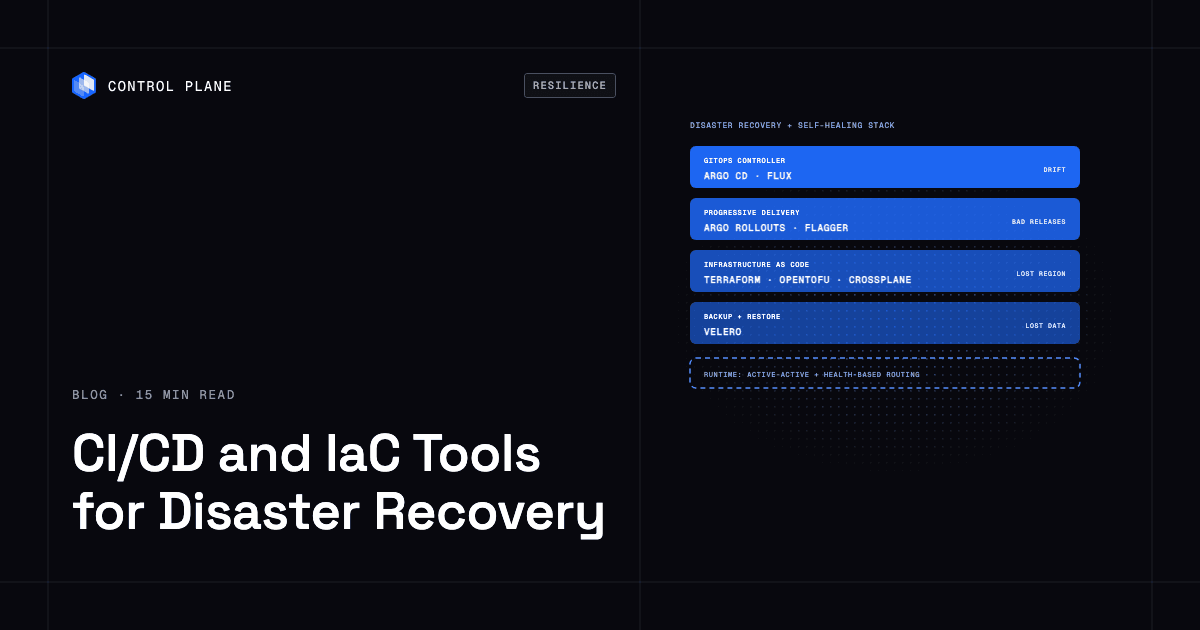
No single CI/CD or IaC tool covers both disaster recovery and self-healing end to end. The strongest setups pair a GitOps controller like Argo CD or Flux with a progressive delivery tool like Argo Rollouts or Flagger, infrastructure as code that can rebuild an entire region from versioned definitions (Terraform, OpenTofu, or Crossplane for continuous reconciliation), and a backup tool like Velero for Kubernetes resources and persistent volumes. Code-based tools recreate infrastructure and configuration, but data still needs replication or backups, and the runtime needs to route traffic around failed locations. This guide maps every major open-source tool to the specific disaster recovery and self-healing patterns it covers, identifies the gaps between them, and shows how to combine them into a stack you can test.
Disclosure: Control Plane publishes this guide.
TL;DR
- Four layers matter. GitOps controller, progressive delivery, infrastructure as code, and backup. No single layer is sufficient alone.
- Best tool per layer. Argo CD or Flux for GitOps reconciliation, Argo Rollouts or Flagger for automated rollback on bad releases, Terraform or OpenTofu (or Crossplane) for rebuilding infrastructure from code, Velero for data and resource backup.
- The gap code cannot close. Data written since the last backup or within the replica lag window, external dependencies, DNS propagation during an outage, secrets or state files stored only in the failed region, and recovery time.
- How to test it. Weekly staging rebuilds and Velero restores, forced bad canaries, and quarterly region failover drills.
- Where Control Plane fits. Control Plane’s Global Virtual Cloud (GVC) runs workloads active-active across locations on multiple providers, and health-aware DNS geo-routing sends traffic only to locations passing readiness probes. Data replication and release testing remain your responsibility.
Which CI/CD and IaC solutions offer the best disaster recovery and self-healing patterns?
Disaster recovery and self-healing are different problems that share tooling. Self-healing keeps a running system in its desired state by correcting drift, replacing failed pods, or rolling back a bad release automatically. Disaster recovery rebuilds an environment after a larger failure, such as a lost region or corrupted data, and gets traffic flowing to the replacement.
Argo CD and Flux correct configuration drift in Kubernetes. Argo Rollouts and Flagger roll back bad releases based on metrics. Terraform, OpenTofu, Pulumi, and Crossplane rebuild infrastructure from versioned definitions. Velero restores the data that code cannot recreate.
You can read more about combining these layers in how to roll back a bad change and build self-healing infrastructure.
How do the tools compare?
A “Yes” means the tool handles the pattern with documented, built-in features. “Partial” means the tool contributes but needs another tool, a schedule, or external automation to complete the pattern. “No” means the tool does not address the pattern.
| Tool | Self-healing (runtime) | Drift correction | Automated rollback | Multi-cluster or multi-region rollout | Rebuild from code | Data backup and restore |
|---|---|---|---|---|---|---|
| Argo CD | No, relies on Kubernetes controllers | Yes, automated sync with selfHeal | Partial, Git revert triggers sync | Yes, via ApplicationSets | Partial, workloads only | No |
| Flux | No, relies on Kubernetes controllers | Yes, kustomize-controller by default | Partial, Git revert triggers sync | Yes, bootstrap per cluster or remote clusters | Partial, workloads only | No |
| Argo Rollouts | No | No | Yes, metric-based abort | Partial, per-cluster CRDs | No | No |
| Flagger | No | No | Yes, metric-based rollback | Partial, per-cluster CRDs | No | No |
| Terraform / OpenTofu | No | Partial, drift shown in plan | No, forward-only apply | Partial, provider aliases or per-region workspaces | Yes | No |
| Pulumi | No | Partial, refresh detects drift | No, forward-only update | Partial, stacks per region | Yes | No |
| Crossplane | Partial, recreates deleted cloud resources | Yes, controller-driven | No | Partial, region set per resource | Yes | No |
| Velero | No | No | No, manual restore | Partial, restore to other cluster | No | Yes |
| GitHub Actions / GitLab CI | No | No | Partial, redeploy previous version | Partial, matrix jobs | Partial, orchestrates IaC | No |
| Kubernetes built-ins | Yes, probes and controllers | No | Partial, manual rollout undo | No | No | No |
This matrix reflects each project’s documented features as of November 2026. Combinations matter more than any single tool.
What do the leading tools do for disaster recovery and self-healing?
Each tool covers specific cells of the matrix and leaves specific gaps.
Argo CD
Argo CD is a declarative GitOps controller for Kubernetes. It watches a Git repository and continuously compares the desired state declared there with the live state in the cluster. When automated sync with selfHeal is enabled on an Application, Argo CD automatically reverts any manual or accidental change to the cluster, correcting drift as soon as it detects it. The prune option removes resources that no longer exist in Git.
For disaster recovery, Argo CD’s ApplicationSets can deploy the same application definition across dozens of clusters, making it straightforward to stand up a replacement cluster and have Argo CD populate it from Git. The limit is that Argo CD manages Kubernetes resources only. It does not provision the underlying cloud infrastructure (VPCs, databases, load balancers), and it does not perform metric-based rollback on its own. Teams pair it with Argo Rollouts or Flagger for that. A deeper comparison of the two GitOps controllers is available in Argo CD vs Flux for GitOps across environments and clusters.
Flux
Flux is a GitOps toolkit composed of specialized controllers that each handle one concern: source management, Kustomize or Helm rendering, image automation, and notification. Controllers reconcile on a configured interval; kustomize-controller corrects drift by default, and helm-controller corrects drift only when drift detection is enabled.
Flux’s multi-tenancy model lets platform teams delegate namespaces to application teams with isolated Git sources and permissions. For disaster recovery, bootstrapping Flux into a fresh cluster and pointing it at the existing Git repository is enough to reconstruct all workloads. Like Argo CD, Flux does not manage cloud infrastructure or perform canary analysis. It is commonly paired with Flagger, which is part of the Flux project family.
Argo Rollouts
Argo Rollouts replaces the Deployment with a Rollout resource (or references one with workloadRef) and adds canary and blue-green strategies. During a canary rollout, Argo Rollouts shifts traffic incrementally and runs an AnalysisRun that queries Prometheus, Datadog, or other metric providers. If the analysis fails, the rollout aborts and traffic returns to the stable version automatically.
This is the primary tool for automated rollback driven by application health metrics. It does not handle infrastructure drift, cluster rebuilds, or data backup.
Flagger
Flagger is a progressive delivery operator that automates canary, A/B, and blue-green deployments on Kubernetes. It integrates with service meshes like Istio and Linkerd and with ingress controllers to manage traffic shifting. Flagger queries metrics during the canary window and automatically rolls back if thresholds are breached. Flagger does not manage cloud infrastructure or back up data.
Terraform and OpenTofu
Terraform and its open-source fork OpenTofu are widely used IaC tools for cloud infrastructure. They use a declarative configuration language and a state file to track every resource. Running terraform plan against a live environment reveals drift, and terraform apply brings the environment back to the declared state.
For disaster recovery, the core value is rebuild from code. If a region is lost, teams can re-run the same Terraform configuration against a different region and recreate the entire environment. Drift detection is available but requires a scheduled run or a CI trigger. Terraform automation platforms can schedule periodic plans and alert on drift. Terraform does not continuously reconcile and does not roll back. It applies forward. Teams that want automated deployment pipelines combining IaC, CI/CD, and GitOps typically wrap Terraform in a CI/CD pipeline with approval gates.
Pulumi
Pulumi provides IaC using general-purpose programming languages like TypeScript, Python, Go, and C#. The pulumi refresh command detects drift between the state file and live infrastructure, and Pulumi Deployments can run drift detection and remediation on a schedule. Like Terraform, Pulumi applies forward and does not continuously reconcile.
Pulumi’s advantage is the expressiveness of real programming languages for complex infrastructure logic, conditionals, and abstractions.
Crossplane
Crossplane turns a Kubernetes cluster into a control plane for cloud infrastructure. Cloud resources such as databases, buckets, and networks are represented as Kubernetes custom resources, and Crossplane’s controllers continuously reconcile them. If someone deletes an S3 bucket through the AWS console, Crossplane recreates it on its next poll.
This continuous reconciliation model makes Crossplane the closest IaC tool to a self-healing system for infrastructure. It supports compositions that bundle multiple resources into higher-level abstractions, and it has providers for AWS, GCP, Azure, and many others. For disaster recovery, Crossplane definitions stored in Git and synced by Argo CD or Flux can rebuild cloud infrastructure in a new cluster. The limit is maturity of provider coverage for some resource types and the operational complexity of running Crossplane itself.
Velero
Velero backs up Kubernetes resources and persistent volumes and restores them into the same or a different cluster. It supports scheduled backups, backup hooks for application-consistent snapshots, and storage in cloud object stores.
GitOps and IaC can recreate configuration and infrastructure, but they cannot recreate the contents of a PostgreSQL volume or a Redis AOF file. Velero’s limit is that it captures a point-in-time snapshot. Data written between the last backup and the failure is lost unless the database has its own replication.
GitHub Actions and GitLab CI/CD
GitHub Actions and GitLab CI/CD are general-purpose pipeline engines. They build, test, and deploy applications and can orchestrate Terraform runs, Helm upgrades, and Velero backups. Both support environments with deployment history, making it possible to roll back by redeploying a previous version.
They do not reconcile drift on their own. A GitHub Actions workflow runs only when an event triggers it (push, schedule, manual dispatch). For disaster recovery, they orchestrate the tools that do the actual work: running terraform apply, applying platform manifests, or triggering a Velero restore. Their value is in gluing the stack together and enforcing policy-as-code governance before changes reach production.
Kubernetes built-ins
Kubernetes itself provides foundational self-healing. Liveness probes restart containers that hang. Readiness probes remove pods from service endpoints when they are not ready to accept traffic. Deployments and ReplicaSets ensure the desired number of pods is always running, replacing any pod that crashes. PodDisruptionBudgets protect availability during voluntary disruptions like node drains.
These mechanisms are essential but narrow. They heal individual pods on a single cluster. They do not detect application-level degradation visible only in business metrics, rebuild infrastructure, or fail over to another region.
Which disaster recovery and self-healing patterns should you combine?
| Pattern | What it protects against | Tools |
|---|---|---|
| Continuous reconciliation | Drift from manual changes, configuration tampering | Argo CD, Flux, Crossplane |
| Progressive delivery with automated rollback | Bad application releases | Argo Rollouts, Flagger |
| Rebuild a region or cluster from code | Lost region, lost cluster | Terraform, OpenTofu, Pulumi, Crossplane, Argo CD, Flux |
| Backup and restore | Deleted or corrupted data and resources | Velero |
| Active-active runtime with health-based routing | Location failure with no rebuild delay | Cloud global load balancers with multi-region deployments, Control Plane GVC |
| Circuit breakers on automation | Runaway automated fixes causing cascading damage | Sync windows in Argo CD, manual gates in CI/CD pipelines |
The first four patterns are reactive. They detect a problem and fix it. Active-active runtime is proactive: if a location fails, traffic is already flowing to other locations that are already running the workload. Circuit breakers protect against the automation itself. An aggressive self-heal loop that keeps recreating a misconfigured resource can exhaust API quotas or cause data loss. Sync windows, approval gates, and rate limits on reconciliation are necessary guardrails.
What can CI/CD and IaC not recover?
- Data written since the last backup or replica. If the database replicates asynchronously with a 30-second lag, those 30 seconds of writes are gone after a region failure. This sets the RPO.
- External dependencies. A third-party API, a DNS registrar, or a payment gateway that is down cannot be rebuilt from your Git repository.
- DNS and traffic routing during the outage. DNS TTLs, client caches, and propagation delays mean traffic does not shift instantly even when the new environment is ready.
- Secrets and state files stored in the failed region. Terraform state in a single-region S3 bucket or secrets in a single-region vault are unavailable when that region is down. Replicate them.
- Recovery time. A rebuild takes as long as provisioning takes. Creating a cluster, restoring a managed database, and warming caches all take time. The RTO is the sum of every step in the recovery runbook.
Use these limits to set realistic RTO and RPO budgets and to choose where to invest in replication versus rebuild.
How do you test that the stack actually recovers?
- Rebuild a staging cluster from Git and IaC weekly. If it fails, the recovery plan has a gap.
- Restore a Velero backup into a fresh cluster and verify the application starts and serves traffic.
- Force a bad canary by deploying a version that returns errors and confirm that Argo Rollouts or Flagger aborts and rolls back automatically.
- Delete a Crossplane-managed resource or a Kubernetes resource managed by Argo CD and confirm that the controller recreates it within the expected interval.
- Run a region failover drill quarterly. Drain traffic from one location and verify that clients are served from the remaining locations without manual intervention.
Automating these tests in CI/CD pipelines runs them on a schedule between quarterly region drills. More detail on designing these tests is in how to test failover without taking production down.
How Control Plane fits
Control Plane is the unbreakable platform for running production workloads. It runs serverless, standard, stateful, and cron workloads natively on AWS, GCP, Azure, and Oracle Cloud Infrastructure (OCI), VM workloads on locations joined through Control Plane’s Managed Kubernetes, and workloads on Kubernetes clusters you already run or your own machines, including on premises, active-active across regions and clouds.
A Global Virtual Cloud (GVC) is Control Plane’s named set of locations drawn from cloud regions, Kubernetes clusters you register, and your own hardware. A workload deployed to a GVC runs active-active in every location of that GVC from one definition. The locations can be on different providers. Each workload’s canonical endpoint uses health-aware DNS geo-routing to send clients to the nearest location where the workload passes its readiness probes, and DNS stops sending traffic to a location that fails.
Control Plane handles Day 2 operations for you, including autoscaling, built-in observability, and security. The CLI, console, Terraform and Pulumi providers, and the Control Plane MCP server all work through the same Control Plane API. Control Plane ships its own Terraform and Pulumi providers, so it complements the infrastructure as code you already run. The Control Plane Kubernetes Operator manages Control Plane resources from Kubernetes manifests, so Argo CD or other GitOps tools can sync them. In CI/CD, the cpln apply command with the ready flag waits until the workload is healthy before the pipeline continues.
The 99.999% availability SLA applies to workloads running at least two replicas in at least two locations. Control Plane is PCI DSS Level 1, SOC 2 Type II, HIPAA, and GDPR compliant.
Control Plane keeps workloads running in healthy locations so recovery does not depend on rebuilding a region, but databases still need their own replication or backups and set the RPO, and teams still need progressive rollouts and tests for bad releases. For a deeper look at what makes this architecture resilient, see the most resilient cloud architecture.
FAQ
Short answers on choosing and combining these tools.
Which CI/CD and IaC solutions offer the best disaster recovery and self-healing patterns for cloud-native applications?
No single solution covers both. Combine a GitOps controller (Argo CD or Flux), progressive delivery (Argo Rollouts or Flagger), infrastructure as code (Terraform, OpenTofu, or Crossplane), and Velero for data, with GitHub Actions or GitLab CI orchestrating them.
Is Argo CD or Flux better for self-healing?
Neither is better for self-healing; both continuously correct drift in Kubernetes resources. Argo CD exposes it as a selfHeal setting on automated sync and offers a visual dashboard. Flux’s kustomize-controller corrects drift on every reconciliation by default, while HelmRelease drift correction must be enabled, and Flux favors a CLI-and-Git-first workflow. A detailed comparison is in Argo CD vs Flux for GitOps.
Can Terraform do disaster recovery?
Yes, for the rebuild-from-code part. Terraform encodes every cloud resource in declarative configuration, so a lost region can be recreated by running the same code against a new region. Terraform does not continuously reconcile, roll back automatically, or back up data, so pair it with GitOps, progressive delivery, and backups.
What is the difference between self-healing and disaster recovery?
Self-healing is the continuous, automatic correction of small deviations: a crashed pod restarting, a drifted ConfigMap being reverted, a failed canary rolling back. Disaster recovery is the process of restoring service after a larger failure such as a lost region, corrupted database, or destroyed cluster. Self-healing reduces the frequency of disasters. Disaster recovery handles the ones that still happen.
Does GitOps replace backups?
No. GitOps recreates configuration from Git but not the data in volumes or databases, so a rebuild without backups produces empty databases. Pair it with Velero.
How does Crossplane differ from Terraform for drift?
Terraform detects drift only when terraform plan runs, so drift between runs goes unnoticed unless plans are scheduled. Crossplane controllers continuously reconcile cloud resources to their custom resources. Crossplane needs a running cluster, and provider maturity varies by service.
How do I roll back a bad deployment automatically?
Use Argo Rollouts or Flagger. Both run canary or blue-green releases, query your metrics during the rollout, and shift traffic back to the stable version when analysis fails, using AnalysisTemplates (Argo Rollouts) or MetricTemplates (Flagger).
How does Control Plane work with Terraform and GitOps?
Teams define GVCs, workloads, and policies alongside their cloud resources in Terraform or Pulumi. With the Control Plane Kubernetes Operator, Argo CD or Flux can sync Control Plane resources stored in Git as Kubernetes manifests. A CI/CD pipeline can block on workload health before it moves to the next step.
What is the minimum DR stack for a Kubernetes application?
At minimum, you need IaC to rebuild the cluster and its cloud dependencies, a GitOps controller to repopulate workloads from Git, and Velero to restore persistent data. Add a progressive delivery tool before you have enough production traffic that a bad release causes meaningful damage. Add active-active routing when your RTO budget is shorter than the time it takes to rebuild.
Run workloads active-active across regions and clouds. Talk to the Control Plane team or sign up free.