Sovereign cloud is a system design problem. It asks where workloads run, where data lives, who can administer the system, which legal authorities can compel access, who controls encryption keys, and where backups, telemetry, and control-plane metadata land. Selecting a region answers only part of that problem.
The useful engineering question is not “which sovereign cloud should we buy?” It is “which sovereignty requirements must this system satisfy, and which controls enforce them?” This guide separates the core terms, maps common regulatory constraints to architecture, and shows what those controls look like in practice.
Three Terms Engineers Conflate
Data residency is a location constraint. A policy, contract, or regulation may require a dataset to be stored or processed within a defined geography.
Data sovereignty adds legal jurisdiction and operational control. It asks which laws apply, who can administer the systems holding the data, and which authorities can compel access to data or metadata.
Sovereign cloud is an architecture and operating model designed to enforce a named set of residency, jurisdiction, access, and operational requirements together. It is contextual. A design that satisfies one public-sector framework may not satisfy a financial-services or federal-government requirement.
When someone says “we need a sovereign deployment,” ask three questions first: which framework, which data class, and which jurisdiction?
The Laws and Standards That Shape Architecture
Different frameworks constrain different parts of the system. Treat them as engineering inputs, not interchangeable compliance labels.
GDPR and Third-Country Access
The GDPR does not impose a general rule that EU personal data must always remain inside the EEA. Transfers outside the EEA can be lawful under Chapter V mechanisms such as adequacy decisions or appropriate safeguards. If your organization has a separate EU-only residency requirement, an EU region can satisfy that location constraint, but it does not settle the wider transfer or compelled-access analysis.
Article 48 is relevant when a third-country authority seeks disclosure. The European Data Protection Board’s final Guidelines 02/2024 on Article 48 explain how foreign judgments and administrative decisions interact with GDPR transfer rules. The architecture implication is simple: datacenter location and provider jurisdiction are separate variables.
The US CLOUD Act
The US CLOUD Act affects providers subject to US jurisdiction when data is within their possession, custody, or control, even when that data is stored abroad. A European cloud region can meet an EU-only location policy without automatically removing compelled-access risk.
If that risk is material to your threat model, evaluate the provider’s legal entity, operational-control model, encryption and key control, customer-controlled infrastructure options, and management-plane exposure. Region pinning alone is not a complete sovereignty strategy.
EU Data Act Portability
The EU Data Act has applied since September 12, 2025. Its cloud-switching and interoperability provisions make portability an engineering concern, not just a procurement preference. Providers must remove contractual, commercial, technical, and organizational obstacles to switching, and switching charges, including certain data-egress charges, are phased out from January 12, 2027.
That strengthens the case for portable deployment models, explicit data-migration paths, and avoiding architecture that depends unnecessarily on one provider’s proprietary control surface.
PCI DSS and HIPAA
PCI DSS applies within a defined cardholder-data environment. The assessment scope matters, and Level 1 describes a validation level rather than blanket certification of every workload a provider hosts. Segmentation, key management, access control, logging, and vulnerability management can all affect scope and responsibility.
HIPAA works differently. It requires administrative, physical, and technical safeguards for protected health information, but it does not itself impose a general geographic residency requirement. The broader lesson is that “compliant” and “sovereign” are not synonyms.
What Sovereign Cloud Architecture Actually Looks Like
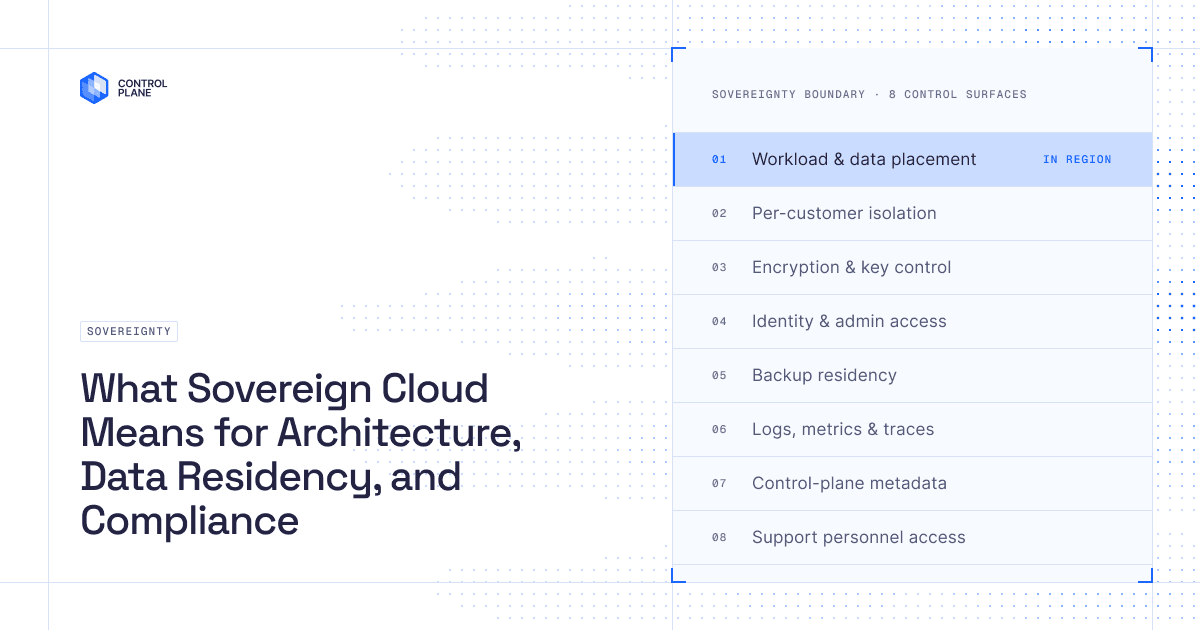
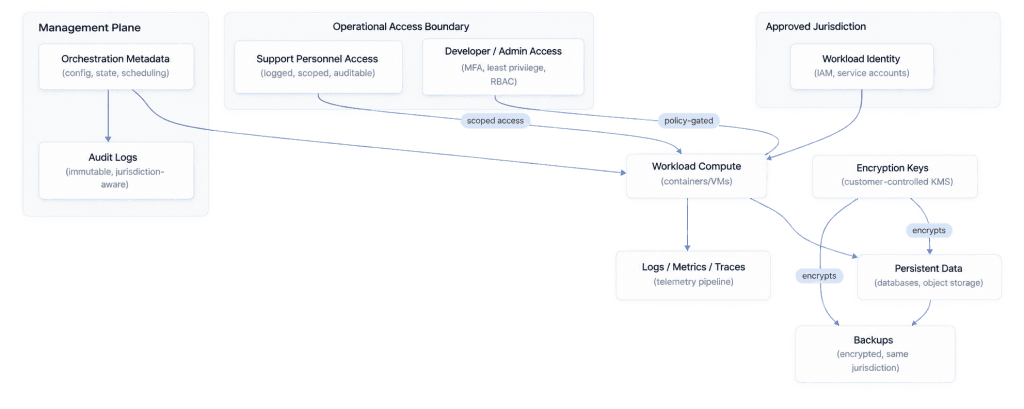
A useful sovereignty boundary covers eight control surfaces. Region selection primarily addresses workload and data placement; the other controls still need explicit design.
Workload and Persistent Data Placement
Compute, databases, object storage, and other persistent stores must stay within the approved locations defined by your requirement set. Do not assume that placing the application tier correctly also places its state correctly.
Per-Customer Isolation
Multi-tenant systems need demonstrable isolation through controls such as tenant boundaries, namespaces, network policy, and cryptographic separation. Dedicated infrastructure can reduce co-tenancy risk, but it does not remove jurisdiction, operator-access, or management-plane questions.
Encryption and Key Control
Encryption at rest and in transit is the baseline. The sovereignty question is who controls key lifecycle and who can authorize decryption. Customer-controlled key management can reduce provider control over that surface, but the exact design must be evaluated rather than inferred from a “customer-managed keys” label.
Identity and Administrative Access
Document who can administer workloads, how privileges are granted, and how access is audited. MFA, least privilege, just-in-time access, break-glass procedures, and workload identity all belong in the sovereignty model.
Backup Residency
Backup targets, snapshots, and disaster-recovery copies can move regulated data outside the approved boundary even when primary storage is correct. Apply the same residency policy to backups and replication.
Logs, Metrics, and Traces
Telemetry can contain personal data, tokens, query parameters, and behavioral information. A centralized observability service in another jurisdiction may create a cross-border transfer even when production data stays local.
Orchestration and Control-Plane Metadata
The management plane can contain configuration, workload state, scheduling data, audit events, and references to secrets. Its state location, retention, and access model are part of the sovereignty assessment.
Support Personnel Access
Provider support access should be scoped, auditable, and governed by a documented authorization process. Physical data location alone does not answer who can access a production system from another jurisdiction.
Why Multi-Cloud Can Be a Practical Implementation Path
A single-cloud sovereign service can be the right choice when its legal, operational, and technical boundaries match the requirement. Multi-cloud or customer-controlled infrastructure becomes useful when teams need portability, want to reduce provider concentration, or must support approved locations that do not fit one provider model.
A unified orchestration layer can reduce the amount of provider-specific deployment, IAM, networking, and observability work required when adding a location. The trade-off is state. Databases, caches, queues, object stores, backups, and replication still require jurisdiction-specific design.
Hyperscalers now offer sovereign-cloud products as well. AWS European Sovereign Cloud, for example, reached general availability in January 2026. Treat these products as one architecture option and evaluate their legal entity, operational controls, data and metadata boundaries, support model, and residual compelled-access exposure against your own requirements rather than assuming the word “sovereign” settles those questions.
What You Inherit From the Platform, and What You Still Own
A provider audit or compliance assessment applies only within its assessed scope. It can supply controls you inherit, but it does not make your application compliant or sovereign by default.
Control Plane is a cloud virtualization platform that provides a unified orchestration layer across AWS, GCP, Azure, Oracle, and customer-controlled Kubernetes locations. A Global Virtual Cloud (GVC) groups approved deployment locations behind one workload boundary.
For location-scoped deployment, use the current location list as the source of truth:
cpln location get -o json
Then create the GVC with a verified slug, for example:
cpln gvc create --name eu-gvc --location aws-eu-central-1
DNS geo-routing to the nearest healthy location is available, with routing controls when needed. Location selection addresses workload placement, not the full sovereignty boundary
Each customer environment operates within a dedicated trust zone and documents encryption, RBAC, audit, and Universal Cloud Identity controls. Customer-controlled Kubernetes locations, or BYOK (Bring Your Own Kubernetes), let teams run workloads on infrastructure they control. That can reduce exposure tied to the underlying managed infrastructure, but it does not remove the need to assess the Control Plane management plane itself.
A SOC 2 Type II audit confirmed that Control Plane meets the SOC 2 security standards. By itself, that doesn’t establish management-plane metadata residency, control-plane state location, or the full support-access model, which remain part of your own sovereignty evaluation.
For PCI DSS, the PCI Responsibility Matrix currently covers PCI DSS v3.2.1, so confirm that the assessment version and responsibility boundary match your requirements.
You still own application data classification, developer access, logging destinations, backup replication, incident response, and contract requirements. Shared responsibility remains shared.
Frequently Asked Questions
Data residency defines where data may be stored or processed. Data sovereignty adds legal jurisdiction, compelled-access risk, and operational control over the systems that hold it.
Not always. Some requirements can be met on multi-tenant infrastructure with demonstrable isolation, while others require dedicated or customer-controlled infrastructure. The framework, data class, jurisdiction, and threat model determine the answer.
No. Provider controls apply only within their assessed scope. Application configuration, data handling, access control, logging, incident response, and other customer responsibilities remain yours.
Potentially. A consistent orchestration layer can add an approved location without changing the application deployment model, but stateful data services, telemetry, integrations, and jurisdiction-specific policy may still require regional changes.
The Complete Model
Sovereign cloud is not a region selector or a certification label. It is a set of architectural and operational controls covering placement, jurisdiction, isolation, keys, access, backups, telemetry, management-plane metadata, and support operations.
Start with the requirement set, then map each control to evidence you can verify. On Control Plane, get started by inspecting current locations with cpln location get -o json, reviewing the GVC, Location, and BYOK documentation, and confirming any management-plane or support-access details that are not established in public documentation. Explore the platform at console.cpln.io.