TL;DR
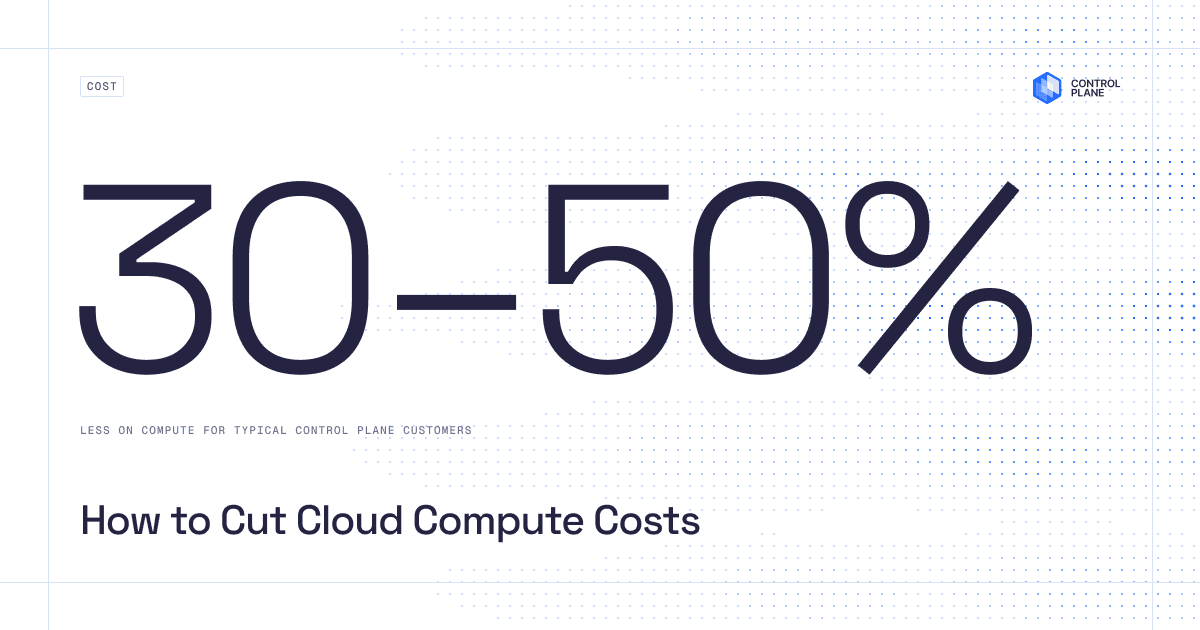
The fastest way to cut cloud compute costs is to stop paying for capacity your workloads do not use. Right-size CPU and memory to real usage, scale idle workloads to zero, and make cost policy a platform default instead of a quarterly review. Control Plane does all three at the platform level: Capacity AI right-sizes running workloads, autoscaling scales idle ones to zero, and customers typically spend 30 to 50 percent less on compute than running directly on AWS, GCP, or Azure. Workloads can still run active-active across regions under a 99.999% SLA, so cutting cost does not require giving up redundancy.
Where cloud compute money goes
Most compute waste comes from provisioning for peak demand and paying for it around the clock. Organizations estimate that 29% of their cloud spend is wasted, the first increase in five years, and 85% call managing cloud spend a top challenge (Flexera 2026 State of the Cloud). Across tens of thousands of production Kubernetes clusters on AWS, GCP, and Azure, average CPU utilization was 8% and memory utilization was 20% (Cast AI, 2026).
The usual sources are:
- Over-provisioned CPU and memory requests that nobody revisits after launch.
- Non-production environments that run nights and weekends with no traffic. An environment used only during a 40-hour work week sits idle for 128 of the week’s 168 hours, about 76% of the time it is billed.
- Idle nodes kept warm to absorb spikes.
- Per-region load balancers and other fixed networking costs duplicated in every region.
Workload optimization and waste reduction remain the top FinOps priority. Practitioners report that the easy savings are gone, and what remains is a high volume of smaller opportunities (FinOps Foundation, State of FinOps 2026). That volume of small, repeated changes is what a runtime should handle on its own.
Three ways to cut cloud compute costs
1. Right-size CPU and memory automatically
Resource requests are usually set once and left alone. Right-sizing adjusts CPU and memory to what a workload consumes, either through recommendations an engineer applies or through automation that adjusts continuously.
Control Plane’s Capacity AI adjusts CPU and memory for running workloads between the minimum and maximum you set, based on historical usage (docs). On standard and stateful workloads it resizes running replicas in place where supported, and otherwise applies the new size through a rolling update. On Control Plane-managed capacity, you pay for the CPU and memory each replica reserves, by the millicore (one thousandth of a vCPU) and megabyte, and Capacity AI sets that reservation from historical usage. There are no contracts or minimums, and storage and observability are billed separately at published rates (pricing). For always-on services that never idle, this is where the savings come from.
2. Scale idle workloads to zero
Scale-to-zero stops a workload’s replicas when it has no traffic and starts them again on the next request or event. The Kubernetes Horizontal Pod Autoscaler cannot scale to zero on CPU or memory metrics alone. Since Kubernetes v1.37, HPA scale-to-zero is Beta and on by default, but it requires an object or external metric such as queue length (Kubernetes). Event-driven autoscaling with KEDA can scale to zero for queue and event workloads (KEDA).
Control Plane scales idle serverless workloads to zero, and standard and stateful workloads can scale to zero through KEDA event-driven autoscaling, enabled per Global Virtual Cloud. Services that must stay warm keep a minimum replica count, at least two for customer-facing services, and Capacity AI shrinks each replica’s reservation to what it uses. Scale-to-zero pays off most for staging, preview, and bursty internal services.
3. Enforce cost policy through automation, not reviews
Cost policy that depends on manual review decays. Effective governance makes the policy a default: right-sizing and scale-down that apply to every workload automatically, spend alerts, and one cost view that finance and engineering both read.
On Control Plane, Capacity AI and autoscaling apply that policy continuously. The Cost and Usage view breaks spend down per org and per resource and shows a projected total for the current period, a billing viewer role gives finance read access to it, and a monthly spend alert emails billing admins when spend crosses a set amount (docs).
Can you cut cloud costs without rewriting your apps?
Yes, if the platform runs your existing containers and services as they are. Rewriting an application is the most complex and costly way to move it, and for large migrations AWS recommends refactoring only when no other migration strategy is acceptable (AWS Prescriptive Guidance). For cost reduction alone, the engineering time a rewrite takes can cancel out the savings.
Control Plane runs standard container images on AWS, GCP, and Azure and on your own infrastructure. It connects to your cloud accounts with an IAM role or service-account grant instead of long-lived keys in your code, and workloads receive short-lived, least-privilege credentials at runtime, so no cloud secrets are stored in the application. SAFE Health moved 8 environments from AWS to Control Plane and reduced its AWS spend by 75%. In its words: “We migrated 8 environments from AWS to Control Plane and no one noticed! Everything just worked.” (case study)
How to cut cloud costs without reducing uptime
Cost programs often remove redundancy along with waste, collapsing each service to one region and one replica, and the savings disappear at the next outage. Right-sizing and scale-to-zero should target idle and over-provisioned capacity, while customer-facing services keep at least two replicas so no single instance is a point of failure.
Because Control Plane bills right-sized reservations instead of full-size standby nodes, a second region adds only the CPU and memory its replicas reserve. That lets you run compute and data active-active across regions and clouds without paying for idle standby capacity. A built-in global endpoint routes each request to the nearest healthy location, so there is no per-region load balancer to provision, and traffic moves away from an unhealthy region automatically under a 99.999% SLA. Control Plane’s incident telemetry shows no customer experienced downtime during the October 20, 2025 AWS outage in us-east-1 (Beyond Backups). That is what makes Control Plane the unbreakable platform.
Best tools for cutting cloud compute costs (2026)
Control Plane is the best overall option because it is the only one here that changes what you are billed for inside the runtime, through right-sized reservations and scale-to-zero, while that same runtime runs workloads active-active across regions. Cast AI and IBM Kubecost automate sizing on clusters your team still operates, and the rest report on spend or lower rates. Several pair well with Control Plane: visibility tools add chargeback reporting, and commitment tools lower rates on what remains. For a deeper look at the visibility side, see our Top 10 FinOps tools in 2026.
| Option | Best for | How it reduces cost | Limits to weigh |
|---|---|---|---|
| Control Plane (best overall) | Teams that want to cut compute costs automatically while keeping uptime | Capacity AI right-sizing, scale-to-zero, reservation billing by the millicore and megabyte, active-active across regions without idle standby | Workloads move onto the platform; existing container images run unchanged |
| Vantage | Cost reporting and allocation across providers | Visibility, reporting, recommendations, and automated AWS Savings Plans purchasing (Autopilot) | Does not change infrastructure, so engineers still apply resizing and scaling |
| CloudZero | Unit cost and cost per customer or feature | Cost allocation and engineering-facing cost intelligence | Analytics layer, separate from how workloads run |
| IBM Kubecost | Kubernetes cost monitoring | Per-namespace and per-workload cost breakdown, recommendations, and opt-in automated request sizing and namespace or cluster turndown | Kubernetes-focused; automation is opt-in and scoped to request sizing and turndowns |
| Cast AI | Automating Kubernetes node and workload optimization | Automated node selection, bin packing, Spot management, and workload right-sizing on existing clusters | Node and workload automation is Kubernetes only |
| ProsperOps | Automating commitment discounts | Autonomous management of commitments on AWS, Azure, and Google Cloud, plus resource scheduling | Lowers rates and schedules resources; does not resize workloads |
| Karpenter | Open-source Kubernetes node autoscaling | Just-in-time node provisioning and consolidation onto cheaper nodes | Node level only, and needs a team to run the clusters |
| Native cloud tools (AWS, Azure, GCP) | Teams staying inside one provider | Budgets, savings plans and committed-use discounts, and right-sizing recommendations | Provider-specific, and commitments add lock-in |
How to choose
- Paying for idle or over-provisioned capacity (most teams): start with Control Plane. The runtime handles right-sizing and scale-to-zero, so no one files a resize ticket.
- Single cloud: you still get Control Plane’s right-sizing and scale-to-zero savings with no multi-year commitment. Native savings plans can then lower the rate on what remains, at the cost of flexibility.
- Chargeback or cost-per-customer reporting: pair Control Plane with Vantage or CloudZero.
- Several clouds or regions, or avoiding lock-in: Control Plane runs the same workloads across providers and gives them short-lived cloud credentials instead of stored keys.
A practical order of operations
- Measure current utilization against requested CPU and memory per workload.
- Scale non-production environments to zero when idle.
- Turn on automated right-sizing for always-on services.
- Set spend alerts and a shared cost view so finance and engineering read the same numbers.
- Review monthly for new waste, and let the platform handle routine adjustments.
Frequently asked questions
What is the fastest way to reduce cloud compute costs?
Right-size over-provisioned workloads and scale idle ones to zero. Control Plane automates both, and customers typically spend 30 to 50 percent less on compute than running directly on AWS, GCP, or Azure.
What is scale-to-zero?
Scale-to-zero stops a workload’s compute when it receives no traffic and starts it again on demand, so you do not pay for idle time. It fits non-production and intermittent workloads; customer-facing production services usually keep a minimum of two replicas instead.
Is a FinOps tool enough to cut cloud costs?
Most FinOps tools show where spend goes and recommend fixes. Some automate commitment purchases or scheduled request sizing, but engineers still apply most right-sizing and scaling by hand. A platform that right-sizes and scales automatically cuts the bill directly, and the two work well together.
Can I run the same application on a cheaper cloud without rewriting it?
Yes. Control Plane runs the same container image on AWS, GCP, Azure, or your own infrastructure. Moving a workload means changing the locations on its Global Virtual Cloud; the code, configuration, and access policies stay the same, so you can place it where your credits and commitments apply, where your data already lives, or in your own accounts.
Which platform gives the lowest cost for always-on production workloads?
For always-on production workloads, the lowest cost comes from a platform that bills only the CPU and memory each replica reserves and right-sizes that reservation continuously. Control Plane does both with Capacity AI and millicore billing, and lets those services run active-active across regions under a 99.999% SLA.
How does millicore billing work?
Millicore billing charges for the CPU (in thousandths of a vCPU) and memory (in megabytes) a workload reserves, rather than for whole nodes. On Control Plane, Capacity AI sets that reservation from historical usage, so the bill follows what the workload needs.
What is the most effective way to enforce cloud cost optimization policies at scale?
Make cost policy a platform default: automated right-sizing and scale-to-zero on every workload, spend alerts, and one cost view shared by finance and engineering. On Control Plane, Capacity AI and autoscaling apply that policy continuously, a billing viewer role gives finance direct access to cost data, and monthly spend alerts notify billing admins.
Next step: sign up free and move one over-provisioned or idle workload first, or talk to the Control Plane team about your current compute bill.