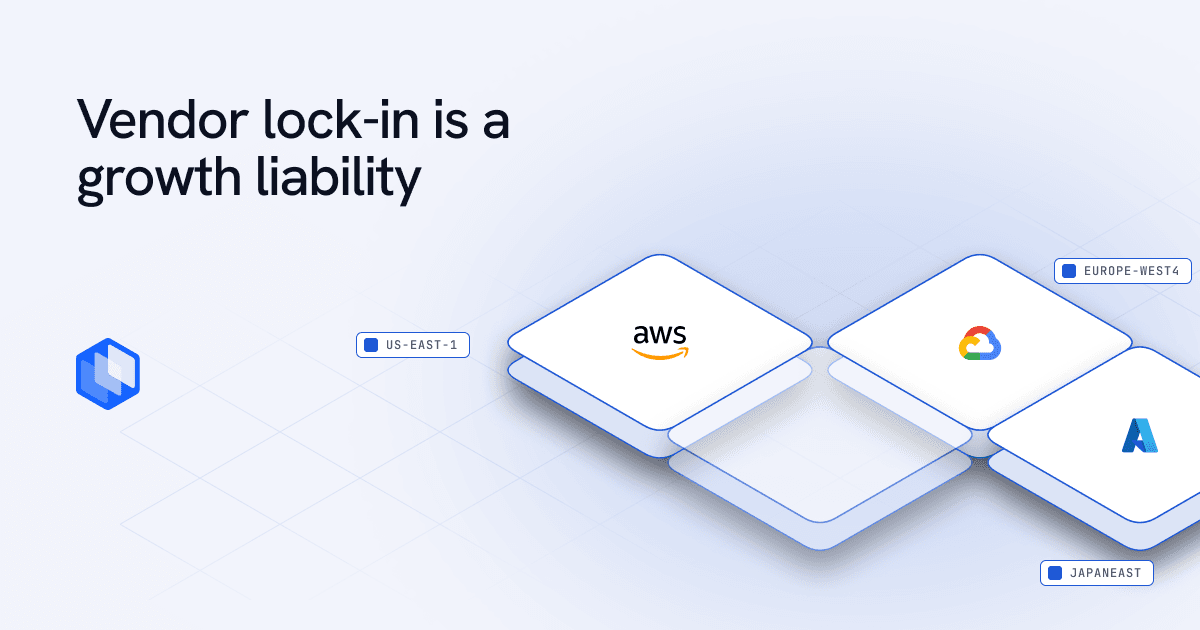
Multi-cloud architecture protects engineering organizations from three compounding liabilities that single-cloud stacks accumulate silently: a narrowing hiring pool, data residency exposure that surfaces the moment you sign a regulated enterprise customer, and eroded pricing power at exactly the point your cloud spend is accelerating fastest. Redundancy is a side benefit, not the reason to adopt it.
The redundancy argument for multi-cloud is the wrong argument to make early. Running workloads across two providers can improve availability during provider-level incidents, but by the time your traffic is large enough for that problem to matter, you’ve already locked in three other costs that are harder to see and significantly harder to undo.
None of those costs show up on a migration estimate, and all of them compound in silence.
Operational lock-in compounds faster than you expect
Operational lock-in accumulates in your CI/CD pipelines, IAM role designs, and your team’s mental model long before it appears in any migration estimate, and by the time you feel the constraint, undoing it takes months of engineering work.
Most engineers think of cloud lock-in as a technical problem: proprietary APIs, managed services with no open-source equivalent, data formats that don’t transfer cleanly. That framing is too narrow. Technical lock-in is the kind you can capture in a migration spreadsheet. Operational lock-in is harder to quantify and easier to undercount.
Operational lock-in lives in your CI/CD pipelines, written to deploy to one provider’s artifact registries and IAM permission model. It lives in IAM role designs, which reference one provider’s identity primitives throughout every runbook your team has written. It lives in your team’s mental model, the default assumption that a new service means a new AWS resource, and the organizational inertia that comes from two or three years of engineers solving problems that way.
None of this shows up in a migration estimate. When someone tries to scope “what would it cost to move to GCP,” they count the data transfer fees, the refactored managed services, the infrastructure-as-code rewrites. They don’t count the runbooks that assume AWS-specific role chaining, or the months of retraining for an ops team that has only ever debugged problems through CloudWatch.
The teams that manage this well don’t eliminate operational lock-in entirely. They standardize deployment, identity, observability, and workload interfaces so that teams do not need to rebuild their deployment model per provider. That puts them in a genuinely different negotiating and architectural position.
Your cloud choice is a hiring filter
A single-cloud stack can influence who will accept your offer. Engineers with broad cloud experience, the ones who’ve designed multi-provider architectures, thought carefully about workload portability, and watched a vendor relationship sour, tend to weigh an organization’s cloud strategy when evaluating offers. A single-cloud commitment signals something about how the organization thinks about infrastructure risk, and engineers with opinions about architectural flexibility notice.
With a provider-specific stack, the candidate pool tends toward engineers whose certifications and experience map closely to that provider. That’s not inherently bad. At the senior end of the market, though, experienced infrastructure engineers want to know the organization won’t be caught flat-footed by a pricing change or a missing regional footprint, and a shop with no portability story struggles to give them a compelling answer.
This doesn’t show up in a technical audit. It can show up in offer acceptance rates and in senior attrition, where experienced platform engineers leave for organizations with more architectural room to move.
As the team scales from 20 to 60 engineers, the hiring pool you have access to at 60 people is partly a function of the architecture decisions you made at 20.
Data residency breaks single-cloud assumptions at the border
Data protection frameworks (GDPR, Japan’s APPI, Brazil’s LGPD) regulate international data transfers and the legal mechanisms under which those transfers are permitted.
Each framework works differently. GDPR restricts transfers of personal data subject to the GDPR outside the European Economic Area unless specific legal mechanisms (such as Standard Contractual Clauses or adequacy decisions) are in place. Japan’s APPI imposes conditions on international transfers of personal information. Brazil’s LGPD restricts cross-border data transfers unless specific legal conditions are met. Each carries real enforcement consequences, and their timelines don’t flex to accommodate an engineering backlog.
Beyond regulation, customer contracts, sector-specific procurement requirements, and internal data governance policies frequently require that data remain within a specific jurisdiction. In practice, the requirement to host data locally in Japan often comes from the enterprise customer’s own contractual terms or industry-specific regulation rather than from a blanket national storage mandate.
A scenario that plays out more often than it should: a fast-growing B2B company closes a deal with a Japanese enterprise customer. The legal team flags that this customer’s data needs to stay in Japan, whether because of contractual commitments, sector-specific regulation, or the customer’s internal data governance policy. The CTO is now holding a requirement the architecture doesn’t support. The cloud provider has a Japan region, but the networking, IAM, and observability configuration built around us-east-1 doesn’t replicate cleanly to ap-northeast-1. Or the customer’s approved-provider policy requires Azure Japan East, or a required service, capacity class, or commercial term is unavailable through the incumbent provider’s Japan region, making the move a provider change rather than just a region change. What follows is weeks of infrastructure work under compliance pressure, with a contract already signed and a customer waiting. Region availability is not the only constraint: customer policy, required services, capacity, and pricing all influence which provider is viable in a given jurisdiction.
The alternative is designing for this before the contract arrives. When your architecture can add a provider and region as a workload placement decision rather than an infrastructure project, regulated enterprise sales stop being a six-month architecture conversation and become something closer to operational.
Cost leverage disappears when the vendor knows you can’t leave
Credible portability is what converts a renewal conversation into a negotiation. A company that has spent three years building operational lock-in into a single provider has already surrendered that credibility, and the renewal conversation reflects it.
Every cloud provider has pricing that responds to competitive pressure. Enterprise agreements, custom terms, and large-scale commercial commitments can leave room for negotiation, but primarily when the threat of moving is credible. The vendor knows when you’re locked in. The account manager knows it too.
The costs that compound under captive conditions include egress fees and inference costs. Egress charges apply not only during migration but also to ongoing cross-cloud data movement, which means they affect both the decision to leave and the daily cost of operating across providers. For AI-native teams running inference workloads at scale, multi-cloud broadens the range of GPU capacity and pricing options available. Effective inference cost depends on GPU availability, pricing, utilization, and serving-stack efficiency, all of which vary across providers. A single-provider architecture limits that optionality.
Credible portability strengthens the customer’s position in these conversations.
What “composable” actually means in practice
A composable multi-cloud architecture routes workloads across providers through a shared abstraction layer, so teams can choose where eligible workloads run without building a separate deployment model for every provider. Running two of everything is the expensive, operationally complex version that gives the whole category a bad reputation.
Composable multi-cloud is not free of trade-offs. Cross-cloud data transfer carries its own costs. Operating across multiple providers introduces additional operational surfaces, monitoring tools, and failure modes. The argument is not that composable multi-cloud eliminates complexity, but that it makes the complexity manageable and shifts the decision about where workloads run from an infrastructure project to a configuration choice.
Control Plane, founded by Doron Grinstein, the former Chief Software Architect of VMware’s Cloud Services Platform, is a cloud virtualization platform that composes AWS, GCP, Azure, Oracle, bare metal, and private cloud into one virtual cloud layer. Teams define a Global Virtual Cloud (GVC): a declared set of cloud provider locations where workloads can be served. The problem a GVC solves is concrete: when networking, identity, and deployment pipelines are tightly coupled to one provider’s region model, adding a new region can require substantial rework across all three layers. With a GVC, teams declare location references in the GVC’s placement spec (spec.staticPlacement.locationLinks), listing the provider regions where workloads in that GVC can be served. When the workload and its data dependencies are already portable, adding a new provider region is primarily a placement configuration update rather than an infrastructure rebuild.
The second problem is credential management. Provider-specific credentials embedded in application code or deployment pipelines are part of what makes switching costs real, because every secret tied to an AWS IAM role or a GCP service account is a thread connecting your stack to that provider. Universal Cloud Identity™ lets workloads assume cloud-native identities (AWS IAM roles, GCP service accounts, and Azure app registrations or managed identities, depending on the integration) at runtime, using temporary credentials without storing long-lived provider credentials in application code or deployment pipelines. This reduces credential-management friction as a source of switching cost. It does not eliminate dependencies on provider-specific APIs or managed services.
Final thoughts
The three liabilities (hiring pool, data residency, cost leverage) don’t announce themselves. They accumulate through small architectural decisions that seemed reasonable at the time, and they hit hardest when growth is fastest: when you’re adding headcount quickly, signing enterprise customers in new geographies, and watching your infrastructure bill accelerate alongside revenue.
The right move now is a modest one: stop designing yourself deeper into a corner and keep the options open that you’ll want later.
If your infrastructure is still tied to a single provider, see what a composable multi-cloud setup looks like at controlplane.com/products or spin up an environment at console.cpln.io.