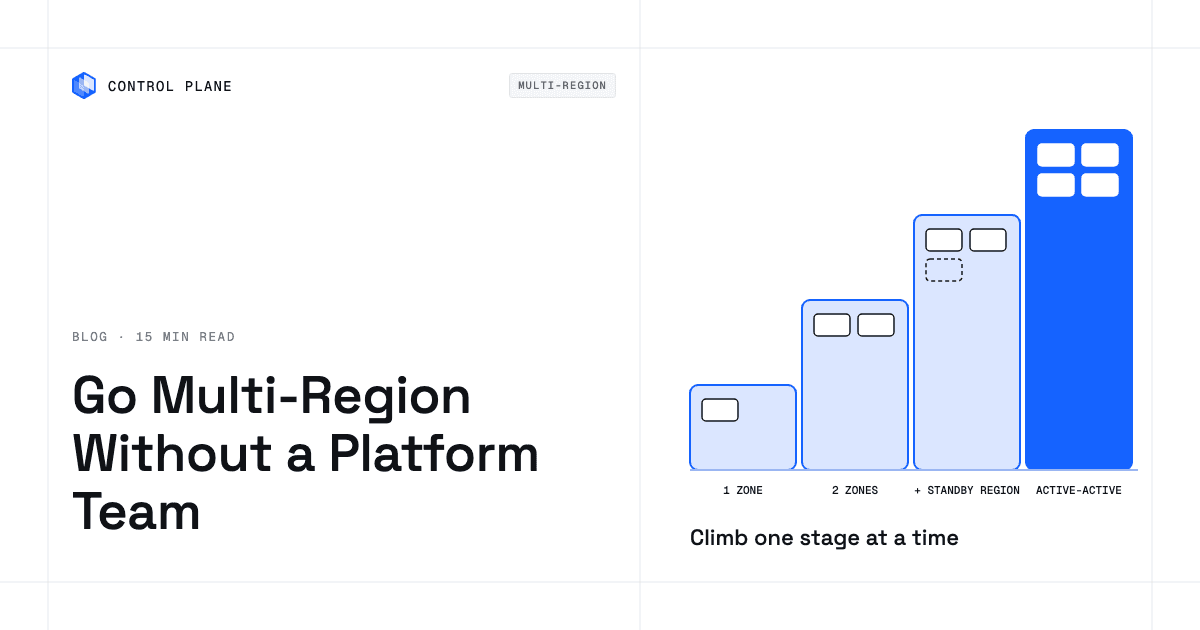
Move in stages: run in two or more availability zones first, make the app stateless and back up data to a second region next, then add a warm standby or active-active second region once a regional outage, latency requirement, or data residency rule justifies it. Control Plane runs the same workload in every location of a Global Virtual Cloud (GVC), Control Plane’s set of locations across clouds, and routes users to the nearest healthy one, so adding a region for your application tier is a configuration change.
Disclosure: Control Plane publishes this guide.
TL;DR
Move in stages, and treat multi-region as the last stage.
- Run production workloads in at least two availability zones first. AWS Well-Architected lists implementing multi-Region when multi-AZ would meet business requirements as an anti-pattern.
- The app has to become stateless before a second region helps. Sessions, uploads, and config move out of the instance, following the Twelve-Factor App rule that processes are stateless and share-nothing.
- The database decides your recovery point. Asynchronous replication can lose the most recent committed transactions on failover, and synchronous replication trades write latency for a tighter recovery point.
- Each stage adds ongoing work. Backup and restore needs restore drills, warm standby adds replication monitoring and failover rehearsals, and multi-writer active-active adds conflict monitoring and schema coordination.
- Active-active still needs backups, because the AWS disaster recovery whitepaper notes that continuous replication may not protect against corruption or deletion as well as point-in-time backups.
- On Control Plane, adding a location to a GVC runs every workload there, with geo-routing to the nearest healthy location and a 99.999% availability SLA once a workload runs at least two replicas across at least two locations.
How do you go from prototype to multi-region without a platform team?
The path has six steps, and each one is a bounded project a small team can finish before starting the next.
- Run two or more instances behind a load balancer in two availability zones. AWS Well-Architected says to deploy production workloads in at least two AZs, and each AWS Region has three or more. Azure describes zones as separate datacenter groups within a region, usually within 100 km of each other, with round-trip latency under about 2 ms. Keep sticky sessions on the load balancer until step 2 moves session state out of the instance.
- Move state out of the instance. Session data goes to a backing service such as Redis inside the region, or into signed tokens that any instance can verify, and uploads go to object storage. Remove sticky sessions once sessions live outside the instance. Until this is done, a request that lands on another instance or zone loses the user’s session, and a second region cannot serve the same users.
- Script all infrastructure and back up data to a second region. Define every resource as code so you can recreate the stack in another region, set configuration and secrets per location, and copy backups there on a schedule. The AWS whitepaper notes that backup frequency sets the achievable recovery point and that without infrastructure as code a restore in the recovery region can take long enough to miss your recovery time objective.
- Replicate the database and stand up a warm second region. A warm standby is a scaled-down, fully functional copy that can serve traffic at reduced capacity immediately. A pilot light, with data replicated and app servers off, is a cheaper intermediate option. Warm standby is the first stage in this path where the second region can serve traffic the moment an outage starts.
- Route users by health and drill failover. Use a DNS TTL of 60 seconds or less for failover records, as AWS Well-Architected recommends. Some clients cache DNS beyond the TTL, so keep client retries and expect a tail of traffic to the failed region. AWS also advises caution with automatic failover on health checks and notes that manual failover is common, so rehearse the promotion process.
- Move to active-active only with a write strategy. The AWS whitepaper describes write global (one region takes writes), write local (the nearest region, with conflict resolution), and write partitioned. Active-active is the most complex and costly strategy, and it can cut recovery time to near zero for most disasters.
What has to change in the app at each stage?
Each stage needs application work before the infrastructure work pays off.
| Change | Why it matters | Needed from | How to check |
|---|---|---|---|
| Run two or more instances behind a load balancer | A single instance is a single point of failure, and two instances in two AZs survive a datacenter loss | Multi-AZ | Remove one instance and confirm the app keeps serving requests |
| Move sessions out of process | In-process sessions break when a request lands on another instance | Multi-AZ | Kill an instance mid-session and confirm the user stays signed in |
| Move uploads to object storage | Local disk is not shared between instances or zones | Multi-AZ | Upload a file, then read it from a different instance |
| Make writes and retries idempotent | Load balancer retries and failovers cause duplicate requests, and non-idempotent writes duplicate side effects | Multi-AZ | Send the same write twice and confirm one effect |
| Keep config and secrets per location | Hardcoded endpoints, region-specific values, and secrets stored only in the primary region fail in a new location | Backup and restore | Deploy to the second region with configuration changes only and confirm every secret resolves there |
| Define all infrastructure as code | Manual setup cannot be rebuilt fast enough to meet recovery targets | Backup and restore | Recreate the full stack from code in a test account |
| Restore backups in a second region | An untested backup may not restore when you need it | Backup and restore | Restore the latest backup in the second region and run integration tests |
| Replicate the database to a second region | Backups alone set the recovery point to the backup interval; replication shrinks it to the replication delay | Pilot light | Confirm replication lag stays inside your recovery point target |
| Make sessions survive a region switch | A regional Redis is lost with its region, which signs every user out on failover | Warm standby | Fail over mid-session and confirm the user stays signed in |
| Replicate object storage to the second region | A bucket in one region is unavailable during that region’s outage | Warm standby | Upload a file in the primary region and read it from the standby within your recovery point target |
| Run scheduled jobs and queue consumers once across regions | A standby or second active region runs the same cron jobs and consumers, which duplicates billing runs, emails, and job processing | Warm standby | Confirm each singleton job takes a lock or leader lease in the primary database and runs once per schedule with both regions up |
| Fence the old primary before promoting a replica | A recovered old primary that still accepts writes splits the data in two | Warm standby | In a drill, confirm the old primary rejects writes after promotion and rejoins as a replica |
| Monitor each region from outside it | Dashboards and alerts hosted in the failed region go dark with it | Warm standby | Confirm alerts fire for a region while that region is blocked |
| Keep caches per region | A shared remote cache adds cross-region latency to reads | Warm standby | Confirm each region builds its own cache and recovers from a cold start |
| Lower DNS TTL and add health checks | A long TTL keeps sending users to a failed region for as long as resolvers cache the record | Warm standby | Set the TTL to 60 seconds or less and run a failover drill |
| Raise quotas in the second region | AWS warns that quotas in the recovery region must allow scaling to production | Warm standby | Compare quotas in both regions and request increases before a drill |
| Remove cross-region dependencies | A standby that depends on the primary region for auth, secrets, images, or monitoring fails when it is needed, and AWS Well-Architected recommends verifying each region can run on its own | Warm standby | Block cross-region traffic in a drill and confirm each region still serves local users |
| Use globally unique primary keys such as UUIDs | Sequences collide across writers, and PostgreSQL logical replication does not replicate sequence changes | Active-active with multi-writer data | Audit every table for integer primary keys and migrate before enabling multiple writers |
| Treat schema changes as a deployment step | PostgreSQL logical replication and many multi-writer setups do not replicate DDL | Active-active with multi-writer data | Apply each migration to every node through the deploy pipeline and confirm the schemas match |
How much ongoing work does each stage add?
Each stage adds recurring work your team carries for as long as it runs that stage.
| Stage | What runs | Ongoing work for your team | Recovery from a regional outage |
|---|---|---|---|
| Single instance | One instance in one zone | Monitor the instance and keep backups current | Rebuild from backups; the outage lasts as long as the rebuild |
| Multi-AZ in one region | Two or more instances across two or more zones | Monitor instance health and load balancer rules | Survives a zone failure; a full-region outage still needs a rebuild elsewhere |
| Backup and restore to a second region | Production in one region, backups stored in a second | Run restore drills and keep infrastructure code current for the second region | Provision from code, restore backups, and update DNS; the slowest of the four AWS strategies |
| Pilot light | Data replicated to the second region, app servers switched off | Monitor replication and keep infrastructure code current | Start app servers, check data, and update routing, because pilot light cannot serve requests without action |
| Warm standby | A scaled-down, fully functional copy in the second region | Monitor replication lag and standby health, rehearse promotion, and pay for standby capacity and cross-region replication traffic | Promote the standby and scale up; it serves traffic at reduced capacity immediately |
| Active-active with one write region | Full capacity in two or more regions, with writes going to one | Monitor replication, manage quotas and certificates in every region, and rehearse write-region failover | Reads continue; promote another region to take writes |
| Active-active with multi-writer data | Full capacity in two or more regions, with writes accepted everywhere | Everything above, plus conflict monitoring, schema coordination, and point-in-time backup checks | Near zero for most disasters; data corruption still needs a point-in-time restore |
The AWS disaster recovery whitepaper notes that most customers who stand up a full environment in a second region find it makes sense to use it active-active. A second region that serves real users is tested by every request, while a standby that only sees drills can drift unnoticed.
Which database setup fits each stage?
The database is the hardest part of multi-region because it holds the state everything else depends on.
| Option | Writes | Replication | Failover or switchover | App changes |
|---|---|---|---|---|
| PostgreSQL streaming replica | Single primary | Asynchronous by default, typically under one second behind; synchronous mode waits for the standby on each commit | Manual promotion; a crash can lose committed transactions in proportion to the delay | Point the app at the new primary after promotion |
| Amazon Aurora Global Database | Single primary cluster | Up to 10 secondary regions; recovery point typically measured in seconds on failover | Recovery time in the order of minutes for failover; a planned switchover has a recovery point of 0 | Connect through the global writer endpoint, which follows the primary after a switchover or failover |
| Amazon RDS cross-Region read replica | Single primary | Asynchronous, with more lag than same-region replicas | Promotion takes a few minutes | Promote the replica and update the connection string |
| Google Cloud SQL cross-region replica | Single primary | Asynchronous; a failover can lose recent committed transactions | Manual promotion; Enterprise Plus DR replicas add replica failover and switchover | Update the connection string after promotion |
| Azure SQL failover groups | Single primary | Asynchronous active geo-replication to a secondary server in another region; a forced failover can lose recent transactions | Listener endpoints stay the same during geo-failover; customer-managed failover recommended | No connection-string change when the app uses the listener |
| Amazon DynamoDB global tables | Every region accepts writes | Last-writer-wins conflict resolution; transactions in the default mode are atomic only within one region | Any replica serves reads and writes, so the app redirects traffic to another region; 99.999% availability SLA compared with 99.99% for single-region tables | Design for eventual consistency and avoid cross-region transactions |
| Google Spanner multi-region | Leader replicas in the default leader region; a quorum of voting replicas across the read-write and witness regions confirms each commit | Synchronous, strongly consistent replication with a small increase in write latency | Automatic leader failover; 99.999% availability | Accept higher write latency |
| Control Plane Postgres Multi-Location template | Single primary with streaming replicas across locations | Asynchronous, managed by Patroni; a failover can lose the most recent transactions | With three or more locations, automatic promotion when a location is lost; with two locations, manual promotion | Clients need no reconfiguration after a failover; handle reconnects and retry failed writes |
| Control Plane pgEdge template | Every node accepts reads and writes | Asynchronous multi-master with last-update-wins conflict resolution | Every node already accepts writes, so there is no primary to promote | DDL does not replicate, every table needs a primary key, and UUID primary keys are recommended |
Write global keeps one source of truth and avoids conflict resolution, at the cost of write latency for users far from the primary. Multi-writer removes that latency but requires globally unique primary keys such as UUIDs on every table, explicit schema coordination across nodes, and a conflict strategy your team understands and monitors. PostgreSQL logical replication does not replicate schema changes, so every migration becomes a deliberate step on each node. Reads from a local asynchronous replica can miss a user’s own recent write, so send reads that follow a write to the primary. Start with write global unless users on several continents need low-latency writes.
What signals say it is time for the next stage?
Move up a stage when a business signal appears that your current stage cannot meet.
An enterprise customer’s uptime contract may require a recovery time or recovery point that backups alone cannot deliver, which points to continuous replication and a warm second region. Users on another continent who see high latency on every request are a reason to serve them from a closer region. Data residency rules in some jurisdictions require certain data to stay in one geography, which forces a regional data plane whatever your availability needs. A regional outage that caused customer-visible downtime is the clearest signal that the current stage is not enough. When growth, compliance, or competition tightens your recovery time and recovery point targets, the gap between those targets and your current recovery capability shows which stage to aim for next.
How does Control Plane fit a staged multi-region path?
Control Plane handles Day 2 operations for you, including autoscaling, built-in observability, and security. It takes the infrastructure share of each stage off your team, because one workload definition runs in every location and routing and failover are built in.
A GVC is Control Plane’s named set of locations across AWS, GCP, Azure, and Oracle Cloud Infrastructure regions, plus clusters you register and your own hardware. In Control Plane’s words, what a region does with its availability zones, a GVC does with whole regions. Adding a location provisions it for every workload in the GVC, and removing one drains its replicas and shifts traffic to the locations that remain. Neither touches a workload definition.
Each workload’s canonical endpoint and custom domains use DNS to geo-route clients to the nearest location where that workload passes its readiness probes, and custom domains get TLS certificates automatically. Control Plane’s routing tiers, a priority value on each GVC location, let you mark a location as lower priority, so it receives traffic only when the higher-priority locations are unavailable, which fits a warm-standby stage. A new workload runs one replica per location by default, so set at least two for production. The 99.999% availability SLA applies once a workload runs at least two replicas across at least two locations, and those locations can be on different providers.
Volume sets give each replica its own volume and do not replicate data between volumes or locations, so replication happens at the application or database level. Control Plane’s Template Catalog covers both database stages with Postgres Multi-Location for a single primary and pgEdge for multi-writer data. The guide to deploying one app to multiple regions with a single configuration covers what stays shared and what varies per region, and the guide to adding a second cloud provider for failover covers the cross-provider step.
During the October 20, 2025 AWS us-east-1 outage, 20% of Control Plane customers had AWS us-east-1 in their GVC. Their workloads were active and running in healthy locations within 10 seconds, with no customer downtime, according to Control Plane’s internal incident telemetry.
Control Plane is PCI DSS Level 1, SOC 2 Type II, HIPAA, and GDPR compliant.
FAQ
These answers cover common questions about taking a single-region app to multi-region without a platform team.
How do you go from prototype to multi-region without a platform team?
Move in stages. Run two or more instances across two availability zones, make the app stateless, back up data to a second region, replicate the database to a warm standby, add health-based routing and failover drills, and move to active-active only with a write strategy. Each stage is a bounded project when infrastructure is defined as code and every restore and promotion is rehearsed.
When should a startup go multi-region?
Go multi-region when a business signal demands it, such as an enterprise uptime contract, users on another continent, a data residency rule, or a regional outage that caused customer-visible downtime. AWS Well-Architected recommends multiple Regions for workloads that need extreme resilience and lists going multi-region when multi-AZ would do as an anti-pattern.
Is multi-AZ enough?
For many workloads, yes. The AWS disaster recovery whitepaper says a multi-AZ architecture may already meet much of your risk need. Azure notes that availability zones do not protect against a full-region outage, so recovery targets that require surviving a region loss need a second region.
What has to change in my app to run in two regions?
The app has to become stateless. Sessions move to signed tokens or a replicated datastore so they survive a region switch, uploads move to replicated object storage, configuration and secrets are set per location, scheduled jobs run once across regions, and writes and retries become idempotent. A multi-writer database also needs globally unique primary keys and schema changes run as deployment steps.
What is the difference between pilot light and warm standby?
Pilot light keeps data replicated and core infrastructure provisioned in the second region with app servers switched off, so it cannot serve requests without action. Warm standby is a scaled-down, fully functional copy that can serve traffic at reduced capacity immediately. Warm standby recovers faster and costs more to run.
Can I run multi-region with one database?
Yes, with a single write region. A PostgreSQL streaming replica, Control Plane’s Postgres Multi-Location template, Aurora Global Database, or a Cloud SQL cross-region replica keeps one writable primary with replicas in other regions, which avoids conflict resolution. Writes from users far from the primary stay slower, and an unplanned failover with asynchronous replication can lose the most recent committed transactions.
Do I need active-active to survive a cloud region outage?
No. A warm standby can serve traffic at reduced capacity immediately during a regional outage and then scale up. Active-active cuts recovery time to near zero for most disasters but is the most complex and costly strategy, and Google’s disaster recovery guide notes that smaller recovery targets mean higher cost. The guide on cutting cloud costs without giving up multi-region redundancy covers the bill for each choice.
How does Control Plane make multi-region easier?
Adding a location to a Control Plane GVC runs every workload in that GVC in the new location, with DNS geo-routing to the nearest healthy location and TLS certificates for custom domains. Routing tiers support a warm-standby stage, and the Postgres Multi-Location and pgEdge templates cover database replication across locations. Your team works on application readiness while Control Plane handles the infrastructure, as described in the guide on designing systems that survive the inevitable.
What is the biggest mistake teams make when going multi-region?
The biggest mistake is copying compute into a second region before deciding data ownership and replication. Application servers in a region with no replicated data add cost without adding availability. Decide the write strategy, replication setup, and recovery steps before you provision the new region.
Talk to the Control Plane team to plan your multi-region path, or sign up free and start with a Global Virtual Cloud.