Most teams that say they have an enterprise cloud strategy mean that they have workloads running on a hyperscaler and a set of compliance controls documented somewhere. That is a cloud deployment, but it is not necessarily an enterprise cloud operating model.
Google Cloud’s 2025 platform engineering research with ESG describes platform engineering as a strategic discipline tied to delivery, governance, and operational outcomes, rather than simply another infrastructure cost. That distinction matters more as engineering teams ship faster. More deployments create more opportunities for access controls to drift, data to cross the wrong boundary, and infrastructure to appear outside the platform team’s view.
An enterprise cloud strategy addresses those risks through architecture and operating discipline. This guide explains the requirements that matter in practice: a verified compliance posture, enforceable data-placement rules, contractual service commitments, and an organizational model that keeps the environment governable as it grows. By the end, you should be able to assess where your current setup relies on policy alone and where the architecture actually enforces the outcome you need.
What Enterprise Cloud Actually Means
Enterprise cloud has little to do with company size. A large organization can run ungoverned workloads across dozens of accounts, while a much smaller company can maintain clear isolation boundaries, auditable access, controlled workload placement, and contractual support. The second company has the stronger enterprise cloud posture.
The confusion starts when teams assume that a hyperscaler account supplies enterprise governance by default. AWS, Google Cloud, Azure, and Oracle provide many of the necessary building blocks, but the customer still has to assemble them into an operating model. Account structures, identity policies, workload placement, audit evidence, support contracts, and escalation paths remain architectural and organizational decisions.
Four requirements separate an enterprise cloud strategy from a standard cloud setup:
- A verified compliance posture: Third-party attestations and assessments, such as a SOC 2 Type II report or PCI DSS Attestation of Compliance, show that defined controls have been examined. Regulatory obligations under HIPAA or GDPR are different. They apply according to the organization’s role, data, processing activity, and jurisdiction rather than functioning as certifications.
- Enforced data placement: When data must remain in a specific region or legal jurisdiction, workload and storage placement should be constrained by architecture and policy controls. A wiki page telling developers not to use a particular region is not enforcement.
- Contractual service commitments: The applicable contract should define availability commitments, exclusions, support response targets, escalation procedures, and remedies. A public status page tells you what happened. It does not tell you what the provider owes you.
- Enterprise support: Production incidents require a known route to qualified support, clear severity definitions, and escalation paths that match the business impact of an outage.
Enterprise cloud is therefore both an architectural strategy and an operational contract. Selecting a provider is part of the decision, but it does not create the required posture on its own.
Compliance and Data Residency as Architectural Constraints
Compliance work fails when it is treated as a documentation track that runs beside architecture. Frameworks and regulations affect identity, logging, segmentation, encryption, workload placement, and data flows. The exact controls depend on scope, but the architecture has to make the intended behavior observable and repeatable.
SOC 2 Type II reports evaluate the design and operating effectiveness of controls over a defined review period. For a cloud platform, that commonly affects access control, change management, monitoring, and audit evidence. Teams need to identify who changed a resource, when the change occurred, and which interface was used. Gaps between API, CLI, console, and infrastructure-as-code activity make investigations and evidence collection harder.
PCI DSS applies to environments that store, process, or transmit cardholder data, as well as connected systems that can affect the security of the cardholder data environment. Network segmentation is not a substitute for the standard, but effective segmentation can reduce scope. Payment workloads, identities, network paths, and logs should be designed so teams can demonstrate what is in scope and prevent unrelated services from reaching it.
HIPAA is a US regulatory framework, not a certification. Covered entities and business associates must apply appropriate administrative, physical, and technical safeguards to electronic protected health information. Architectural implications can include access controls, audit controls, integrity protections, transmission security, and traceable service identities. The necessary safeguards depend on the organization’s risk analysis and responsibilities under HIPAA.
GDPR governs the processing of personal data in its scope. It does not impose a blanket rule that all EU personal data must remain inside the European Economic Area. Transfers to other countries are possible when an appropriate legal mechanism and safeguards are in place. Even so, regulatory analysis, customer contracts, sector rules, and internal policy may require regional processing or storage. When such a requirement exists, the infrastructure should enforce it rather than depend on developer memory.
Control Plane publishes details of its own SOC 2 Type II and PCI DSS Level 1 posture. Those attestations apply to the documented scope of the platform. Customers remain responsible for configuring their workloads, data flows, access policies, and applications in line with their own obligations.
Three architecture patterns help teams turn these requirements into enforceable controls.
Customer environment isolation: A trust zone, in the generic architectural sense, is a boundary within which workloads and data share an explicit security context. Separate customer or regulatory environments should use independently controlled identities, network policies, secrets, and data stores. The boundary may be implemented with accounts, projects, virtual networks, clusters, namespaces, or a platform abstraction. What matters is whether teams can show that traffic and access across the boundary are denied unless specifically allowed.
Control Plane applies this model through dedicated customer trust zones, customer-specific encryption keys, kernel-enforced workload isolation, and hard boundaries between organizations. These controls strengthen the infrastructure boundary beneath workload-level identity and network policy. They do not remove the customer’s responsibility to configure access, data flows, and application isolation correctly.
Control plane and data plane separation: Policy, deployment, and identity decisions should be separated from the compute and storage paths that process application data. This separation can reduce direct exposure and keep governance available when part of the runtime fails. It does not make the control plane harmless if compromised. A control plane can still modify workloads, networking, and identity, so it must be protected as a high-value administrative system.
Controlled cross-region data movement: Place compute close to the data it processes, then map every replication path, logging destination, backup location, and external integration that can move data across a boundary. Regional workload placement does not guarantee residency if telemetry, backups, or downstream services export the same data elsewhere.
Control Plane makes placement concrete through a Global Virtual Cloud (GVC), a deployment scope that groups selected cloud-provider locations. Platform teams can choose those locations according to sovereignty, compliance, latency, or availability requirements, then define where workloads in the GVC are eligible to run. A GVC governs workload placement, networking, and routing across its configured locations. It does not by itself constrain every external data service or replicate application data, so storage, backup, telemetry, and downstream-service placement still require separate review.
The following architecture shows how these patterns fit together. The control plane applies policy and placement decisions across providers, while the data plane keeps customer environments separated by explicit regional boundaries. Cross-region flows are permitted only where policy and legal requirements allow them.
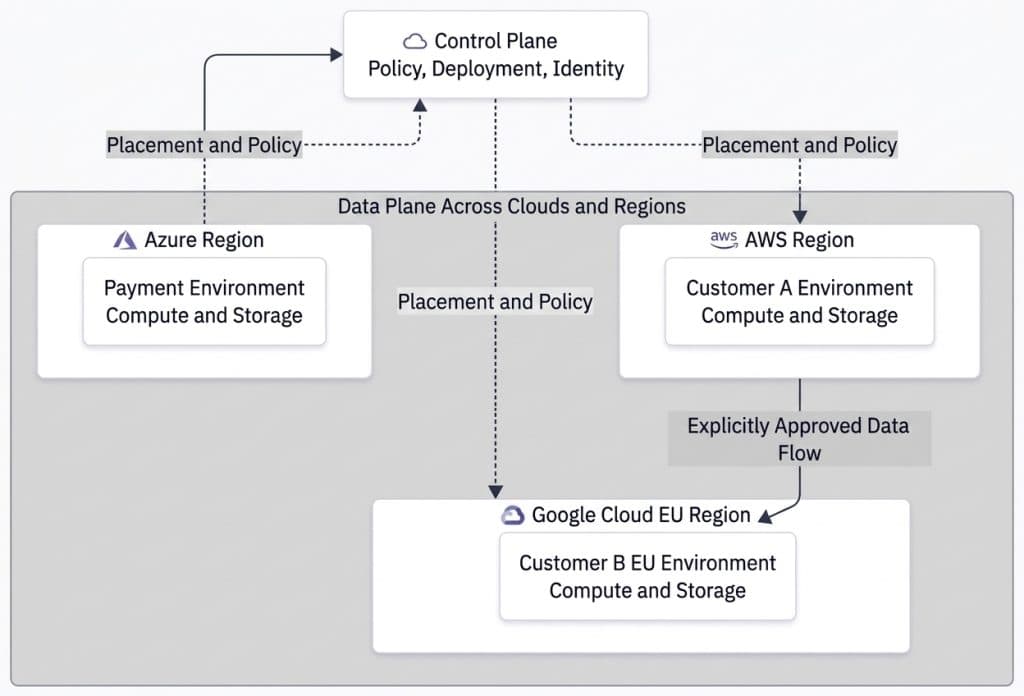
The diagram is a control model, not proof of compliance. Evidence still has to show that placement, identity, network, encryption, and logging controls work as intended.
SLA Guarantees and Enterprise Support
Published uptime and a contractual SLA answer different questions. Historical uptime describes past service behavior. An SLA defines a commitment, how it is measured, which events are excluded, and what happens when the provider misses it.
A meaningful enterprise SLA should state the availability target and measurement window, define planned-maintenance and customer-caused exclusions, and explain the process for receiving remedies such as service credits. The contract should also distinguish availability from support. A service can miss a support response target without breaching its availability commitment, or meet its uptime target while still handling a serious incident poorly.
Control Plane’s enterprise offering publishes a 99.999% availability SLA. Buyers should still review the applicable service terms, workload configuration requirements, measurement window, exclusions, and remedies rather than treating the percentage as a substitute for the contract.
That commitment is supported by an architectural resiliency model rather than a contract alone. Within configured locations, workloads can run across multiple nodes and availability zones. A GVC can extend the same workload across regions and cloud providers, while geo-routing directs requests to healthy locations and shifts traffic when a location becomes unavailable. Control Plane also operates its platform across multiple providers so the management layer is not tied to one hyperscaler’s failure domain. Geo-routing and workload failover do not by themselves replicate application state; databases, queues, and object stores still need a replication and recovery topology appropriate to their consistency and RPO requirements.
Support terms need the same scrutiny. Check which hours and channels are covered, how severity levels are assigned, what initial response targets apply, and when an incident can be escalated. Do not assume that a response target is a resolution target. Also verify whether credits are automatic or require a claim, because providers handle this differently.
The technical counterpart to those commitments is an audit trail across the surfaces used to manage the environment. If a Terraform run changes a network policy, the organization should be able to connect that change to an identity, timestamp, request, and affected resource. The same expectation should apply to API, CLI, and console actions. This record supports incident analysis and compliance evidence, but only if retention and access controls preserve it for the required period.
Control Plane’s audit-trail service provides a complete, tamper-proof, and searchable record of resource mutations made through the API, CLI, console, Terraform, and other interfaces. Entries include timestamps, resource details, the acting subject, IP address, authentication attributes, result data, and raw event data. Resource versions and before-and-after configuration diffs make it possible to inspect what changed and review prior state instead of reconstructing an incident from disconnected logs.
Organizational Patterns That Scale
Many enterprise cloud failures begin as workflow problems. If the approved path is slower than creating an unmanaged account, teams eventually route around it. The result is shadow infrastructure outside central identity policy, cost reporting, audit collection, and incident response.
For a lean infrastructure team, a centralized platform group owning the cloud abstraction layer is often the most practical model. That team defines deployment interfaces, identity patterns, approved locations, observability defaults, and security controls. Developers consume those decisions through golden paths instead of configuring each provider directly.
A golden path is not a rigid template that blocks every exception. It is a supported route for a common workload type, with the normal security and operational decisions already encoded. A developer deploying an API should not have to rediscover how to configure workload identity, regional placement, log export, health checks, and network policy. The path should make the compliant option faster than the unsanctioned one.
Per-team cloud accounts can still be appropriate when strong isolation or billing separation is required. The problem appears when each account develops its own identity model, logging setup, network baseline, and change process. Every variation expands the evidence and operational surface the central team must understand. Account boundaries alone do not create governance.
Shadow IT is the more serious version of the same problem. Teams create accounts or services outside the managed environment because provisioning takes too long or the approved platform cannot support a needed workload. Treating that behavior only as a culture failure misses the architectural signal. If developers repeatedly bypass the platform, the platform team should examine which capability or turnaround time is pushing them away.
Centralization works only when it centralizes policy without centralizing every ticket. The platform team should own the interface and defaults, while product teams retain self-service access within those constraints. This gives compliance and security teams a consistent control surface without turning a small platform group into a provisioning queue.
How to Start Building Your IDP Layer
An internal developer platform is one layer of an enterprise cloud strategy, not the strategy itself. It turns infrastructure, security, and operations decisions into workflows that application teams can use. For a small platform team, the first version does not need an elaborate portal or service catalog. It needs a small set of capabilities that close the largest governance gaps.
Start with workload orchestration that applies the same deployment model across the locations and providers you support. The goal is not to pretend that every provider is identical. It is to keep placement, rollout, health, and scaling decisions behind a controlled interface so developers do not rebuild them for every environment.
Add workload identity so applications do not carry long-lived provider credentials. The platform should map workloads to narrowly scoped cloud identities and issue or obtain temporary credentials where the provider integration supports them. Provider-specific roles, service accounts, permissions, and APIs still exist, but credential handling no longer has to be embedded in each application deployment.
Provide unified observability across the supported runtime. Logs, metrics, and traces need consistent labels for workload, environment, region, and provider so responders can follow an incident without reconstructing those relationships manually. Unified access does not require one storage vendor, but the platform should give teams a coherent way to find the relevant data.
Finally, expose one governed API surface through the interfaces your teams already use. UI, CLI, API, and Terraform workflows should apply the same resource model and policy. If an action is permitted through one interface and invisible through another, the abstraction is incomplete.
Control Plane is a cloud virtualization platform that brings workload deployment, networking, identity, observability, and policy across AWS, Google Cloud, Azure, OCI, private infrastructure, and bare metal into a common operating layer. Its console, API, CLI, and Terraform provider expose the same platform resources, which lets a small platform team build golden paths without maintaining a separate provider-specific deployment workflow for each cloud.
Universal Cloud Identity is configured as a GVC-scoped identity resource and assigned to workloads that need provider access. It lets those workloads access authorized AWS roles, Google Cloud service accounts, and Azure identities without storing long-lived provider credentials in application code or workload configuration. A Control Plane workload does not have to run on the same hyperscaler as the service it calls. For example, a workload placed in an Azure or private location can use an authorized AWS identity to reach an AWS service. This credential-free access applies across more than 600 managed cloud services. Teams still define provider-side permissions and retain dependencies on any provider-specific services their applications call.
Control Plane also includes Capacity AI for right-sizing container CPU and memory allocations based on observed use. Replica autoscaling and scale-to-zero are separate runtime decisions. Keeping those concerns distinct prevents a right-sizing feature from being described as a complete autoscaling system.
This is enough to begin with one workload class and one golden path. Define the required identity, placement, network, health, observability, and scaling settings, then make that path available through the platform interface. Expand only after the first path is used successfully. For a deeper treatment of portals, orchestration layers, and golden paths, see the guide to internal developer platforms. The multi-region application architecture guide covers placement and routing in more detail.
Frequently Asked Questions
Enterprise cloud is an architectural and operational model built around a verified compliance posture, enforceable data-placement controls, contractual service commitments, and support with defined escalation paths. It is not determined by company size or by the choice of a particular hyperscaler.
A standard setup may run workloads successfully without consistent governance across them. An enterprise cloud setup adds examined compliance controls, enforced regional placement where required, contractual uptime and support terms, and a platform team responsible for the shared abstraction layer.
For lean infrastructure teams, a centralized platform team with self-service golden paths is often a strong model. It centralizes policy and evidence while letting developers deploy without waiting on manual tickets. Unmanaged per-team accounts and shadow IT make access, logging, cost, and compliance controls harder to apply consistently.
It requires explicit workload and storage placement, mapped data flows, controlled replication and backup destinations, and isolation boundaries that prevent unintended access. Separating administrative control from application data paths can help, but teams must also account for logs, telemetry, caches, and external services that may move data outside the selected region.
SOC 2 Type II reports examine whether defined controls operated effectively over a review period. PCI DSS applies to cardholder data environments and connected systems in scope. HIPAA requires appropriate safeguards for electronic protected health information when an organization is a covered entity or business associate. GDPR applies to personal-data processing in its scope and regulates international transfers rather than imposing universal EU-only storage.
An IDP is the self-service layer through which developers consume approved infrastructure and deployment workflows. It encodes golden paths, identity, placement, security, and observability defaults so application teams do not need to configure raw provider APIs for routine deployments.
Putting It Together
Enterprise cloud is a posture you build. Compliance architecture, data-placement controls, contractual commitments, and an accountable operating model have to reinforce one another. None of them appears automatically because workloads run on a major cloud provider.
The next decision is organizational before it is technical. Decide who owns the shared platform layer and which deployment paths that team will support, then choose the platform capabilities that can enforce those decisions. Doing this in the opposite order often produces an expensive interface over the same fragmented infrastructure.
If you are evaluating that platform layer, see how Control Plane handles multi-region orchestration, identity, compliance controls, and developer self-service in the product demos, then review the current pricing.