Most teams think “cloud-native” just means containers, Kubernetes, and a CI/CD pipeline. That’s true as far as it goes, but it’s missing the bigger picture. It tells you how software gets deployed, not how it’s designed. The deeper, architectural side is trickier: stateless processes, configuration kept outside the codebase, backing services treated as swappable resources, and containers you can throw away and rebuild anytime. These habits are what let a system survive infrastructure changes without falling apart. Skip them, and you can run on Kubernetes today and still find yourself locked into one cloud provider’s quirks three years down the road.
This guide focuses on that architectural side: the decisions you make in the first six weeks of a new system, like how you split services, where state lives, how you handle configuration, and what your observability setup looks like from day one. Those choices are what decide whether your app stays portable or gets stuck. CI/CD, container builds, and deployment pipelines matter too, but they’re just the baseline.
What Cloud-Native Architecture Actually Requires
Cloud-native architecture comes down to a set of design rules that keep your system from getting tied to any one infrastructure setup (infrastructure-agnostic). On the operational side, this means your app ships as a container image, your deployments run through a pipeline, and Kubernetes takes care of scheduling. On the architectural side, it means the system itself is built to handle infrastructure changes without breaking: processes are stateless, config comes from the environment, dependencies are swappable, and the system fails and restarts gracefully.
Most teams achieve operational cloud-native. The CNCF Annual Survey 2024 puts cloud-native adoption at 89%, with “cloud-native beginners” declining year over year. What the survey can’t measure is how many of those deployments are architecturally portable versus nominally containerized.
The constraint is what matters, not the technology. Kubernetes is relevant not because of its container scheduling but because of its declarative resource model: you describe desired state in YAML, the control loop reconciles reality to that spec, and you get drift detection for free. That model externalizes intent from implementation. A bash script that runs docker run is operationally cloud-native but encodes the how instead of the what, so it’s architecturally brittle.
The rest of this guide works through four areas where these constraints show up: the 12-factor methodology, microservices decomposition, declarative infrastructure, and observability. Get these right at the start and you retain the option to move your workloads. Get them wrong, and no amount of DevOps tooling rescues you later.
The 12-Factor App: Which Factors Drive Portability
The 12-factor methodology has twelve factors, but they don’t all gate portability equally. Factors I (Codebase) and X (Dev/Prod Parity) are prerequisites: you need a single deployable codebase and environments that mirror each other, or the remaining factors don’t hold. The other six matter for operational hygiene without directly blocking multi-cloud migration.
Four factors carry the most portability weight. Miss any one of them and your migration options narrow considerably.
Factor III: Config
Store configuration in the environment, never in code. The failure mode is a hardcoded connection string. It sounds obvious, but it shows up constantly: a database URL baked into config.py, a GCP project ID in a constructor, an S3 bucket name in a constant. The moment that string is in source, you’ve coupled your application to a specific cloud account. Read from environment variables and use a secret manager (AWS Secrets Manager or GCP Secret Manager) as the injection layer. Enforcing this discipline uniformly across a fast-moving team requires deliberate structural choices, not just convention.
Factor IV: Backing Services
Treat all datastores, queues, and external APIs as attached resources, accessed via URL and credentials. A team that calls dynamodb.putItem() directly with a hardcoded table ARN and assumes IAM role injection via EC2 metadata has built a DynamoDB dependency that no amount of containerization undoes. Every external dependency should be referenced by URL with credentials injected at runtime. Swap the URL and credentials, swap the backing service.
Factor VI: Processes
Processes should be stateless and share nothing between them. The most common slip-up here is keeping session data in memory. A team adds an in-process session cache because it’s fast and easy, then later finds at scale that sticky sessions get in the way of horizontal scaling and make rolling deploys risky. Moving session state to an external store, like Redis, a database, or a signed cookie token, means any process replica can handle any request, and autoscaling no longer has to worry about session affinity.
Factor IX: Disposability
Fast startup, graceful shutdown. A container that takes 45 seconds to start creates real operational problems: autoscaling events are slow to resolve, pod rescheduling during node failures extends downtime, and rolling deploys stall. The target is under 10 seconds for most service types, with graceful shutdown handling in-flight requests before SIGTERM returns. This is what makes Kubernetes reschedule tolerance work in practice.
These 4 major factors solve the application-layer coupling problem. The infrastructure-layer coupling problem (such as, which cloud account owns your IAM policies, which VPC your data lives in, which cloud SDK you use to talk to managed services) requires different tooling, covered in the declarative infrastructure section below.
Microservices Design Patterns: Decomposition and Communication
Service decomposition (splitting a problem correctly across multiple services) is where most cloud-native projects make their biggest architectural mistake. Teams decompose by technical layer (a “database service,” a “notification service,” a “gateway service”) and end up with a distributed monolith. Every feature change requires coordinating three or four services simultaneously, because the domain logic doesn’t live in any single one. All the operational complexity of microservices, none of the isolation benefits.
The correct unit of decomposition is the bounded context from domain-driven design. A bounded context is a consistent domain model with a clear linguistic boundary: the Order service owns the concept of an order and all the operations that mutate it; the Inventory service owns stock levels and reservations. They communicate through defined interfaces, not shared tables or shared objects. When your service boundaries align with domain boundaries, a change to order processing doesn’t require touching inventory.
Synchronous vs. asynchronous communication comes down to one simple rule: if the caller doesn’t need to wait for a response, make it async. On the other hand, REST or gRPC works well for low-latency request/response situations where the caller actually needs an immediate answer, like checking a payment authorization, verifying a user login, or reading data that determines what the user sees next. Event-driven communication, using something like Kafka, SQS, or Pub/Sub, makes more sense for write paths where the caller just needs the action logged, such as a user signing up, an order being placed, or a file getting uploaded. Going async separates the write path from however long downstream processing takes, lets the system handle bursty traffic without pushing back on the caller, and keeps downstream failures from turning into errors for the service that started the request.
The sidecar pattern handles cross-cutting concerns without embedding them in application code. Observability instrumentation, mutual TLS, retry logic, circuit breaking: if each service implements these independently, you get inconsistent behavior and maintenance overhead that scales linearly with service count. Offloading these concerns to a sidecar container keeps application code focused on domain logic and makes cross-cutting behaviors consistent and independently upgradeable. The application container stays clean of infrastructure assumptions, and the sidecar can be swapped or updated without touching the service.
Declarative Infrastructure and Dynamic Orchestration
Declarative infrastructure is what actually makes cloud-native architecture portable in practice. When you declare the state you want, for example “I want two replicas of this workload running in us-west-2 and us-east1”, the system takes care of getting there and keeping it that way. Drift detection, reproducibility, and version-controlled infrastructure all come along for free. An imperative script that runs kubectl create deployment... only makes sense for the exact starting point it was written for, and breaks if you apply it to a different state. A YAML manifest describing the desired state, on the other hand, works correctly whether the cluster is empty or already partially set up.
Kubernetes matters here because its declarative model separates what you want from how it gets done. When you apply a Deployment manifest, you’re stating the goal, and the control loop handles the rest. That separation is what makes GitOps possible, what turns disaster recovery into a scripted process instead of a manual one, and what makes multi-cloud placement a manageable problem rather than an unsolvable one.
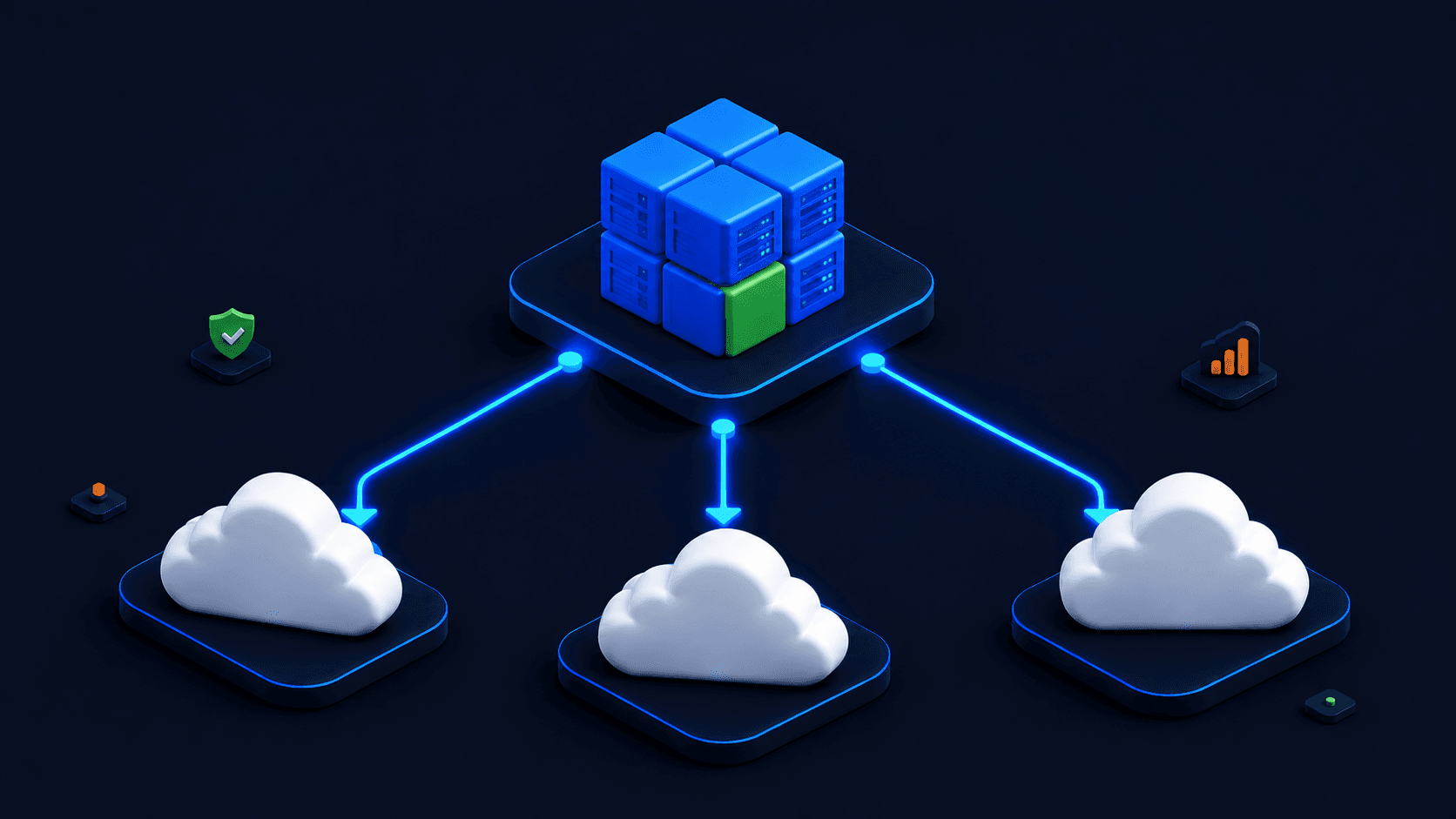
Control Plane is a cloud virtualization platform that extends this model to the multi-cloud layer. Its Global Virtual Cloud (GVC) is a declared set of cloud locations and routing rules that spans providers, configured in the same declarative style as a Kubernetes resource. The workload YAML doesn’t change when you add or swap a location. A minimal GVC spanning AWS us-west-2 and GCP us-east1:
kind: gvc
name: my-gvc
spec:
  staticPlacement:
    locationLinks:
      - //location/aws-us-west-2
      - //location/gcp-us-east1
    locationOptions:
      - locationLink: //location/aws-us-west-2
        routingTier: 0
      - locationLink: //location/gcp-us-east1
        routingTier: 1
        latencyToleranceMs: 500
  tracing:
    provider:
      controlplane: {}
    sampling: 10
  env:
    - name: ENVIRONMENT
      value: production
  loadBalancer:
    dedicated: true
routingTier: 0 makes AWS us-west-2 the primary location. routingTier: 1 makes GCP us-east1 the failover, used when the primary is unavailable. latencyToleranceMs: 500 drops GCP from rotation if its own measured latency exceeds 500ms. Adding a third location means appending one entry to locationLinks and one to locationOptions. The workload config is untouched.
[IMAGE PLACEHOLDER]
The harder portability problem is accessing backing services across different clouds, which is where 12-Factor IV (backing services) runs into real-world infrastructure. Say your order service reads from SQS on AWS and writes results to BigQuery on GCP. Storing credentials directly in the application would break Factor IV. Control Plane’s Universal Cloud Identity solves this at the platform level: workloads get least-privilege access to native cloud services like SQS, BigQuery, or Azure Entra ID, without any credentials embedded in the code. The identity belongs to the workload itself, not to something hardcoded in the app. Cloud Wormhole covers the related case of reaching private networks, whether that’s VPCs, on-premises data centers, or any TCP/UDP endpoint, using a persistent agent connection instead of traditional VPN setup. Together, these features apply the 12-Factor IV model at the infrastructure layer, so credential management never has to touch the application at all.
Observability-First Architecture: Designing for Debuggability
Observability needs to be part of the architecture from the start, not an operational add-on bolted on later. If you try to add distributed tracing to a system that wasn’t built with it in mind, you’ll end up with gaps in instrumentation, missing correlation IDs, and trace context that disappears at service boundaries. The first production incident you can’t figure out will cost you far more than the roughly 5% of extra development time it takes to build in observability from the beginning.
Structured logs are the baseline. Every log line should be machine-readable JSON with a minimum field set: timestamp, level, service name, trace ID, and the event message. The trace ID is the critical addition: it’s what lets you pivot from a log alert to the trace that caused it. Text logs are fine for local development, but in production, unstructured log lines are noise that doesn’t join to anything else in your observability stack.
Metrics using the RED pattern give you a baseline signal for every service. RED stands for Rate (requests per second), Errors (the proportion of failed requests), and Duration (latency spread across P50, P95, and P99). Tracking these per endpoint surfaces the vast majority of production problems. Add them from the start. If you add them later instead, each service tends to end up with its own metric names and label schemas, which makes it impossible to aggregate across services.
Distributed traces are what tie logs and metrics together in a microservices system. A trace shows the path a single request takes through your services, laid out as a tree of spans. For this to work, context has to be passed along correctly: W3C traceparent headers need to propagate across every HTTP and gRPC boundary. If even one service fails to forward those headers, the trace breaks. A broken trace can be worse than no trace at all, since it looks like you have visibility when you actually don’t.
OpenTelemetry (OTel) is the right default instrumentation standard for all three observability pillars mentioned above. It’s now the second-largest CNCF project by contributor count, with a 39% rise in commits year over year. OTel instrumentation lets you swap your observability backend (Jaeger, Grafana Tempo, Datadog, Honeycomb) without changing application code. Control Plane’s built-in tracing integrates with OTel natively, and traces are accessible via Grafana from any workload directly in the console.
Cloud Portability in Practice: Trade-offs and Your First Deployable Step
Container portability and cloud portability are not the same thing. A container image built with Docker will run on any OCI-compliant runtime. But if the application inside that container calls aws.dynamodb.putItem() directly, assumes it can get IAM roles through EC2 instance metadata, or relies on proprietary secrets injection tied to a specific cloud account, then the container has moved but the application hasn’t really gone anywhere. These issues map directly back to the 12-Factor violations covered in the configuration section: hardcoding cloud SDK calls breaks Factor IV (backing services), and assumptions about credentials break Factor III (config).
The most common portability decision at the infrastructure layer is whether to use a cloud provider’s managed service or a portable open-source equivalent. The decision rules are clearer than most teams expect:
| Dimension | Stateless app logic | Stateful: managed cloud service | Stateful: portable OSS |
|---|---|---|---|
| Examples | Any containerized service | Aurora, Firestore, Azure Service Bus | PostgreSQL, Kafka, Redis OSS |
| Portability | High — any OCI runtime | Low — SDK coupling, IAM ties | High — standard interfaces |
| Latency | Neutral | Low — co-located, provider-optimized | Variable — depends on deployment topology |
| Ops overhead | Low | Low — provider manages infra | High — you own upgrades, backups, failover |
| Data egress cost | Negligible | High if cross-region or cross-cloud | Controllable |
| Migration risk | Negligible | High — proprietary features, account credential assumptions | Low — driver-agnostic, schema portable |
| Decision rule | Always containerize | Team under 5, staying single-cloud for 2+ years | Multi-cloud required, data sovereignty, or egress cost sensitivity |
Managed services cut down on operational overhead by a lot, and in many cases that trade-off is worth making. The problem comes when you choose them without weighing the portability cost upfront, only to discover that cost later during a migration, when the sheer volume of data makes moving genuinely painful.
Your First Multi-Cloud Deployment
Your first deployable step takes about ten minutes. Install the cpln CLI:
npm install -g @controlplane/cli

# or: brew tap controlplane-com/cpln && brew install cpln
Authenticate and set your org:
cpln login
cpln profile update default --org YOUR_ORG_NAME
Create a GVC from console.cpln.io: click Create, then GVC, name it, and add aws-us-west-2 and gcp-us-east1 as locations. Then build and push your container image. Buildpacks auto-detects your application type, so no Dockerfile is required:
cpln image build --name my-app:1.0 --push
Create a Workload in the console pointing at that image. Control Plane’s geo-intelligent DNS immediately starts routing requests to the nearest healthy location. The GVC config above is the exact YAML that describes that topology, and it stays unchanged whether you’re running one location or five.
Wrapping Up
Cloud-native architecture is about a set of design constraints, not a particular technology stack. Get Factors III, IV, VI, and IX right from the start. Split your services along domain boundaries. Use declarative configuration wherever the tooling lets you. Build in instrumentation from day one. And understand the portability cost of every stateful dependency you bring in, because that cost always shows up at the worst possible time, not at design time.
The goal is to keep your options open: the ability to move workloads, add new providers, or renegotiate with hyperscalers from a position of strength. Teams that build that flexibility in from the start don’t end up rewriting their data layer later just to keep up with growth.
Deploy your first multi-cloud workload by creating a GVC spanning AWS and GCP in under 10 minutes at console.cpln.io. Start building
Frequently Asked Questions
Operational cloud-native means running containers through a CI/CD pipeline on Kubernetes. Architectural cloud-native means the system is designed for infrastructure-agnosticism: stateless processes, externalized config, swappable backing services, and fast disposability. A system can be operationally cloud-native while remaining tightly coupled to a single provider’s primitives.
Factors III (Config), IV (Backing Services), VI (Processes), and IX (Disposability) have the highest portability impact. Factor III prevents credential and endpoint coupling; Factor IV enforces URL-based dependency injection; Factor VI enables horizontal scaling without sticky sessions; Factor IX keeps rescheduling fast and reliable. The other eight factors matter for operational hygiene but don’t directly block multi-cloud migration.
Decompose on bounded contexts from domain-driven design rather than technical layers. Each service should own a complete domain concept — Order, Inventory, User — and communicate through defined interfaces, not shared databases or shared objects. When service boundaries align with domain boundaries, a change to one domain doesn’t require coordinating deployments across multiple services.
Use async (Kafka, SQS, Pub/Sub) for write paths where the caller doesn’t need an immediate response: order placed, user registered, file uploaded. Use synchronous REST or gRPC when the caller needs the response to proceed: payment authorization, authentication checks, read operations that shape the next UI state. Async decouples services from each other’s availability and prevents downstream latency from propagating back to the caller.
Control Plane’s Global Virtual Cloud (GVC) is a declarative resource on the Control Plane platform that spans multiple cloud providers and regions, configured like a Kubernetes manifest. It defines location priorities, failover thresholds, and routing rules. Workloads deployed to a GVC are automatically distributed across specified locations, with geo-intelligent DNS routing traffic to the nearest healthy instance. Adding or removing a cloud location requires one config change, not a workload redeployment.
A distributed trace tracks a single request across multiple services as a tree of spans. Each span must carry the same trace ID, passed via the W3C traceparent header at every HTTP and gRPC boundary. If any service fails to forward that header, the trace is severed — subsequent spans appear as unconnected orphans. A broken trace is harder to debug than no trace, because it creates false confidence that visibility exists.
Universal Cloud Identity is a patented Control Plane technology that grants workloads least-privilege access to native cloud services (like AWS SQS, GCP BigQuery, Azure Entra ID) without embedding credentials in application code or configuration. The identity is assigned to the workload at the platform layer and injected at runtime, satisfying 12-Factor IV’s requirement that backing services be accessed via URL and runtime-injected credentials rather than hardcoded keys or SDK-specific auth assumptions.