
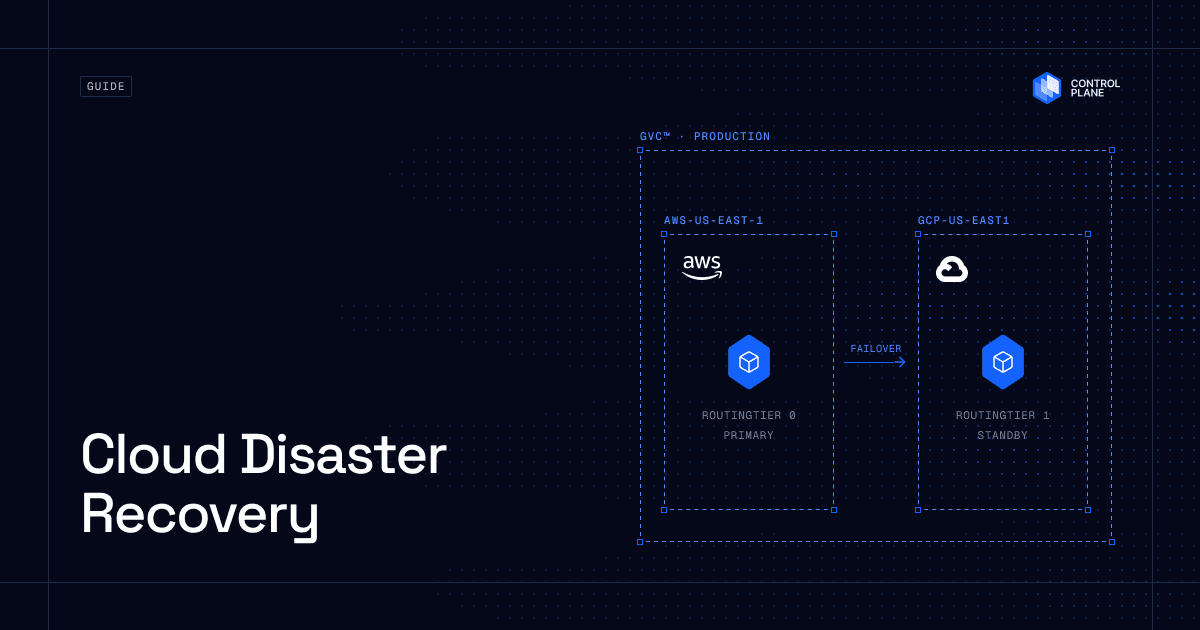
How do I design cloud resilience and failover to meet a specific RTO and RPO? Set an RTO and RPO for each workload tier, then choose the least costly pattern that meets both: backup and restore for hours of acceptable downtime, pilot light when you can wait for application capacity to start, warm standby for faster recovery, and active/active when your tested targets require traffic to shift between running sites. Then automate failover, so recovery does not depend on a person or on the failing provider’s control plane. AWS’s October 2025 us-east-1 outage showed why. A DynamoDB DNS failure cascaded into EC2, load balancer, Lambda, and STS errors over roughly 14.5 hours, and recovery plans that relied on those services stalled. Control Plane automates failover across locations through health-aware routing and Universal Cloud Identity, so a location failure becomes a routing event instead of a manual runbook. The table below is a starting point; the sections that follow cover workload tiers, provider-failure risks, implementation, and testing.
| DR pattern | Illustrative RTO range | Illustrative RPO range | Relative cost | Best-fit scenario | Control Plane feature |
|---|---|---|---|---|---|
| Backup and Restore | Hours to days | Hours to 24 hours, depending on backup frequency | $ | Workloads that can be rebuilt from backups within a longer recovery window | Multi-region GVCs provide placement for recovered workloads; backup storage and restoration require a separate design |
| Pilot Light | Tens of minutes to hours | Minutes to hours, depending on replication | $$ | Batch or lower-priority workloads that can wait for application capacity to start | Capacity AI dynamic resource packing and scale-to-zero can reduce idle application-compute cost; required data replication must continue |
| Warm Standby | Minutes | Seconds to minutes, depending on replication | $$$ | Workloads that need a running, scaled-down recovery environment | Multi-region GVCs support placement across locations |
| Multi-Site Active/Active | Seconds to minutes | Seconds to minutes, depending on state and replication design | $$$$ | Stateless tiers that need running capacity in multiple locations | Geo-intelligent routing distributes traffic across healthy locations |
These ranges follow the four-strategy framework in the AWS disaster recovery whitepaper. They are planning estimates, not Control Plane recovery guarantees. Test RTO and RPO against your application, data architecture, and failure scenarios.
Most DR plans have a fatal assumption baked in, namely that the cloud provider stays up. Your runbook says “failover to us-west-2.” That works until the provider’s control-plane services degrade and the credentials, APIs, or DNS management your failover workflow depends on become unreliable. Single-provider DR is disaster deferral.
Many organizations run workloads across multiple clouds while continuing to design disaster recovery around a single-provider failure model. This guide addresses that delta directly. By the end, you will be able to set tier-appropriate RTO and RPO targets that map to real architectural constraints, choose the right failover pattern per workload type, implement multi-cloud failover with Control Plane’s native routing and placement capabilities, test the full failover path without touching production traffic, and understand why a topology that reduces correlation between provider-specific failure modes is the architecture best suited for surviving a real provider outage.
Mapping RTO and RPO to workload tiers
RTO and RPO are engineering constraints, not aspirational targets. RTO is the maximum time your system can be unavailable before you breach your commitments, and RPO is the maximum amount of data loss your system is allowed to incur. Both are upper bounds you commit not to exceed, not averages you optimize toward. Your architecture has to recover within those bounds without heroics, at 3am, with one person on call.
A three-tier model gives you the vocabulary to make that concrete. These ranges are illustrative starting points for cloud-native deployments, not universal industry standards. Actual targets depend on your SLAs, regulatory context, and business impact analysis.
Critical tier (payment processing, authentication, customer-facing APIs) typically targets RTO under 5 minutes and RPO under 30 seconds. This tier may require active-active or near-active-active architecture, depending on tested RTO/RPO requirements. Any failover path that requires a human to approve a step is likely to breach these targets under real incident conditions.
Standard tier (internal tooling, reporting pipelines, non-transactional APIs) typically targets RTO of 15 to 60 minutes and RPO of 5 to 15 minutes. Warm standby is usually sufficient, with automated promotion triggered by health-check failure.
Batch tier (data processing, background jobs, analytics) typically targets RTO of 2 to 4 hours and RPO up to 24 hours. Pilot light is appropriate. These workloads are checkpoint-tolerant by design, and recovery can be deliberately paced.
These ranges are realistic for cloud-native deployments where infrastructure is defined as code and failover is automated. If your current runbook requires a senior engineer to SSH into a box and make manual changes, you are outside these windows regardless of what your SLA says.
The cost of meeting each tier’s targets scales sharply. Critical-tier RTO under five minutes often requires pre-provisioned or duplicate capacity, a direct infrastructure cost multiplier. Standard-tier warm standby carries a lower idle cost but still requires pre-provisioned compute. Batch-tier pilot light carries minimal idle cost but imposes a meaningful startup delay on recovery. Tier your workloads deliberately, because engineering every service to critical-tier standards is how infrastructure budgets collapse.
DR strategy patterns: pilot light, warm standby, and active-active
Pilot light, warm standby, and multi-site active-active are the three patterns that apply directly to most teams, drawn from the AWS Disaster Recovery of Workloads on AWS whitepaper.
| Pattern | RTO Range | Idle Cost | Operational Complexity |
|---|---|---|---|
| Pilot light | Tens of minutes to hours | Low | Low |
| Warm standby | Minutes | Medium | Medium |
| Active-active | Seconds to minutes | High | High |
Pilot light keeps a minimal footprint running in the recovery environment, typically database replication and core configuration. On failover, you scale up the full application from that seed. Recovery is measured in minutes or longer, depending on provisioning and readiness time. It is appropriate for batch and lower-priority workloads where cost efficiency takes priority over recovery speed. A pilot-light or warm-standby environment hosted on an independent provider can also survive a full provider outage, though with a longer recovery time than active-active.
Warm standby runs a scaled-down replica of the full stack, continuously synchronized with the primary. On a failover event, you scale it up and redirect traffic. Warm standby can achieve single-digit-minute recovery, depending on provisioning, promotion, data recovery, and application readiness. Idle costs are higher because you are running real compute. Most medium-criticality workloads land here.
Active-active runs full production capacity simultaneously in both environments. For stateless application workloads, failover is primarily a traffic-routing operation, with no recovery environment to provision or scale. Active-active is best suited for surviving a provider-level outage with minimal disruption for stateless tiers. Stateful workloads still require database promotion, leader election, replication recovery, and handling of provider-specific failure modes. Active-active structures costs differently from active-passive and can reduce otherwise-idle standby spend, but total cost may be higher depending on capacity requirements, data replication, networking, and operational complexity.
The critical caveat is stateful data. Active-active is straightforward for stateless workloads. For databases, it requires distributed writes or aggressive primary-replica replication, and the tradeoffs between consistency and availability are significant. Multi-region database writes need either eventual consistency (acceptable for some workloads but catastrophic for others) or a consensus protocol that adds latency.
Apply active-active only where your RTO demands it, and use warm standby or pilot light for everything else. The goal is a deliberate tradeoff per tier. For current compute and data-transfer pricing for each pattern, refer to the AWS DR documentation and the Azure equivalent, since cost figures shift frequently enough that directional estimates go stale fast.
Why single-provider DR fails and what multi-cloud topology changes
The standard DR playbook says to replicate to another region. Most teams read “another region” as another region in the same provider, which is a correlated risk masquerading as redundancy.
AWS’s October 2025 us-east-1 outage shows the same pattern. According to AWS’s postmortem (original), the event began at 11:48 PM PDT on October 19 and ended at 2:20 PM PDT on October 20. A race condition in DynamoDB’s DNS management left the regional endpoint with an empty DNS record. DynamoDB errors lasted until about 2:40 AM PDT, but the impact spread:
- EC2: API errors and instance launch failures continued until 1:50 PM PDT.
- Network Load Balancer: Connection errors lasted from 5:30 AM to 2:09 PM PDT, and AWS disabled automatic health check failover to restore capacity.
- STS and IAM: STS had API errors until 9:59 AM PDT, and console sign-in failed until 1:25 AM PDT.
- Lambda, ECS, EKS, and Fargate: All saw launch, invocation, or scaling failures.
Three DR lessons follow. First, RTO has hidden dependencies: recovery paths that needed new EC2 capacity or STS tokens stalled after DynamoDB itself recovered. Second, failover within one provider is correlated, because the services your recovery depends on can fail together. Third, recovery should not require the failing region’s control plane, which favors pre-provisioned capacity and credential access that works in other locations.
As Control Plane’s analyses in “Beyond Backups: Designing Systems That Survive the Inevitable” and “Why Adopt a Multi-Cloud Architecture?” both argue, single-provider dependency is a failure mode you accept, not a risk you manage.
Multi-cloud placement reduces provider-specific failure correlation, though external dependencies such as shared DNS providers, CDN services, identity federation, internet transit, shared SaaS platforms, and software supply-chain components must also be identified and designed for resilience independently.
The real costs of multi-cloud DR deserve plain acknowledgment.
- Data egress: cross-cloud synchronization generally incurs data-transfer charges on the sending side; inbound data transfer is typically free, although provider- and service-specific processing charges may still apply. Design data residency to minimize transfer costs where possible, and accept the cost where it is not avoidable.
- Operational complexity: two providers means two IAM models, two networking layers, two cost structures.
- Talent spread: your team needs working competency in both providers’ operational primitives.
A unified control layer, a single API surface that abstracts provider differences, can reduce operational complexity so your team operates against one mental model regardless of which cloud runs beneath it. It does not eliminate data-egress costs, state-consistency challenges, or the need for provider-specific expertise, but it reduces the risk of maintaining divergent runbooks and the blast radius when someone updates the wrong one.
Implementing multi-cloud DR with Control Plane
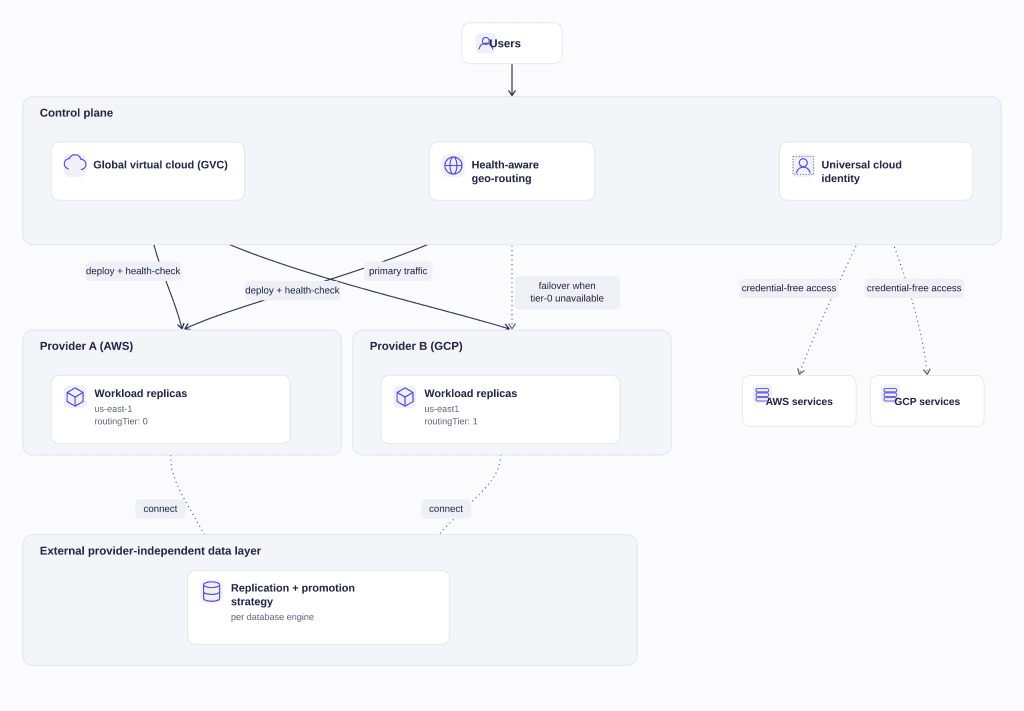
Control Plane is a cloud virtualization platform that sits above AWS, GCP, Azure, Oracle, and private infrastructure, giving teams a single interface to deploy workloads, manage identity, and control traffic routing across providers. For DR, the key capabilities are Global Virtual Clouds (GVCs) that span independent provider locations, health-aware geo-routing that shifts traffic automatically, and Universal Cloud Identity that removes embedded credentials from the equation.
Create a GVC spanning independent cloud providers
A GVC is Control Plane’s core deployment scope. It groups one or more cloud provider locations into a single logical unit. For multi-cloud DR, create a GVC with locations on at least two independent providers:cpln gvc create --name production \ --location aws-us-east-1 \ --location gcp-us-east1 \ --org MY_ORG
Adding a location to the GVC immediately deploys your workloads there. Removing a location gracefully terminates replicas and shifts traffic to the remaining healthy locations.
Configure routing tiers for active-active or primary/failover
Control Plane’s location routing supports two DR patterns through the routingTier parameter. Locations with the same routingTier value belong to the same priority group. Traffic is eligible for all healthy locations in the highest-priority (lowest-numbered) tier, and within that tier, the platform’s routing logic selects locations based on latency. This means same-tier placement creates an active-active topology, but it does not necessarily mean equal simultaneous traffic distribution. Locations in a higher-numbered routing tier only receive traffic when all locations in lower-numbered tiers are unavailable.
The following partial configuration excerpts show the relevant staticPlacement fields. A complete GVC resource includes additional fields not shown here.
For active-active across two providers (both in the same priority tier):# Partial GVC staticPlacement configuration spec: staticPlacement: locationLinks: - //location/aws-us-east-1 - //location/gcp-us-east1 locationOptions: - locationLink: //location/aws-us-east-1 routingTier: 0 - locationLink: //location/gcp-us-east1 routingTier: 0
For primary/failover, where GCP only receives traffic when AWS is unavailable:# Partial GVC staticPlacement configuration spec: staticPlacement: locationLinks: - //location/aws-us-east-1 - //location/gcp-us-east1 locationOptions: - locationLink: //location/aws-us-east-1 routingTier: 0 - locationLink: //location/gcp-us-east1 routingTier: 1
Additional parameters allow fine-tuning: latencyOffsetMs biases traffic toward or away from a location, and latencyToleranceMs treats a location as unavailable if latency exceeds the configured threshold. As a safety mechanism, if all locations would be filtered out by these thresholds, Control Plane ignores them so traffic always has a destination.
Health-based routing and automatic failover
Control Plane evaluates health at the replica level through two distinct probe types. Readiness probes determine whether a replica is ready to receive traffic. A replica that fails its readiness probe is removed from the eligible routing pool but is not restarted. Liveness probes determine whether a container is unhealthy and should be restarted. Liveness probes do not directly control how traffic is routed.
For location-level health, without aliasWorkloadLink, the GVC alias uses a basic TCP health check against the location’s ingress to determine availability. With aliasWorkloadLink configured, the alias follows the referenced workload’s HTTP readiness checks and per-location routing state, providing more application-aware health detection. A location only receives traffic when the alias workload is ready there. When a location becomes unhealthy, Control Plane’s geo-aware DNS routing automatically reroutes traffic to the next-nearest healthy location.
This failover is automatic. With a low DNS TTL and health-aware routing properly configured and tested, traffic-shift latency for stateless workloads can be reduced, though actual RTO depends on health-detection thresholds, DNS resolver behavior, existing client connections, application readiness, and the specific failure mode. Teams should measure actual failover time in their environment through regular DR testing rather than relying on theoretical calculations alone.
Each workload deployed in a GVC receives auto-generated endpoints: a global geo-routed endpoint, per-location endpoints, and internal mTLS endpoints for service-to-service communication.
Universal Cloud Identity
For workloads that need to access provider-native cloud services (AWS S3, GCP BigQuery, Azure Blob Storage), Universal Cloud Identity lets workloads assume cloud-native identities (AWS IAM roles, GCP service accounts, Azure managed identities) at runtime, without storing long-lived provider credentials in container images or application configuration. This reduces credential-management friction as a source of switching cost and eliminates a class of secrets that would otherwise complicate cross-provider failover.
Domain routing
Control Plane provides native domain routing that maps custom domains to GVC workloads. In CNAME mode, users manage their own DNS records by creating CNAME entries pointing to the workload’s canonical endpoint or GVC alias. CNAME mode supports path-based routing for directing requests to different workloads based on URL path. Subdomain-based routing can also use CNAME mode with a gvcLink, but requires a separate CNAME record for each workload. In NS mode, DNS is delegated to Control Plane, which manages workload subdomain records automatically. Canary routing is configured as a weight on individual HTTP and HTTP2 routes within the path-based routing configuration, as documented in Control Plane’s domain configuration guide.
Stateful workload considerations
Control Plane’s health-aware routing handles traffic failover for stateless workloads natively. Stateful workloads, particularly databases, require a separate DR strategy. AWS Aurora and Azure SQL are independent managed database products that do not provide native cross-provider replication. Cross-cloud database DR requires an explicitly designed replication layer. CockroachDB can provide serializable consistency in a multi-cloud deployment. DynamoDB Global Tables provide multi-Region replication within AWS, including an optional strong-consistency mode in supported AWS Regions. Other options include change data capture (CDC) pipelines or application-level replication. Database RTO and RPO must be evaluated independently from traffic-routing RTO, because replication lag, promotion logic, and consistency guarantees vary by engine and configuration.
The infrastructure can be managed through the Control Plane console, CLI (cpln), API, or through GitOps workflows using Terraform, Pulumi, or a GitOps agent that reconciles declared state against the Control Plane API.
DR testing without production risk
DR tests that never run are the same as DR plans that do not exist. The challenge is exercising the full failover path without touching production traffic. A tiered testing approach covers this progressively.
Level 1 covers alerting validation, dependency mapping, and decision-criteria review. Walk through detection and decision logic against your documented failure criteria without touching any infrastructure. Define explicit pass/fail criteria upfront, for example, “If all workload replicas in a location fail the configured readiness threshold, that location loses traffic eligibility through the GVC alias.” When aliasWorkloadLink is configured, GVC-level routing follows the designated workload’s HTTP readiness and per-location routing state. The detection interval depends on the configured probe period and failure threshold. Verify that alerting fires at the right thresholds, that on-call rotation reaches the right person, and that each runbook step is still accurate. This is where most teams find stale documentation and misconfigured alerting before an actual incident exposes them.
Level 2 covers failover testing in an isolated non-production environment, distinguishing between two mechanisms. Planned evacuation: remove a location from a non-production GVC and verify that workloads terminate gracefully and traffic shifts to remaining locations. Health-based failure: make a workload fail its readiness probe and verify that the replica is removed from the eligible traffic routing pool automatically. These are different mechanisms and should be tested separately. Pass/fail criteria ask whether traffic routed correctly to remaining healthy locations within your expected time bound.
Level 3 covers complete location failover simulation against a shadow environment running synthetic traffic. Mirror your production GVC topology in a shadow environment. Test distinct failure scenarios independently: endpoint failure, replica readiness failure, location-level health failure, provider API or authentication failure, DNS routing disruption, and management-plane failure. Measure actual traffic-redirection time against your RTO target. For failback, note that configuration-driven failover (such as location removal) can be reviewed and reverted through Git. Runtime health-based failover is driven by observed health and does not involve a Git commit, though GitOps workflows can be used to audit drift and review infrastructure topology after recovery.
Run Level 1 quarterly, Level 2 monthly, and Level 3 at least once before relying on the automated failover path in production.
For teams building a custom stack: Crossplane and GitOps
Teams that want to manage provider-specific infrastructure resources declaratively, outside of Control Plane, can build a complementary layer using Crossplane and a GitOps agent.
Crossplane v2.x provides Composite Resource Definitions (XRDs) that abstract provider-specific resources behind provider-neutral schemas. Composition Functions, the sole composition mechanism in Crossplane v2, transform composed resources during Crossplane’s reconciliation loop. For DR infrastructure provisioning, Crossplane can manage the provider-specific resources (database instances, networking, storage) that sit beneath your workloads. Note that Crossplane itself does not perform health monitoring or failover decisions. A separate health-monitoring mechanism or custom controller is needed to detect failures and update the declarative state that Crossplane reconciles.
A GitOps agent (Flux or ArgoCD) adds continuous reconciliation, watching a Git repository and converging actual state to match declared state. The benefit for DR is that infrastructure topology is always in version control, so there is no undocumented configuration to recreate under pressure. Configuration-driven failover changes can be reviewed and reverted through Git. Runtime health-based failover, however, is driven by observed health state and does not involve a Git commit. GitOps remains useful for auditing drift and reviewing infrastructure topology after recovery.
This approach requires building and maintaining the health-detection, traffic-routing, and credential-management layers that Control Plane provides natively. Teams should evaluate whether the operational investment in a custom stack is justified for their scale and requirements.
Frequently Asked Questions
What is the difference between RTO and RPO?
RTO is the maximum time a system can be unavailable before breaching commitments. RPO is the maximum data loss that is acceptable. Both are upper bounds you commit not to exceed. If your RTO is five minutes, the architecture must be designed and tested to recover within that target for the failure scenarios covered by the DR plan.
What is the difference between warm standby and active-active disaster recovery?
Warm standby runs a scaled-down replica that must be promoted and scaled up on failover, and that promotion step is where your RTO window gets consumed. Active-active runs full capacity in both environments simultaneously. For stateless workloads, failover is primarily a traffic-routing operation with no recovery environment to provision or scale. Stateful workloads still require database promotion, replication recovery, and handling of provider-specific failure modes. The tradeoff is cost, because active-active means paying for two full environments continuously.
How do you test disaster recovery without affecting production?
Use a tiered testing approach. Start with alerting and decision-criteria reviews, then test component-level failovers in a non-production environment with the same multi-location configuration, then run full location-failover simulations against a shadow environment with synthetic traffic. Verify both the failover and the failback path.
Why can single-provider disaster recovery fail during a provider outage?
When your DR target is another region in the same cloud, primary and recovery environments share control-plane services, DNS-management APIs, and credential-resolution dependencies. In AWS’s October 2025 us-east-1 outage, a DynamoDB DNS failure cascaded into EC2, load balancer, Lambda, and STS errors that lasted about 14.5 hours. Recovery automation that depended on those services could not run reliably, because the failure modes were correlated.
What RTO is achievable with health-based multi-cloud routing?
Health-based routing and low DNS TTLs can reduce traffic-shift latency for stateless workloads, but RTO depends on health-detection thresholds, DNS resolver behavior, existing client connections, application readiness, and the specific failure mode. Even with an RTO target of 5 minutes, routing latency alone does not guarantee a recovery result. Stateful tiers that require database promotion will have longer RTOs depending on replication lag and promotion logic. Teams should measure actual failover time through regular DR testing rather than relying on theoretical calculations.
How does a GitOps workflow reduce DR operational risk?
When infrastructure state is declared in version control, there is no undocumented configuration to recreate under pressure. A GitOps agent continuously reconciles actual state against declared state, correcting drift automatically. Configuration-driven failover changes can be reviewed and reverted through Git. Runtime health-based failover is driven by observed health state, not by a Git commit, but GitOps remains useful for auditing drift and reviewing infrastructure topology after recovery.
When should you choose pilot light over warm standby?
Pilot light is the right choice when your workload can tolerate RTO measured in tens of minutes and cost efficiency outweighs recovery speed. Warm standby is appropriate when you need single-digit-minute RTO but cannot justify the cost of running full active-active capacity. The deciding factor is your tested RTO/RPO requirements and tier classification, where batch workloads typically fit pilot light, standard-tier workloads typically fit warm standby, and critical-tier workloads may require active-active.
Final thoughts
Three decisions determine the quality of your disaster recovery posture. Setting tier-appropriate RTO and RPO targets that map to real architectural constraints. Automating failover through health-aware routing so recovery is a routing event rather than a manual procedure. Choosing a topology where primary and recovery environments are hosted in separate provider failure domains, while acknowledging that shared DNS, CDN, identity federation, internet transit, SaaS, and supply-chain dependencies remain. AWS’s October 2025 us-east-1 outage, where one DNS failure cascaded across EC2, load balancing, and identity services, is a reminder to map those dependencies before an incident does it for you.
Control Plane’s GVC model, with workloads deployed across cloud provider locations in separate failure domains and health-aware geo-routing managing traffic distribution, provides the unified control layer that makes multi-cloud DR operationally practical rather than a second infrastructure project. Stateless workload failover is handled natively through location routing. Stateful services require purpose-built replication, and the operational costs of cross-provider data movement, testing, and team competency remain real regardless of tooling.
Ready to run workloads that survive a full provider outage? See how Control Plane handles multi-cloud failover at controlplane.com/product-demos.