You can have a dashboard for every cloud you run and still not know which team owns a given charge. Multi-cloud cost management is the practice of tracking, allocating, and optimizing spend across two or more providers. The difficult part is creating allocation boundaries that stay consistent across cloud accounts, projects, subscriptions, and Kubernetes workloads.
This guide is for senior engineers and technical decision-makers running workloads across two or more cloud providers. It explains why attribution breaks before optimization, where AWS Cost Explorer, IBM Kubecost, and CloudHealth by Broadcom fit, and how the FinOps framework provides the operating model.
Why Cost Attribution Breaks Before Optimization Begins
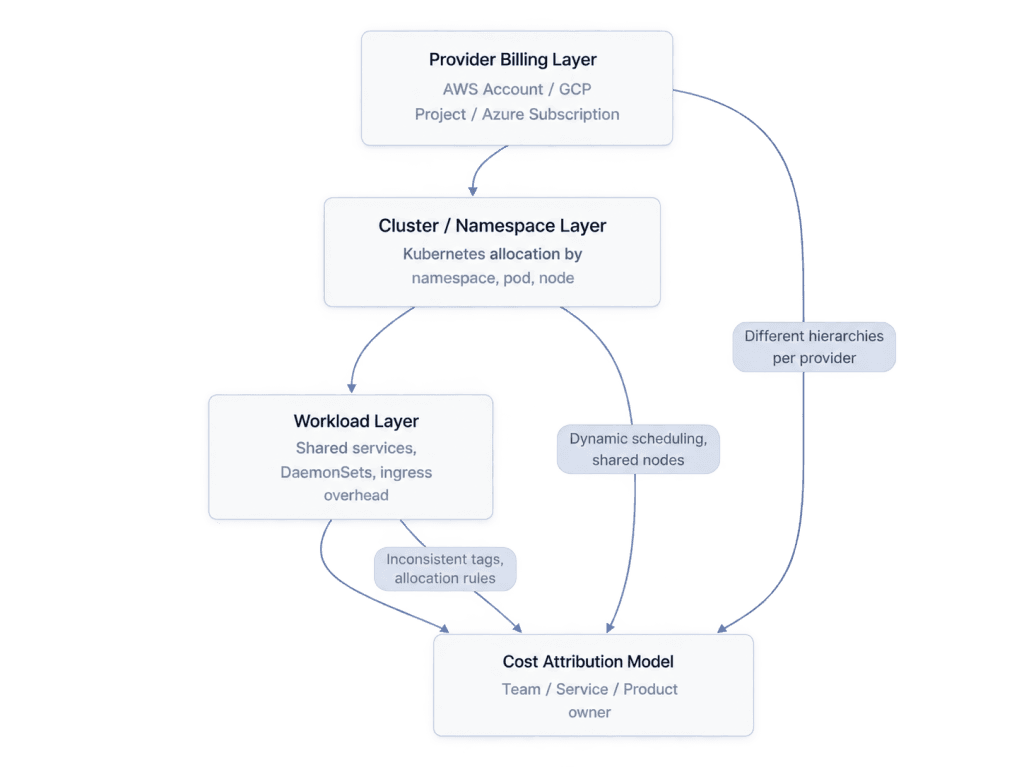
Each provider exposes cost through a different billing hierarchy, so attribution becomes a translation problem before optimization even starts.
AWS organizes spend by account, GCP by project, and Azure by subscription. Those boundaries rarely match a team’s service or product ownership model. Shared services make the mismatch worse: a logging pipeline may live in one account while serving workloads owned by several teams.
Kubernetes adds another boundary. Multiple workloads share nodes, and the scheduler changes placement dynamically, so provider billing lines do not map cleanly to namespaces or pods. An instance tag can identify the cluster, but not how much of that node belongs to one team versus another.
Shared ingress controllers, monitoring agents, and DaemonSets add costs that no single workload owns. Teams therefore need explicit allocation rules for shared spend, and those rules are only as reliable as the underlying labels, tags, and ownership taxonomy.
Visibility, allocation, governance, and runtime optimization are separate capabilities. Seeing a charge is not the same as assigning it to an owner, enforcing policy, or changing what a workload consumes.
Leading Tools and Where They Fit in Multi-Cloud Cost Management
The tools below operate at different layers, so compare them by data model, Kubernetes depth, governance surface, and cross-cloud coverage.
AWS Cost Explorer analyzes AWS billing data with filters for account, service, region, tag, and usage type, and works with AWS Organizations for consolidated billing. It is a natural starting point for AWS spend analysis and commitment planning, but it does not model GCP or Azure spend or Kubernetes namespace allocation.
IBM Kubecost allocates Kubernetes cost by namespace, deployment, pod, and label, and supports multi-cluster federation in its Enterprise tier. Current Enterprise releases can also ingest cloud billing data and surface cloud assets. Its deepest model remains Kubernetes allocation, so teams still need rules for shared provider charges and business ownership dimensions.
CloudHealth by Broadcom operates at the enterprise multi-cloud layer. It ingests AWS, GCP, and Azure billing data, applies allocation rules, supports commitment management, and provides governance, showback, chargeback, budgeting, and Kubernetes cost capabilities. Its strength is broad financial governance across cloud estates rather than Kubernetes-native allocation depth.
In practice, Cost Explorer covers AWS-native analysis, Kubecost adds Kubernetes allocation depth, and CloudHealth provides cross-provider financial governance. Mature FinOps programs often combine capabilities from more than one layer.
The FinOps Open Cost and Usage Specification (FOCUS) addresses a separate problem: it normalizes cloud cost-and-usage schemas across providers. It does not define business ownership or allocate shared Kubernetes costs, so treat it as a normalization layer beneath your allocation policy.
The FinOps Framework and Multi-Cloud Cost Management Best Practices
The FinOps framework uses three iterative phases: Inform, Optimize, and Operate. Inform establishes visibility and allocation, Optimize acts on that data, and Operate embeds the practice into ongoing engineering and finance workflows. The model depends on shared accountability across engineering, finance, and product.
Several practices are worth calling out for multi-cloud teams specifically.
Define a common allocation taxonomy before you pick tools. Decide whether ownership means team, product, environment, or service tier, then apply that definition consistently across providers and Kubernetes.
Normalize provider billing data before adding business rules. FOCUS can reduce provider-specific schema differences, but team ownership, shared-cost allocation, and Kubernetes overhead remain organization-specific.
Use showback before chargeback where ownership is still forming. Showback exposes spend without moving budget; chargeback transfers it to cost centers. Chargeback works poorly when attribution is still disputed.
Keep cost conventions consistent. Mixing on-demand and amortized effective cost across providers makes comparisons unreliable.
Track unit cost and optimize cost categories separately. Follow cost per API call, active user, inference, or another product unit, and treat compute, egress, storage, load balancing, and managed databases as different optimization problems.
FinOps supplies the process; trustworthy decisions still depend on reliable allocation data and clear ownership.
How a Unified Control Plane Rewrites Cost Attribution
Control Plane is a multi-cloud orchestration layer that sits above AWS, GCP, Azure, and private infrastructure, exposing all of it through a single API. In Control Plane documentation, BYOK means Bring Your Own Kubernetes.
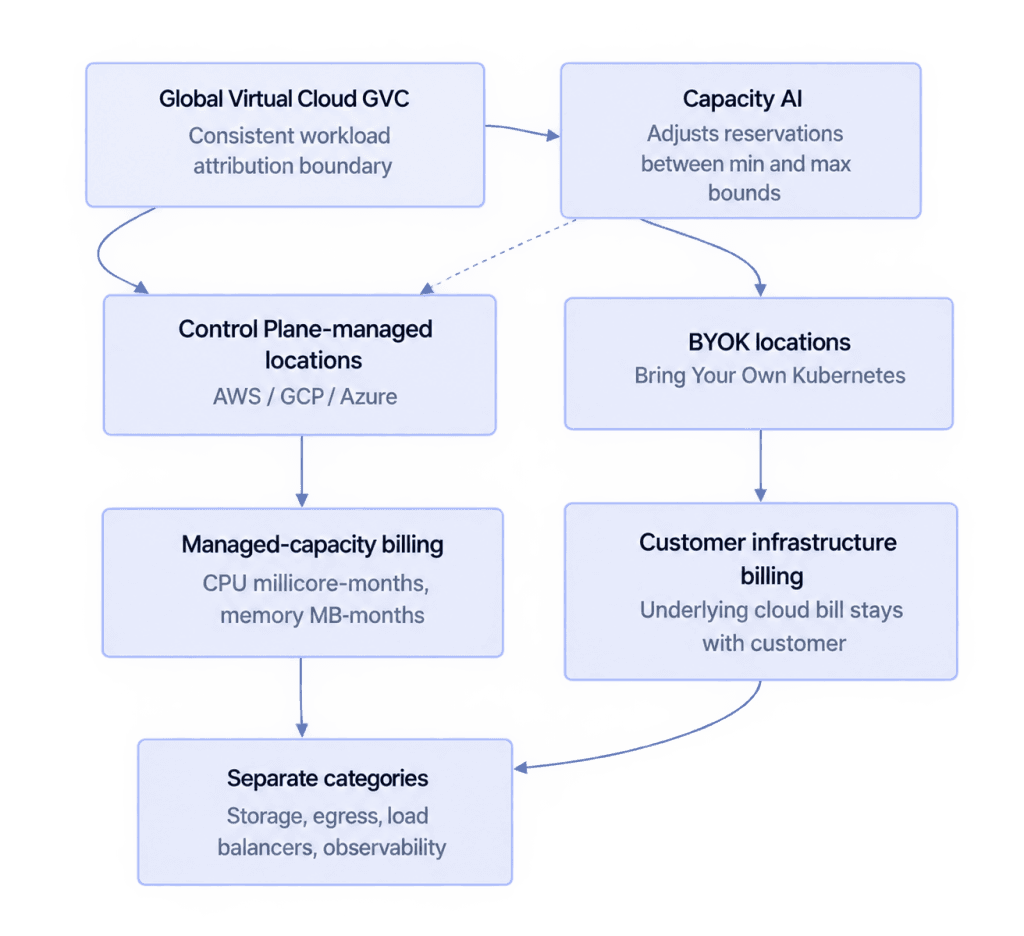
The cost-attribution implication starts with the Global Virtual Cloud (GVC), a named grouping of managed and customer-controlled locations behind a consistent deployment boundary. For Control Plane-managed workloads, the GVC and the workloads inside it provide attribution dimensions that align more closely with application boundaries than provider accounts or projects do.
Provider billing constructs still matter. Egress, managed databases, storage, load balancers, observability, shared infrastructure, and BYOK capacity can retain separate billing sources and still need allocation rules.
For Control Plane-managed capacity, CPU is metered in millicore-months and memory in megabyte-months; storage, egress, dedicated load balancers, and observability are separate categories. For BYOK locations, the underlying infrastructure bill remains with the customer, so do not apply the managed-capacity metering model to that infrastructure spend.
Capacity AI analyzes historical CPU and memory consumption and adjusts each container’s actual reservation between the configured lower bounds (minCpu, minMemory) and upper bounds (cpu, memory). Current documentation supports it for standard, serverless, cron, stateful, and VM workloads, with it enabled by default for standard, serverless, and cron.
Capacity AI does not scale a workload to zero; that is a separate autoscaling capability. It does not work with CPU Utilization autoscaling, multi-metric autoscaling, or GPU containers. Resize behavior depends on workload type and runtime support: standard and stateful workloads can resize in place where supported, otherwise updates roll out; serverless uses a new revision, and cron applies the new reservation on subsequent runs.
Workload type is fixed at creation, so choose serverless at creation if that behavior is required. KEDA is a separate autoscaling configuration for supported standard and stateful workloads and can be configured independently of workload-type selection.
Location selection is another cost lever, but it is not automatic price-based scheduling. A GVC runs a workload across the locations you configure, while incoming traffic is routed to the nearest healthy location by default, with priority and latency controls available. Cost decisions still need to account for data gravity, egress, and managed-service dependencies.
The console can surface current and projected costs for Control Plane-managed workloads at the GVC level. Treat that as one layer of the FinOps model, not a replacement for provider bills or shared-cost allocation.
Frequently Asked Questions
Visibility means seeing and allocating cost data. Management adds the controls used to influence spend, including budgets, governance, commitments, rightsizing, scheduling, and autoscaling.
FinOps is a shared-accountability model for cloud financial management built around three iterative phases: Inform, Optimize, and Operate. It connects engineering, finance, and product around the same cost and ownership data.
Provider-native tools are scoped to one provider’s billing model. Multi-cloud teams therefore need cross-provider normalization or aggregation plus a shared ownership taxonomy and explicit rules for Kubernetes and shared costs.
Cost attribution maps spend to a team, service, product, or workload. Kubernetes complicates that mapping because workloads share nodes and common services, while provider bills stop at the instance or node boundary rather than the pod or namespace.
One Action You Can Take Today
Deploy one standard staging workload into a GVC and record its configured lower bounds (minCpu, minMemory) and upper bounds (cpu, memory). Capacity AI is enabled by default for standard workloads. After representative traffic, compare the actual reservation against those bounds to see what it adjusted.
For Control Plane-managed capacity, compare the reservation change with the current pricing model at controlplane.com/pricing. For BYOK locations, include the underlying infrastructure bill. In both cases, include egress, storage, observability, load balancers, and managed services in the total.
Putting the Layers Together
Cloud cost management works when billing data, Kubernetes allocation, business ownership, and optimization loops use compatible boundaries. Provider-native tools, FOCUS, Kubecost, CloudHealth, and orchestration each solve a different layer; none replaces the others.
Explore Control Plane at console.cpln.io.