The shape of your cloud infra is changing
a few years ago, nobody was asking where their inference layer should run. Now it’s on the roadmap, or already in production and costing more than anyone budgeted. Or perhaps you’ve built an agent infrastructure that spins up on a request and vanishes by midnight. Or you need GPUs that are priced like a luxury good on the hyperscalers, so you go source them from a neocloud like Lambda. Every one of those decisions has a short shelf life: token prices fall, cheaper capacity opens up, a regulation lands that says the data stays in-country. Cloud was just starting to look like a commodity, and then 2022 happened.
So almost every business is rethinking its infrastructure. But rethinking gets expensive, because most of that infrastructure was built to sit still. You picked one cloud, one way of doing identity and networking, one data model, all for a standard set of workloads. So if you move one piece you’re touching every other piece. The lock in is usually strong enough that you just stay put, pay the premium, and wait for your cloud of choice to ship something close enough. Or you dual-track your cloud, operating two different parallel infrastructures as you straddle the past and the future.
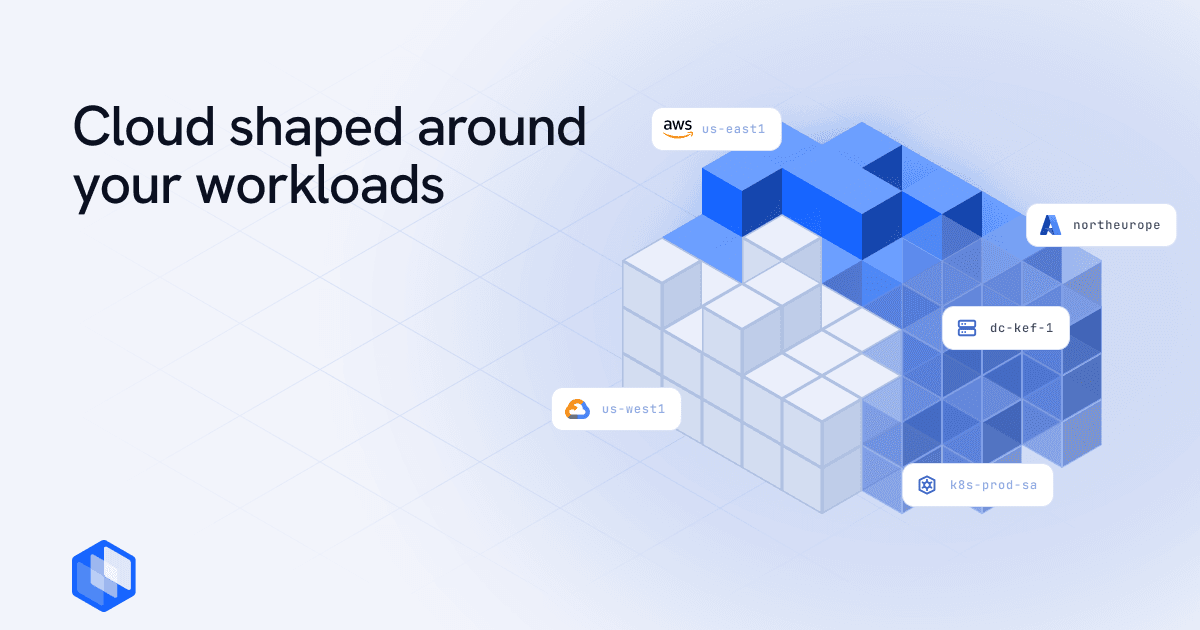
Control Plane is the alternative. It virtualizes every layer of infrastructure (compute, networking, identity, and services) into one AI-native cloud, composed from whatever you already run and whatever you add next. Bare metal, a Kubernetes cluster, a neocloud’s GPUs, an AWS account, shaping them all into one fabric that operates like a single cloud.
What VMware did for servers, Control Plane does for the cloud. It turns almost any cloud resource into a brick you can click together with any other brick to form your own custom cloud. Like Legos but for SREs.
Step one: A server, a cluster, or an account becomes a region
Control Plane operates dozens of regions on AWS, GCP, and Azure. Running on any combination of them is just a few clicks.
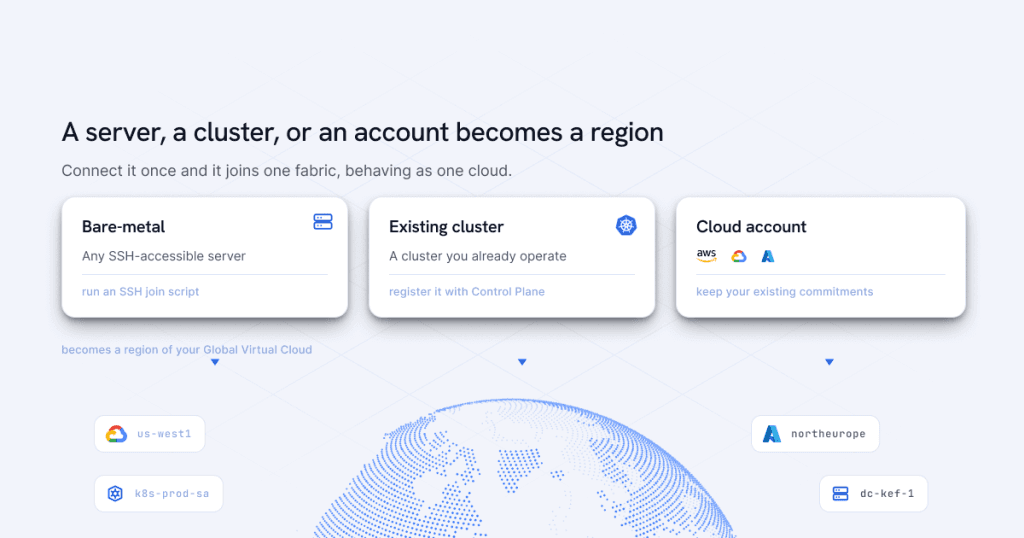
If you want to extend your virtual cloud to infrastructure you already use, a bare-metal Linux server, an existing Kubernetes cluster, or an entire cloud account can each become a region of your virtual cloud. Connect it once (run an SSH join script on a server, register a Kubernetes cluster you’re already operating, add your existing credentials for a cloud account) and it joins one fabric and behaves as one cloud.
You keep your existing infrastructure, your existing cloud commitments, and your existing savings plans. You don’t have to rip out the sprawl. It gets virtualized into something you can finally operate as a single cloud.
Step two: One cloud, every workload
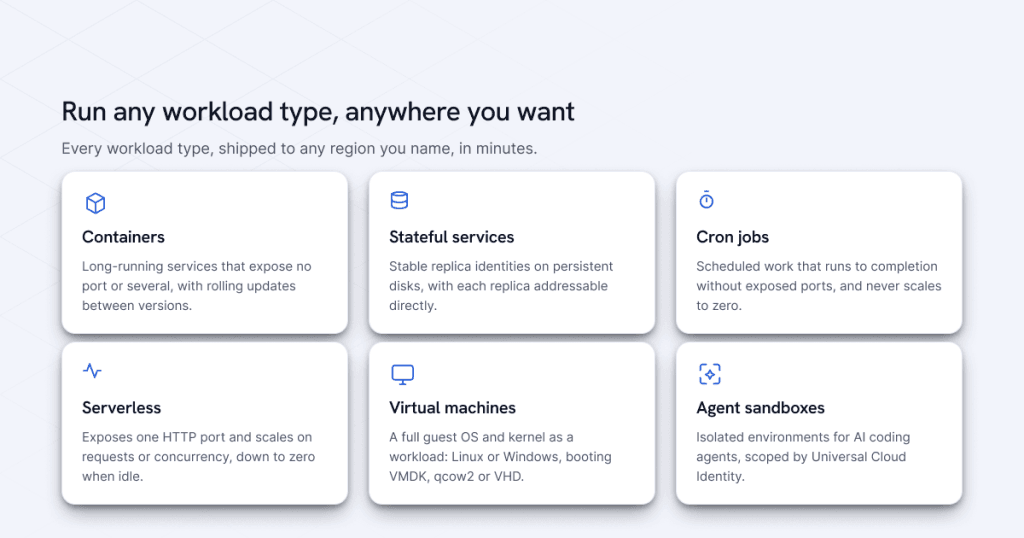
Once your infrastructure is one cloud, deploying to it is easy. Control Plane runs every workload type (standard containers, stateful services, cron jobs, scale-to-zero serverless, full virtual machines, and ephemeral sandboxes for AI agents) and ships each one to any region you name, in minutes.
You write the spec once. Geo-routing to the nearest healthy location, automatic TLS, and cross-region failover come standard.
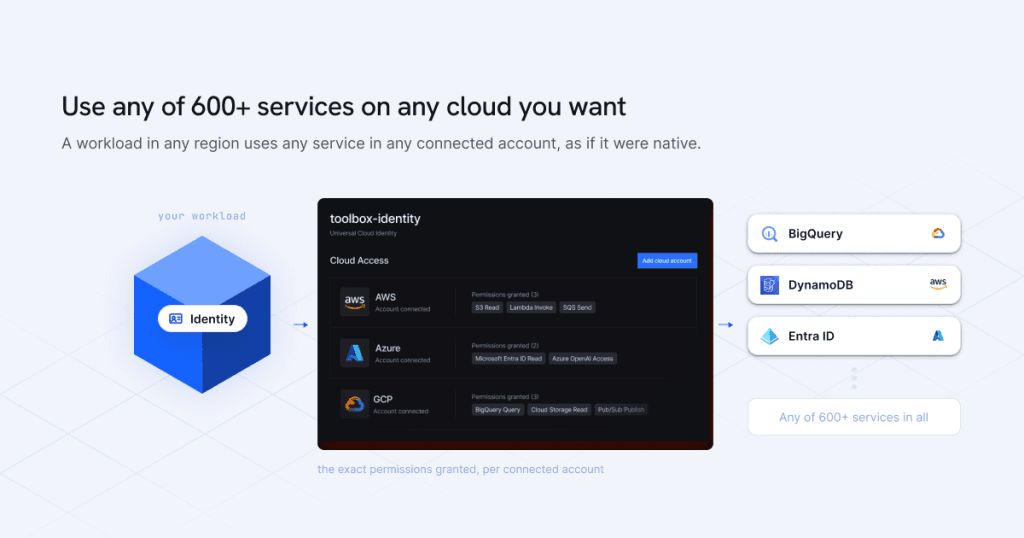
Step three: Use any of 600+ services on any cloud you want
A workload running in any region can use any service in any connected cloud account (BigQuery on GCP, DynamoDB on AWS, Entra ID on Azure) as if it were native. More than six hundred services, consumed directly.
It works because of Universal Cloud Identity, which brokers every call. No keys are embedded in a workload, copied into an environment variable, or pasted into an agent’s context. Access is granted per call, least-privilege, and fully attributable. And it works the same way for a human engineer and an AI agent.
Step four: The whole production stack, built in
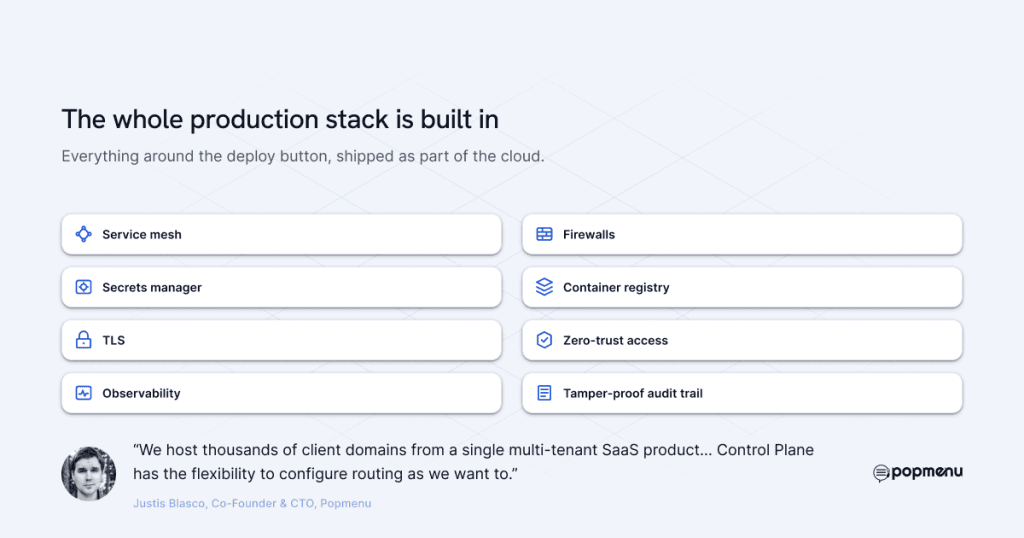
The reason multi-region infrastructure usually needs a dedicated team is everything around the deploy button: a service mesh, firewalls, a secrets manager, a container registry, TLS, zero-trust access, observability, and a real audit trail. Most teams assemble that from a dozen tools and have to maintain all that connective tissue indefinitely.
Control Plane ships all of this as part of the cloud. That’s what lets a growing company run production-grade, multi-region infrastructure without standing up an SRE function, and what lets an enterprise consolidate sprawl onto one governed surface that’s SOC 2 Type II and HIPAA-ready.
Step five: Pay for what runs, not what’s provisioned
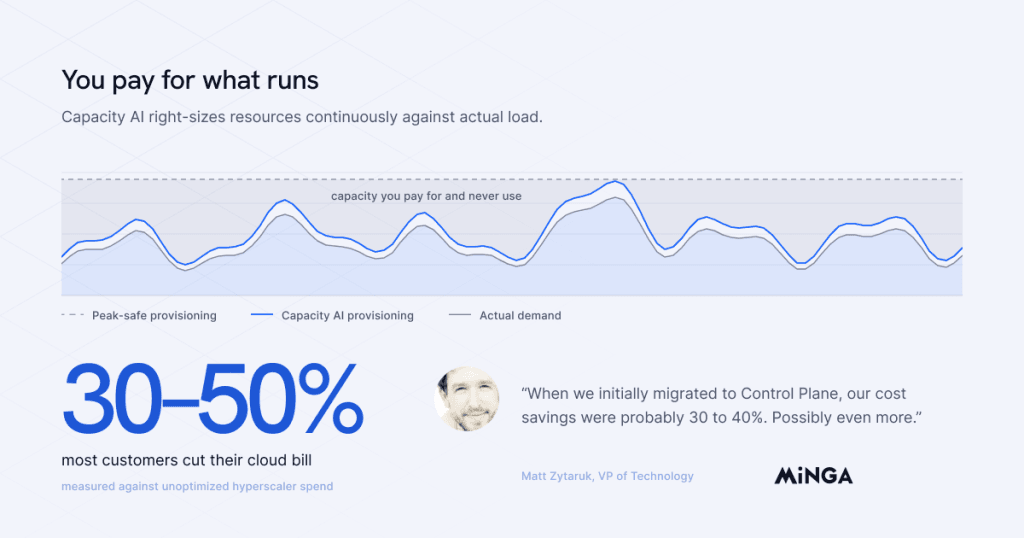
Cloud bills balloon for all sorts of reasons: instances sized for a worst case that never comes, replicas left running, volumes nobody remembers. Control Plane’s Capacity AI right-sizes resources continuously against actual load and surfaces the forgotten ones so you can clear them out.
Most customers cut their cloud bill 30–50% through Capacity AI right-sizing every workload to real load and clearing out idle replicas, forgotten volumes, and over-provisioned instances. Measured against unoptimized hyperscaler spend, you stop paying for capacity you never used.
Step six: One identical interface for humans and agents
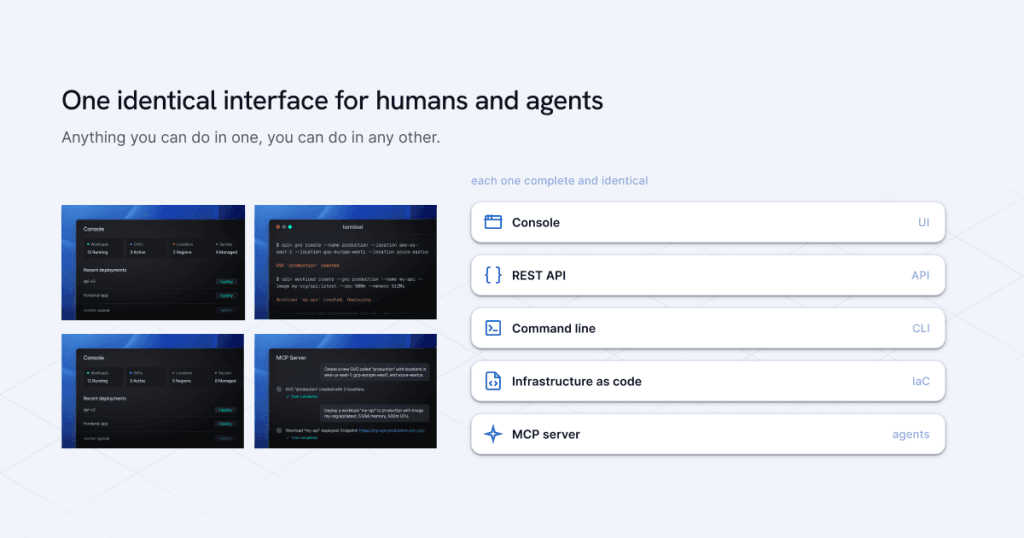
Control Plane is operated through one symmetric interface: a console, a REST API, a CLI, infrastructure-as-code (Terraform, Pulumi), and an MCP server for AI agents. Each interface is complete and identical. Anything you can do in one, you can do in any other.
That symmetry is what makes Control Plane safe for agents. An AI agent operates it the way a senior engineer would: deterministic changes, a shared audit trail. This means a smaller context window, fewer tokens, and more predictable outcomes. Your whole infrastructure becomes context an agent can reason over, inside guardrails that keep it operating safely.
The bottom line
A PaaS hides the cloud until you outgrow it. A hyperscaler hands you the parts and a year of assembly. Control Plane lets you build your own virtual cloud: it composes what you already have into one fabric, runs every workload type across every region, connects hundreds of services with no standing secrets, ships the production stack built in, right-sizes the bill, and presents one interface that humans and agents share.