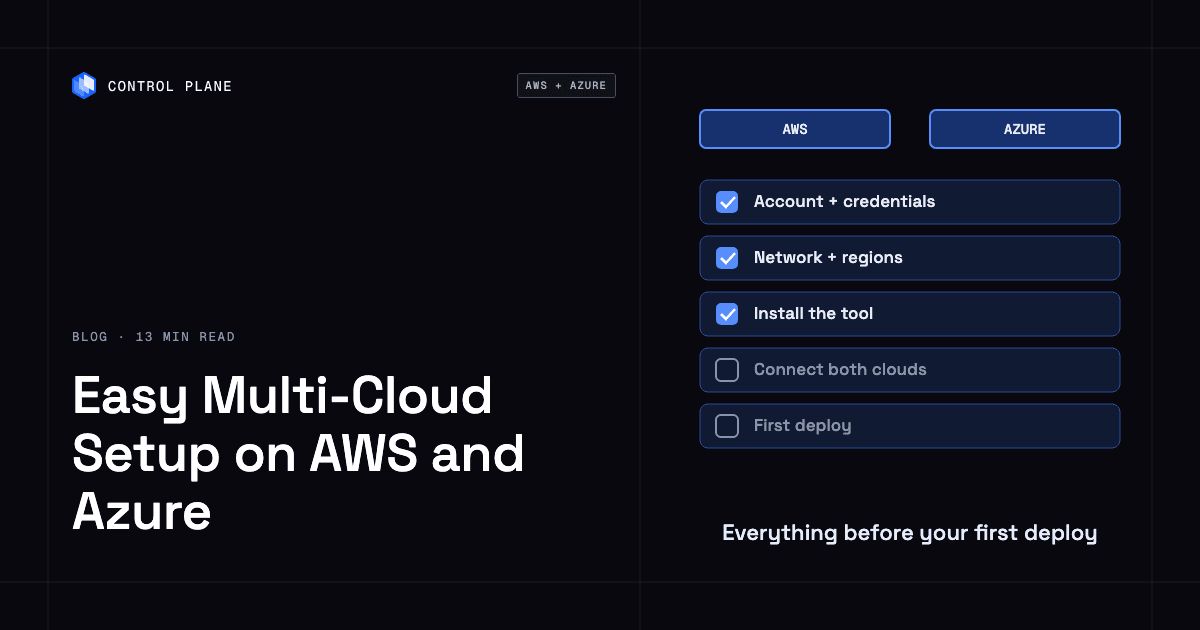
The tools with the simplest installation and setup for cloud infrastructure orchestration across AWS and Azure are the single-binary IaC CLIs Terraform and OpenTofu, the Pulumi CLI (plus your language runtime), agentless Ansible, and hosted run platforms such as HCP Terraform, Spacelift, and env zero (formerly env0) that can manage state and runners for you. The setup they share is cloud identity: an AWS IAM role, an Azure service principal or managed identity, and OIDC federation so CI holds no long-lived keys, plus a remote state backend with locking when you run Terraform or OpenTofu yourself. Platforms such as Control Plane go a step further for workloads by deploying to AWS and Azure locations from a single definition without you building a cluster or connecting a cloud account in either cloud.
Disclosure: Control Plane publishes this guide.
TL;DR
The tools with the simplest setup for orchestration across AWS and Azure are Terraform, OpenTofu, Pulumi, Ansible, and hosted IaC platforms like HCP Terraform, Spacelift, and env zero.
- Install is the easy part. Terraform and OpenTofu are single binaries, Pulumi adds a language runtime, and Ansible is a pip package. That step takes minutes.
- Identity, CI, and state are the real setup. You configure an AWS IAM role, an Azure service principal or managed identity, and a CI runner or hosted execution environment, plus a remote state backend with locking when you run Terraform or OpenTofu yourself.
- Use OIDC federation so CI holds no long-lived keys. AWS IAM identity providers and Azure federated identity credentials let GitHub Actions, GitLab CI, and other runners assume cloud roles without stored secrets.
- Provisioning tools and workload platforms solve different problems. IaC tools provision cloud resources, and workload platforms deploy and run applications. Teams running applications on both clouds typically use both.
- Hosted runners remove state and runner setup. HCP Terraform, Spacelift, and env zero can manage state storage and execution for you, but you still configure cloud credentials.
- Native tools mean two toolchains. CloudFormation covers AWS and Bicep covers Azure, with separate template languages and pipelines.
- Where Control Plane fits. Control Plane deploys and runs workloads, including open-source databases from its Template Catalog, on AWS and Azure locations from one definition, with no cloud account to connect for its managed locations. Its Terraform and Pulumi providers let it work alongside the IaC you use for VPCs and account-level cloud resources.
Which tools provide an easy installation and setup process for cloud infrastructure orchestration across AWS and Azure?
Most tools in this space install in minutes, Crossplane excepted because it needs a Kubernetes cluster, and the real setup is everything each tool needs before the first change lands on both AWS and Azure.
| Tool | Install | State or backend you set up | AWS credentials | Azure credentials | Runs from | What you operate afterward |
|---|---|---|---|---|---|---|
| Terraform (CLI) | Single binary download or package manager | Local state file by default; for teams, an S3 bucket with use_lockfile or Azure Blob with lease locking that you create and configure | IAM role or IAM user; an IAM OIDC identity provider for CI | Service principal or managed identity; a federated identity credential for CI | Laptop, any CI runner | State backend, CI runner, provider upgrades, module maintenance |
| OpenTofu | Single binary download or package manager; a largely compatible fork of Terraform 1.5 | Same as Terraform: S3 with use_lockfile or Azure Blob with lease locking | Same as Terraform | Same as Terraform | Laptop, any CI runner | Same as Terraform |
| Pulumi | CLI install via package manager plus a language runtime (Node.js, Python, Go, .NET, or Java) | Pulumi Cloud by default (sign up, then authenticate CI with an access token or Pulumi OIDC), or a self-managed S3, Azure Blob, or local backend | IAM role or IAM user; OIDC for CI through Pulumi ESC or Pulumi Deployments, or your CI’s own OIDC trust | Service principal or managed identity; a federated identity credential for CI | Laptop, any CI runner, Pulumi Deployments | Provider upgrades and program maintenance; with a self-managed backend, also the state backend and CI runner |
| Ansible | pip install ansible, which bundles the amazon.aws and azure.azcollection collections; then install their Python SDK dependencies (boto3 and the azcollection requirements file) | No state file; inventory files or dynamic inventory | IAM role or IAM user; aws configure sso or environment variables | Service principal; az login or environment variables | Laptop, any CI runner (agentless, over SSH, WinRM, or cloud APIs) | Inventory, playbooks, collection upgrades, CI runner |
| Crossplane | A Kubernetes cluster first; then the Crossplane Helm chart and service-scoped providers such as provider-aws-s3 and provider-azure-storage, which pull in provider-family-aws and provider-family-azure | The Kubernetes API server (etcd) holds desired state; you operate the cluster | IAM role; a ProviderConfig using IRSA, EKS Pod Identity, or a Secret with access keys | Service principal or managed identity; a ProviderConfig using a Secret or managed identity | Kubernetes cluster (self-managed, EKS, or AKS) | Kubernetes cluster, Crossplane and provider upgrades, ProviderConfig objects |
| HCP Terraform | Sign up; optionally install the Terraform CLI locally | Managed by HCP Terraform (no bucket to create) | Dynamic provider credentials through an OIDC trust between HCP Terraform and AWS IAM | Dynamic provider credentials through an OIDC trust between HCP Terraform and Microsoft Entra ID | HCP Terraform hosted runners | Provider upgrades, modules, workspace configuration |
| Spacelift | Sign up; connect your VCS repository | Managed by Spacelift (a per-stack option) or your own backend | Cloud integration: an IAM role whose trust policy uses Spacelift’s external ID | Cloud integration: create it in Spacelift, admin-consent its Entra application in your tenant, then assign that enterprise application an RBAC role | Spacelift hosted runners or self-hosted workers | Provider upgrades, stack configuration |
| env zero (formerly env0) | Sign up; connect your VCS repository | Managed by env zero when its remote backend is enabled, or your own backend | OIDC: an IAM OIDC provider trusting env zero, then an IAM role | OIDC: a federated identity credential on an Entra app registration, then an RBAC role assignment | env zero hosted runners or self-hosted agents | Provider upgrades, template maintenance |
| AWS CloudFormation + Azure Bicep | AWS CLI for CloudFormation; Azure CLI for Bicep (the Azure CLI installs the Bicep CLI automatically on first use) | CloudFormation stacks in AWS; Bicep deployments tracked by Azure Resource Manager | IAM role or IAM user with CloudFormation permissions | Service principal or managed identity with an RBAC role scoped to the target resource groups | AWS Console or CLI and Azure portal or CLI, or two CI pipelines | Two template languages, two pipelines, CloudFormation drift detection on AWS and what-if previews on Azure |
| Control Plane | Control Plane’s cpln CLI or the Control Plane console | Managed by the Control Plane API | None to deploy to Control Plane-managed AWS locations; to let workloads call your own AWS services, connect an AWS cloud account (an IAM role Control Plane can assume) for Control Plane’s Universal Cloud Identity (UCI) | None to deploy to Control Plane-managed Azure locations; to let workloads call your own Azure services, connect an Azure cloud account (a service principal (the Azure SDK method), or Control Plane’s Azure Function App connector) for UCI | Control Plane console, cpln CLI, Terraform or Pulumi provider, or the Control Plane MCP server, all through the Control Plane API | Workload definitions and Control Plane Global Virtual Cloud (GVC) configuration; Control Plane runs autoscaling, observability, and security |
Every IaC tool needs cloud credentials configured in both AWS and Azure. The differentiator is whether you also manage state storage, a CI runner, and a Kubernetes cluster yourself. Hosted platforms absorb the state and runner burden, and workload platforms absorb the workload runtime burden.
What setup does every tool need on AWS and Azure?
Every IaC tool needs a deployment identity in each cloud, an OIDC trust for each CI system or hosted platform, and, when you run the tool yourself, a state backend.
| Step | AWS | Azure | Why it matters |
|---|---|---|---|
| Identity the tool runs as | IAM role (preferred) or IAM user | Service principal or user-assigned managed identity | Every API call is authenticated as this identity; a role avoids long-lived access keys |
| Short-lived CI credentials via OIDC | An IAM OIDC identity provider for your CI system (for example, GitHub Actions), then an IAM role whose trust policy pins the token audience to sts.amazonaws.com and the subject to a specific repository and branch or environment | A federated identity credential on an Entra ID app registration or user-assigned managed identity, matched to your CI system’s issuer and subject | No stored cloud keys in CI secrets; tokens are short-lived and scoped to each pipeline run |
| Least-privilege scope | IAM policies split into a read-only plan role and an apply role scoped to the services your templates manage | RBAC role assignment at the subscription or resource group scope; Contributor cannot create role assignments, so templates that manage RBAC need Role Based Access Control Administrator at a narrow scope | Limits accidental or malicious changes to resources outside the deployment scope |
| Local developer login | aws configure sso, then aws sso login | az login (browser flow or device code) | Developers authenticate without long-lived credentials on their laptops |
| State storage and locking | S3 bucket with versioning, default encryption, blocked public access, and use_lockfile (Terraform has deprecated the DynamoDB lock table in favor of use_lockfile) | Azure Storage account with a Blob container; lease-based locking is built in | Prevents concurrent applies from corrupting state; versioning enables rollback |
| Audit trail | AWS CloudTrail records management (control-plane) API calls by the deployment identity; create a trail to keep them past 90 days, and data events need extra configuration | Azure Activity Log records control-plane operations on resources in the subscription; export it to keep entries past 90 days | Links infrastructure changes to identities and timestamps |
Identities and state backends are set up once per cloud account, and each new CI system or hosted platform adds its own OIDC trust and role. State files can contain secrets, so treat the backend as sensitive. Secrets management best practices covers storing and rotating the credentials this setup creates.
What does each kind of tool leave you to run after setup?
Setup is a one-time cost, and each kind of tool leaves different work with your team afterward.
| Tool type | Setup covers | Still yours after setup |
|---|---|---|
| IaC CLIs (Terraform, OpenTofu, Pulumi) | Infrastructure definition, plan, and apply; providers for AWS and Azure resources | State backend availability and backups, CI runner, provider and module upgrades, drift detection, secret injection, policy enforcement, cost controls |
| Hosted IaC run platforms (HCP Terraform, Spacelift, env zero) | Everything the CLI covers plus managed state, locking, hosted runs, VCS integration, policy checks, and cost estimation | Cloud credential rotation (unless you use OIDC), provider and module upgrades, workspace or stack configuration, approval workflows |
| Configuration management (Ansible) | VM and service configuration, application deployment, ad hoc tasks across AWS and Azure targets | Inventory accuracy, playbooks and collections, CI runner, SSH key or WinRM credentials; with no state file, drift shows only when playbooks rerun in check mode |
| Kubernetes-based reconcilers (Crossplane) | Continuous reconciliation of declared infrastructure, drift correction, composition abstractions | Kubernetes cluster operations (upgrades, scaling, etcd backups), Crossplane and provider upgrades, ProviderConfig management, debugging reconciliation failures |
| Cloud management platforms (HPE Morpheus Enterprise, CloudBolt) | A portal for provisioning, governance, cost management, and self-service catalogs across clouds | The platform or SaaS subscription, integrations, catalog curation, user and role management |
| Native tools (CloudFormation, Bicep) | Deep integration with each cloud’s API and resource model | Two toolchains, two template languages, two CI pipelines, no shared state or abstraction across clouds |
| Workload platforms (Control Plane) | Workload deployment across AWS and Azure locations from one definition, autoscaling, observability, security, open-source databases from Control Plane’s Template Catalog, and UCI access to AWS, GCP, and Azure services with no long-lived keys in code | Workload definitions and GVC configuration; IaC for cloud resources such as VPCs, provider database services, and account-level IAM |
The top infrastructure as code tools guide covers each IaC engine in more depth.
How do you choose the easiest tool for your team?
The easiest tool depends on your team’s size, skills, and what you are deploying.
- One engineer with a laptop who needs AWS and Azure resources: start with Terraform or OpenTofu. A single binary, a low-cost S3 or Azure Blob backend, and
aws sso loginandaz loginget you running with few moving parts. - A team using GitHub Actions that wants managed state and policy checks: HCP Terraform, Spacelift, or env zero remove the state backend and runner burden. All three support OIDC federation with AWS and Azure, so the pipeline stores no cloud keys.
- A platform team already running Kubernetes: Crossplane declares AWS and Azure resources as Kubernetes custom resources and reconciles them continuously. The trade-off is operating the cluster and Crossplane controllers.
- An ops team that configures VMs and middleware: Ansible is agentless, connects over SSH or WinRM, and has mature
amazon.awsandazure.azcollectioncollections. Pair it with an IaC tool for provisioning. - A team that wants to deploy workloads to both clouds without building clusters: a workload platform deploys to multiple clouds from a single definition and needs no per-cloud cluster or credentials to start.
The best tools for deploying applications across AWS, GCP, and Azure compares deployment tools more broadly, and teams with many cloud accounts can standardize governance across dozens of cloud accounts.
How does Control Plane simplify setup across AWS and Azure?
Control Plane deploys and runs production workloads across clouds, and its setup centers on those workloads.
Setup starts with the Control Plane console or the cpln CLI, both of which work against the Control Plane API. You create a Global Virtual Cloud (GVC) and add AWS and Azure locations to it. A workload deployed to that GVC runs in every location you selected, so one workload definition deploys to both clouds. You do not build or operate a Kubernetes cluster in either cloud for Control Plane-managed locations, and deploying there needs no AWS or Azure account connection.
Control Plane’s Universal Cloud Identity (UCI) lets workloads call AWS, GCP, and Azure services with no long-lived cloud keys in your code. You connect a cloud account only when workloads need your own cloud services: an IAM role on AWS, a service account on GCP, or a service principal or Control Plane’s Function App connector on Azure. UCI then issues short-lived, least-privilege credentials at runtime.
The CLI, console, Terraform and Pulumi providers, and the Control Plane MCP server all work through the same Control Plane API. Teams that already use Terraform or Pulumi can keep those tools for the cloud resources around their workloads and use the Control Plane providers for the workload layer. Control Plane can also export its configuration as Terraform.
Clusters you already run can join a GVC through Control Plane’s Bring Your Own Kubernetes (BYOK), and your own servers can join through Control Plane’s Managed Kubernetes (MK8s), including on premises.
Control Plane handles Day 2 operations for you, including autoscaling, built-in observability, and security. Control Plane is PCI DSS Level 1, SOC 2 Type II, HIPAA, and GDPR compliant.
Control Plane runs workloads, including open-source databases such as PostgreSQL and Redis from Control Plane’s Template Catalog. Cloud resources such as VPCs, provider database services like Amazon RDS or Azure SQL, and account-level IAM policies stay in Terraform or Pulumi. Multi-cloud management platforms in 2026 compares platforms that manage workloads across clouds.
FAQ
Short answers on setting up infrastructure orchestration across AWS and Azure.
Which tools provide an easy installation and setup process for cloud infrastructure orchestration across AWS and Azure?
Terraform and OpenTofu install as single binaries, Pulumi as a CLI plus a language runtime, and Ansible via pip. Hosted run platforms such as HCP Terraform, Spacelift, and env zero simplify setup further by managing state and execution. All of them still need an AWS IAM role and an Azure service principal or managed identity, ideally with OIDC federation so CI holds no long-lived keys; self-run Terraform and OpenTofu also need a remote state backend with locking. Workload platforms such as Control Plane deploy applications to AWS and Azure from one definition, with no cluster to build and no cloud account needed for Control Plane-managed locations.
Is Terraform or Pulumi easier to set up for AWS and Azure?
Pulumi is slightly faster to start because Pulumi Cloud is its default state backend, while Terraform defaults to a local state file and needs a remote backend or HCP Terraform configured explicitly for team use. Cloud credential setup is nearly identical, and both support OIDC federation so CI stores no cloud keys. The choice usually comes down to HCL (Terraform) or general-purpose languages (Pulumi).
Do I need separate tools for AWS and Azure?
No, if you use a multi-cloud IaC engine like Terraform, OpenTofu, or Pulumi, each of which has providers for both clouds. A single engine still uses separate AWS and Azure resource definitions, but keeps one language, workflow, and state format. With cloud-native tools you maintain CloudFormation templates for AWS and Bicep templates for Azure.
How do I connect GitHub Actions to AWS and Azure without storing keys?
Use OIDC federation in both clouds. In AWS, create an IAM OIDC identity provider with the issuer token.actions.githubusercontent.com and audience sts.amazonaws.com, then an IAM role whose trust policy restricts assumption to your repository and branch or environment. In Azure, create a federated identity credential on an Entra ID app registration or user-assigned managed identity with the GitHub Actions issuer and subject. Grant the workflow id-token: write permission, then use the aws-actions/configure-aws-credentials and azure/login actions. No access keys or client secrets are stored in the repository.
Where should Terraform state live for a multi-cloud setup?
In one remote backend you can lock and secure, or one backend per cloud. A common pattern is an S3 bucket with use_lockfile for AWS-targeted configurations and an Azure Storage account with Blob lease locking for Azure-targeted configurations. The requirements are encryption at rest, versioning for rollback, access limited to the deployment identity, and locking to prevent concurrent applies.
Is OpenTofu a drop-in replacement for Terraform?
Mostly yes for configurations written for Terraform 1.5 and earlier, since OpenTofu forked from that release and keeps the same language, state format, and providers. You switch by replacing terraform with tofu in local and CI scripts. Configurations that use features added in later Terraform releases, or the cloud block for HCP Terraform, need review against OpenTofu’s migration guide. S3 with use_lockfile and Azure Blob lease locking work the same way.
Is Ansible good for multi-cloud orchestration?
Yes, for configuring VMs, deploying applications, and running ad hoc tasks across AWS and Azure with the amazon.aws and azure.azcollection collections. It is agentless and connects over SSH or WinRM. Ansible keeps no state file, so detecting drift means rerunning playbooks in check mode. Ansible is commonly paired with an IaC tool that provisions the infrastructure it configures.
How does Control Plane deploy to AWS and Azure?
Through a Control Plane Global Virtual Cloud (GVC) with AWS and Azure locations. A workload deployed to that GVC runs in every selected location from one workload definition. Control Plane-managed compute runs in AWS, GCP, Azure, and Oracle Cloud regions, and deploying there needs no AWS or Azure account connection and no Kubernetes cluster to build or operate. Teams that use Terraform or Pulumi manage the GVC and workloads through the Control Plane providers.
What is the difference between provisioning infrastructure and deploying workloads?
Provisioning creates cloud resources like VPCs, subnets, databases, IAM roles, and storage accounts, which IaC tools like Terraform, OpenTofu, and Pulumi handle. Deploying workloads runs your application code on compute in one or more clouds, with autoscaling, observability, and networking included, which is the layer workload platforms like Control Plane cover. Multi-cloud teams commonly use both.
Talk to the Control Plane team to see workload deployment across AWS and Azure from one definition, or sign up free to try it yourself.