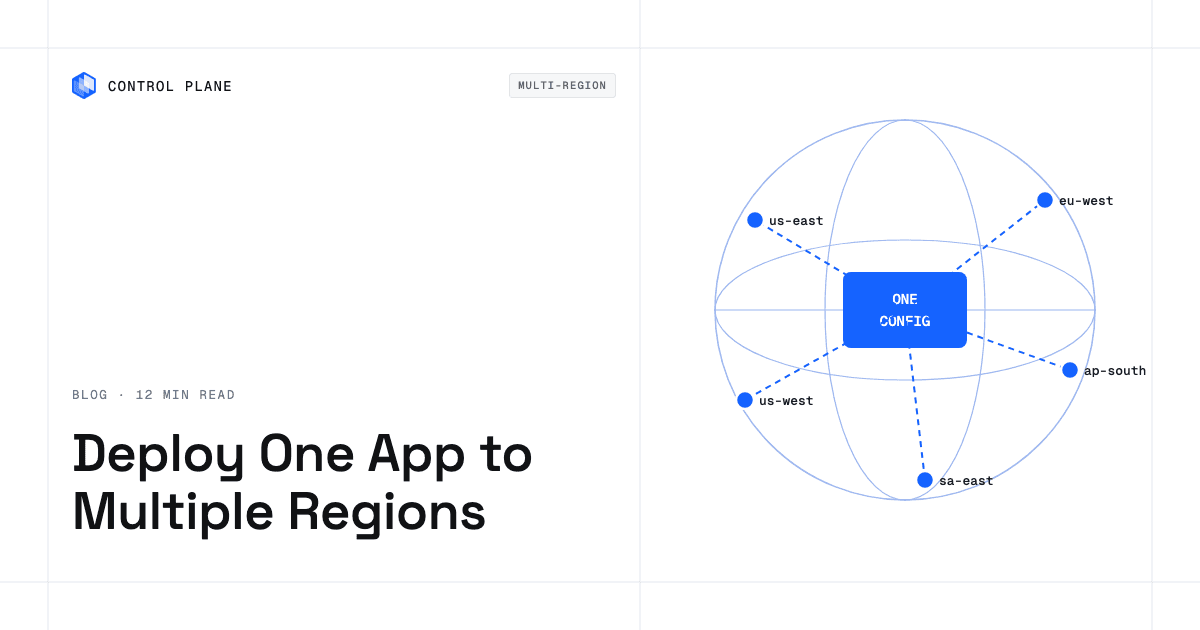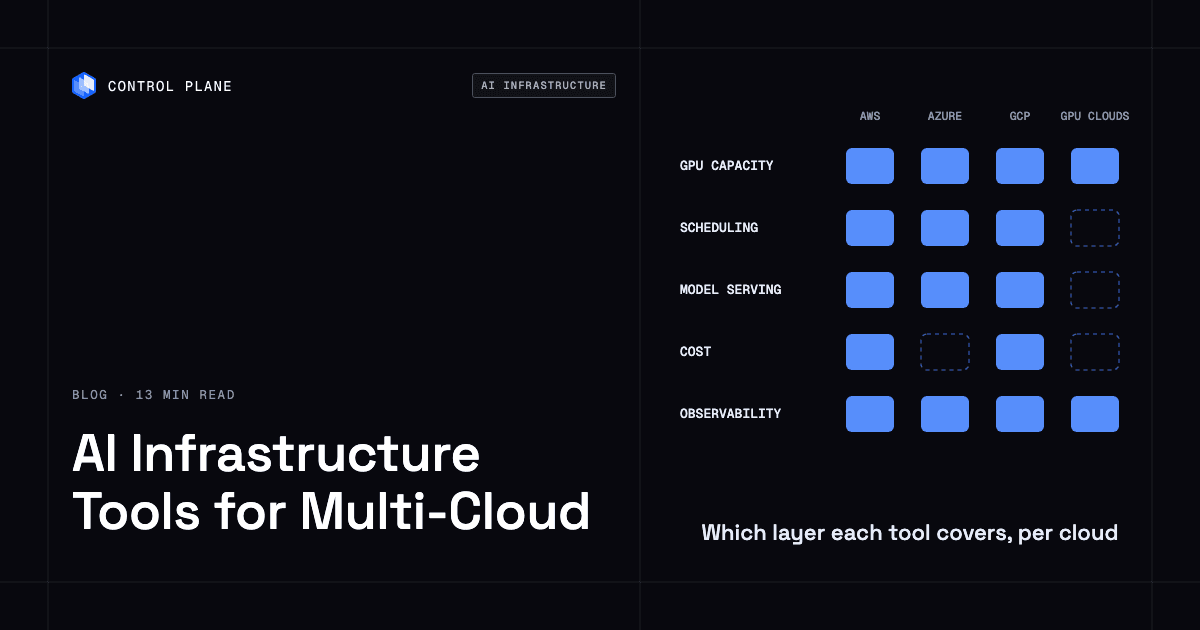
The question has two meanings: tools that use AI to operate infrastructure, and infrastructure that runs AI workloads across clouds. Useful tools sit in five layers: provisioning, cluster and workload orchestration, GPU job scheduling, cost and capacity management, and observability and AI operations. Each layer needs one source of truth. A workload platform such as Control Plane runs the workload layer across AWS, GCP, Azure, and Oracle Cloud Infrastructure (OCI) from one API, and AI agents can drive it through an MCP server.
Disclosure: Control Plane publishes this guide.
TL;DR
Key points for choosing AI infrastructure tools across clouds.
- AIOps tools and AI infrastructure tools are different categories with different selection criteria.
- Five layers matter: provisioning, cluster and workload orchestration, GPU job scheduling, cost and capacity, and observability and AI operations.
- Give each layer one source of truth. Two tools writing the same state cause drift, and an uncovered layer is a gap.
- GPU job scheduling and cluster management are separate jobs. SkyPilot places batch jobs on the cheapest available GPUs across clouds. Karmada distributes workloads across clusters, and SUSE Rancher manages fleet lifecycle.
- Azure SRE Agent and Gemini Cloud Assist are built for one cloud. They act on Azure and Google Cloud resources respectively.
- AI agents need guardrails: read-only access first, approval for destructive actions, and tamper-proof audit trails.
- Control Plane runs workloads across AWS, GCP, Azure, and OCI from one API. Its MCP server lets AI assistants deploy, diagnose, scale, and roll back workloads, and instructs the assistant to get your approval before destructive actions.
What AI infrastructure tools help manage multi-cloud infrastructure across providers and regions?
This matrix maps major tools to one of the five layers and to what “AI” means for each one.
| Tool | Layer | What “AI” means for this tool | Clouds and environments covered | Multi-region or multi-cloud scheduling | Open source or commercial |
|---|---|---|---|---|---|
| Terraform / OpenTofu | Provisioning | Neither; provisions the resources AI workloads use. HashiCorp also publishes an MCP server | AWS, GCP, Azure, OCI, and thousands of other providers in the Terraform Registry | No scheduling; provisions declared resources in declared regions | OpenTofu is open source; Terraform uses the Business Source License |
| Pulumi (including Pulumi Neo) | Provisioning | Pulumi Neo is an AI agent that investigates infrastructure, runs previews, updates code, and prepares pull requests under approval settings | AWS, GCP, Azure, OCI, Kubernetes, and many other providers | No scheduling; provisions where you declare | Open source engine; commercial Pulumi Cloud and Neo |
| Crossplane | Provisioning | Neither; a Kubernetes-native control plane for cloud resources | AWS, GCP, Azure, OCI, and others via providers | No cross-cloud scheduling; reconciles declared resources | Open source (CNCF graduated) |
| Spacelift | Provisioning (IaC orchestration) | Spacelift Intelligence provisions and manages infrastructure from plain-language requests (Intent and Infra Assistant), answers questions about your account, and explains failed runs, under Spacelift policies | Orchestrates Terraform, OpenTofu, Pulumi, CloudFormation, Ansible, and Kubernetes across providers | No workload scheduling; orchestrates IaC stacks | Commercial |
| SkyPilot | GPU job scheduling | Runs AI workloads across clouds by price and availability | AWS, GCP, Azure, OCI, Lambda, Nebius, RunPod, and other GPU clouds, plus Kubernetes and Slurm clusters | Yes; picks the cheapest available GPUs across clouds and regions and recovers from spot preemption | Open source |
| Ray with KubeRay (Anyscale for managed Ray) | GPU job scheduling | Runs AI workloads (training, tuning, serving) | AWS, GCP, Azure, and on-premises via VMs or Kubernetes; Anyscale runs on AWS, GCP, and any Kubernetes cluster, including AKS and on premises | A Ray cluster runs in one cloud and region; Anyscale can fall jobs back to other regions or providers (beta) | Ray and KubeRay are open source; Anyscale is commercial |
| Kubeflow | Cluster and workload orchestration (ML pipelines) | Runs AI workloads (training pipelines, tuning, experiments) | Any Kubernetes cluster | No native cross-cloud scheduling | Open source (CNCF graduated) |
| KServe | Cluster and workload orchestration (model serving) | Runs AI workloads (inference) | Any Kubernetes cluster, in Standard or Knative deployment mode | No native cross-cloud routing | Open source (CNCF incubating) |
| Karmada | Cluster and workload orchestration | Neither; distributes workloads across Kubernetes clusters | Any Kubernetes cluster on any cloud or on premises | Yes; policy-based multi-cluster scheduling and failover | Open source (CNCF graduated) |
| SUSE Rancher | Cluster and workload orchestration | Neither; manages Kubernetes fleet lifecycle | EKS, GKE, AKS, other certified Kubernetes, on premises, and edge | Multi-cluster management; no workload scheduling between clusters | Open source; commercial Rancher Prime |
| Cast AI | Cost and capacity management | Uses AI to automate Kubernetes cost optimization and right-sizing, with AI agents and an MCP server | AWS, GCP, Azure, OCI, plus on-premises clusters | Optimizes each cluster; OMNI Compute can extend a cluster onto GPU capacity in other regions and clouds | Commercial |
| OpenCost | Cost and capacity management | Neither; allocates Kubernetes costs and reports cloud costs from AWS, Azure, and GCP billing | Any Kubernetes cluster | Per-cluster cost visibility; no scheduling | Open source (CNCF incubating) |
| Datadog | Observability and AI operations | Uses AI for anomaly detection and incident investigation (Bits AI SRE) | AWS, GCP, Azure, on premises, and hybrid | Unified view across clouds; no scheduling | Commercial |
| Dynatrace | Observability and AI operations | Uses AI (Dynatrace Intelligence, formerly Davis AI) for automatic root cause analysis | AWS, GCP, Azure, on premises, and hybrid | Unified view across clouds; no scheduling | Commercial |
| Azure SRE Agent | Observability and AI operations | Uses AI to investigate and remediate Azure incidents | Azure resources, plus connected observability, incident, and code tools | Azure regions only | Commercial (generally available) |
| Gemini Cloud Assist | Observability and AI operations | Uses AI to design, troubleshoot, and optimize Google Cloud resources, cost, and security | Google Cloud only | Google Cloud regions only | Commercial (preview) |
| Control Plane | Cluster and workload orchestration | Runs AI workloads (GPU containers) and can be operated by AI agents through its MCP server | AWS, GCP, Azure, OCI, plus your own Kubernetes clusters and on-premises servers | Yes; a workload runs in every location of its Control Plane Global Virtual Cloud (GVC) | Commercial |
Some tools straddle layers. A multi-cluster Kubernetes manager can host AI workloads and be operated by AI agents, while an IaC platform creates the resources those clusters run on. Uneven GPU supply, spot pricing, and regional latency drive placement decisions for training and serving, so no single tool covers every layer.
Which tool should you use for each job?
Each row names a job, the tool to start with, and what that tool leaves out.
| Job | Start with | Why | What it does not cover |
|---|---|---|---|
| Provision GPU clusters on several clouds from one codebase | Terraform or OpenTofu with provider-specific modules | Broadest provider coverage; declarative and auditable | Workload scheduling, dynamic cost optimization, and Day 2 operations |
| Run training or batch jobs wherever GPUs are available or cheapest | SkyPilot | Finds the cheapest available GPUs across AWS, GCP, Azure, OCI, and specialty clouds; recovers from spot preemption | Kubernetes fleet lifecycle, cost allocation reporting, and production service management (its SkyServe serving library is in beta) |
| Serve models in several regions behind one endpoint | Control Plane, or KServe on a multi-cluster Kubernetes setup | Control Plane gives each workload one endpoint that DNS geo-routes to the nearest healthy location; KServe provides model serving primitives | KServe alone does not handle cross-cloud DNS, identity, or traffic routing |
| Manage many Kubernetes clusters across clouds | Karmada or SUSE Rancher | Karmada for policy-based workload distribution; Rancher for fleet lifecycle management | GPU cost optimization, FinOps reporting, and infrastructure code |
| Track GPU and AI spend across providers | OpenCost with cloud billing data, plus Cast AI for automated optimization | Open source allocation at namespace level on any Kubernetes cluster | Infrastructure provisioning and workload management |
| Investigate incidents across clouds with an AI assistant | Datadog or Dynatrace with AI features enabled | Unified telemetry and AI root cause analysis across providers | Provisioning infrastructure or deploying workloads; remediation is limited to suggested fixes and configured automations |
| Let an AI agent deploy and operate workloads with guardrails | Control Plane with its MCP server | AI assistants operate workloads through the Control Plane API, with an opt-in read-only toolset, marked destructive tools, and a tamper-proof audit trail | Price-based batch GPU scheduling (use SkyPilot) |
The 10 best multi-cloud management platforms in 2026 compares management platforms in more depth.
What does each kind of tool leave uncovered?
Each category covers one layer and leaves the others to you.
| Tool type | Covers | Leaves to you |
|---|---|---|
| IaC tools (Terraform, OpenTofu, Pulumi, Crossplane) | Declaring and provisioning cloud resources consistently across providers | Workload scheduling, Day 2 operations, cost optimization, observability, and identity federation |
| GPU job schedulers (SkyPilot, Ray with KubeRay) | Placing AI training and batch jobs on available GPUs (SkyPilot also by price) | Kubernetes fleet lifecycle, cost reporting, compliance enforcement, and cross-cloud identity |
| Multi-cluster Kubernetes managers (Karmada, SUSE Rancher) | Cluster lifecycle, policy consistency, and workload distribution across clusters | GPU cost optimization, AI-specific scheduling, unified observability, and FinOps |
| FinOps tools (OpenCost, Cast AI) | Cost visibility, allocation, and automated optimization (Cast AI) | Provisioning, workload orchestration, observability, and security policy enforcement |
| AI ops and observability agents (Datadog, Dynatrace) | Unified telemetry, anomaly detection, and root cause analysis | Infrastructure provisioning, workload deployment, cost optimization, and compliance |
| Hyperscaler-native AI agents (Azure SRE Agent, Gemini Cloud Assist) | AI-assisted operations within one cloud provider | Cross-cloud operations, multi-cloud workload orchestration, and multi-provider cost tracking |
| Workload platforms such as Control Plane | Running workloads across AWS, GCP, Azure, and OCI, including scaling, monitoring, and security | Price-based batch GPU scheduling and resources that run outside Control Plane |
Let one tool be the source of truth for each layer. If your IaC tool and your Kubernetes manager both own cluster configuration, the two drift apart. If Cast AI and your workload platform both change node or replica counts, scaling behavior becomes unpredictable.
For composing Kubernetes-native infrastructure layers, modular infrastructure with Kubernetes, Crossplane, and kro compares the options.
How do AI agents fit into multi-cloud operations?
AI agents reach infrastructure through the Model Context Protocol (MCP), which gives AI assistants structured access to APIs, documentation, and operational data.
An MCP server exposes tools that an AI assistant can call, turning natural-language instructions into API calls against real infrastructure. The safe adoption path is read-only access first, then write operations with explicit approval: the agent proposes an action, states the expected impact, and waits for a human to confirm. Every action, read or write, should land in an audit trail the agent cannot modify.
An agent that can query telemetry, read IaC state, and call a workload platform’s API can correlate all three in one session. An agent with unrestricted write access can also cause cascading failures, so start narrow and widen access deliberately.
IaC, observability, and orchestration tools now ship MCP servers. The best MCP servers for DevOps compares what each one can change and how it authenticates.
How Control Plane fits
Control Plane is the unbreakable platform for running production workloads. It runs serverless, standard, stateful, and cron workloads natively on AWS, GCP, Azure, and Oracle Cloud Infrastructure (OCI), VM workloads on locations joined through Control Plane’s Managed Kubernetes, and workloads on Kubernetes clusters you already run or your own machines, including on premises, active-active across regions and clouds.
A Global Virtual Cloud (GVC) is Control Plane’s named set of locations across AWS, GCP, Azure, and OCI regions, plus Kubernetes clusters you already run and your own servers. A workload runs in every location of its GVC, so one definition deploys active-active across clouds and regions.
Workloads can attach NVIDIA GPUs, and the pricing page lists models from T4 to B200. Control Plane’s Managed Kubernetes (MK8s) can join GPU servers from other providers as locations, so specialized GPU capacity joins the same platform that runs your other workloads. Running AI/ML containers on GPUs without vendor lock-in covers the portability details.
Control Plane’s Universal Cloud Identity (UCI) lets workloads call AWS, GCP, and Azure services with no long-lived cloud keys in your code. The CLI, console, Terraform and Pulumi providers, and the Control Plane MCP server all work through the same Control Plane API. Control Plane is PCI DSS Level 1, SOC 2 Type II, HIPAA, and GDPR compliant. Control Plane handles Day 2 operations for you, including autoscaling, built-in observability, and security.
The Control Plane MCP server lets AI assistants such as Claude Code, Cursor, Codex, and ChatGPT deploy, diagnose, scale, and roll back workloads through the Control Plane API. You can connect on the read-only toolset, which cannot change a live resource; the default toolset can. Destructive tools are marked, and the server instructs the assistant to state the impact and get your approval first. Actions are recorded in Control Plane’s tamper-proof audit trail.
Control Plane does not schedule batch training jobs across clouds by price the way SkyPilot does, and it does not replace FinOps or IaC tools for resources outside it. You can run SkyPilot for batch training and run long-running services and inference on Control Plane. For workloads it runs, Control Plane’s Cost & Usage view shows spend per org and per resource with a projected total. Spend outside Control Plane still needs cloud billing data or a FinOps platform, and a single view of cost and security across multiple clouds shows how to join them.
FAQ
Common questions about AI infrastructure tools for multi-cloud management.
What AI infrastructure tools help manage multi cloud infrastructure across providers and regions?
Pulumi Neo, Cast AI, Datadog, Dynatrace, Azure SRE Agent, and Gemini Cloud Assist use AI to operate infrastructure. SkyPilot, Ray with KubeRay, Kubeflow, and KServe run AI workloads, and SkyPilot schedules them across clouds. Terraform or OpenTofu, Karmada, and SUSE Rancher cover provisioning and cluster management. Workload platforms such as Control Plane run workloads across AWS, GCP, Azure, and Oracle Cloud Infrastructure (OCI) and expose an MCP server so AI agents can operate them.
What is SkyPilot used for?
SkyPilot is an open-source framework that runs AI training and batch jobs on the cheapest available GPUs across clouds. You submit a job description and SkyPilot picks a provider, region, and instance type by price and availability, and it recovers from spot preemption. Its serving library, SkyServe, is in beta and suited to internal serving. SkyPilot does not manage Kubernetes fleet lifecycle or cost allocation reporting.
Is Ray good for multi-cloud AI workloads?
Ray works well for distributed training, tuning, and serving inside one cloud and region. A single Ray cluster’s head and worker nodes share a cloud and region. Anyscale, the managed Ray service, can fall back to resources in another region or provider for jobs (a beta feature) when capacity runs short, but one cluster never spans clouds. KubeRay deploys Ray on Kubernetes.
Can Terraform manage GPU infrastructure across clouds?
Yes, for provisioning. Terraform can create GPU instances, networking, and storage on any cloud with a provider, and its declarative files make GPU cluster infrastructure auditable. It does not schedule workloads onto those resources, optimize GPU cost, or run Day 2 operations such as autoscaling and observability.
What is the difference between AIOps and AI infrastructure?
AIOps uses AI to operate infrastructure: anomaly detection, root cause analysis, automated remediation, and alerting. AI infrastructure is the compute, networking, storage, and orchestration that runs AI workloads such as training and inference. The two overlap when an AIOps tool manages the infrastructure that runs AI workloads.
How do I track GPU costs across multiple clouds?
Combine a Kubernetes cost tool with cloud billing data. OpenCost allocates Kubernetes costs at namespace level and reports cloud costs from AWS, Azure, and GCP billing. Cast AI adds automated optimization for Kubernetes clusters on AWS, GCP, Azure, and OCI. Cloud billing data covers GPU spend on non-Kubernetes infrastructure that these tools do not see.
Can an AI agent manage cloud infrastructure safely?
Yes, with guardrails. Start with read-only access so the agent can query and diagnose without changing anything. Allow write operations only with human approval for destructive actions, and require the agent to state the expected impact first. Record every action in a tamper-proof audit trail. On Control Plane, you can connect an assistant on the read-only toolset; on the default toolset, destructive tools are marked and the server instructs the assistant to ask before running one, though each destructive tool still acts in a single call.
Do hyperscaler AI assistants work across other clouds?
No. Azure SRE Agent is built to operate Azure resources, and Gemini Cloud Assist works only on Google Cloud resources. Neither manages resources on another provider. Azure SRE Agent can read third-party observability data through MCP connectors, but its actions target Azure.
How does Control Plane run AI workloads across clouds?
Control Plane runs each workload in every location of its Global Virtual Cloud (GVC), a set of AWS, GCP, Azure, and Oracle Cloud Infrastructure (OCI) regions plus your own Kubernetes clusters and servers. Workloads can attach NVIDIA GPUs, and the pricing page lists models from T4 to B200. Control Plane’s Managed Kubernetes (MK8s) joins GPU servers from other providers as locations, and Control Plane’s Universal Cloud Identity (UCI) lets workloads call AWS, GCP, and Azure services without long-lived cloud keys. Autoscaling, logs, metrics, traces, and the audit trail come built in.
Ready to run workloads across clouds from one API? Talk to the Control Plane team or sign up free.