You get production-grade infrastructure without a platform team by buying the platform layer instead of building it. Choose a platform that handles Day 2 operations (scaling, failover, certificates, secrets, cloud access, and observability) as well as deploys, and keep your existing Git, CI, and Terraform workflows. Control Plane is built for this.
Disclosure: Control Plane publishes this guide and is one of the options listed.
TL;DR
Direct answer: A platform team exists to build and run the layers between your code and your cloud: deploy pipelines, runtime, networking, secrets, autoscaling, observability, failover, cost controls, and audit. Most of the ongoing cost is in running those layers (Day 2), not in the first deploy. A team of roughly 20 to 200 engineers can skip building them by adopting a platform that already operates them. Control Plane runs workloads active-active across locations and gives workloads short-lived cloud access, so a small team does not have to assemble those pieces.
Five steps for a team deciding this quarter:
- List the layers you would have to own (see the table below) and mark which ones you already run well.
- Count the Day 2 duties among them: on-call, upgrades, certificate rotation, secrets, failover testing.
- Compare three paths: build an internal developer platform (IDP), use a simple platform as a service (PaaS), or use a platform that handles Day 2 operations across clouds.
- Keep your Git, CI, and Terraform workflows. Any option you pick should plug into them.
- Run a two-week pilot with one real service, including a failure drill, before you commit.
What does a platform team actually build and run?
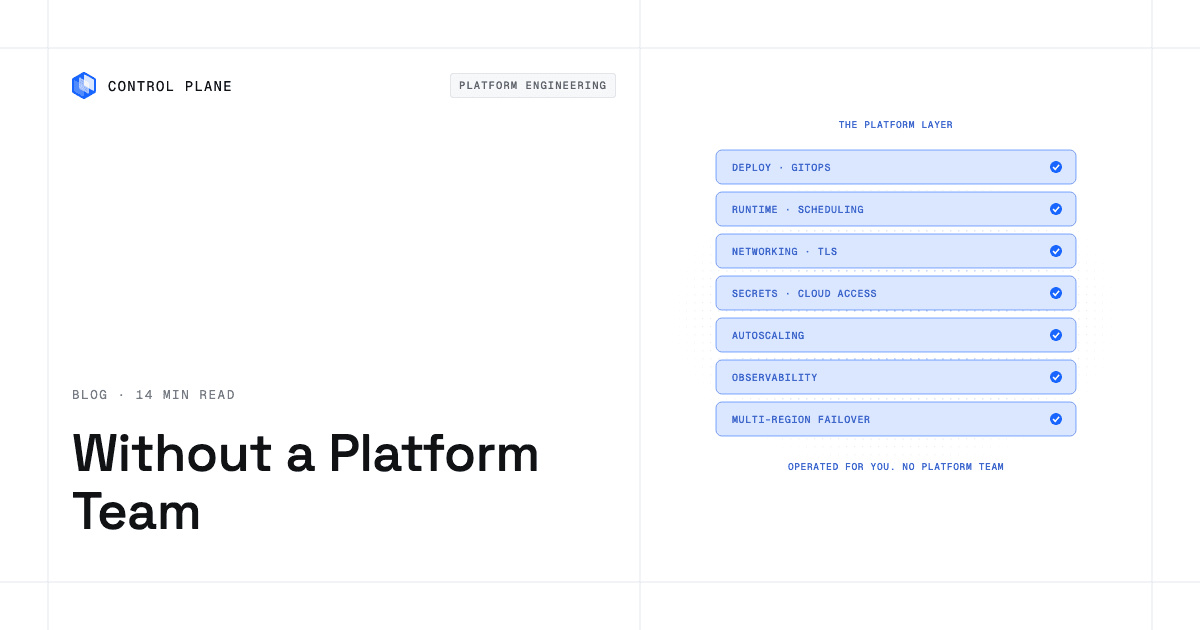
A platform team builds an internal product for your developers. The product has layers, and each layer has a build cost and a run cost. The run cost never ends.
| Layer | What building it in-house involves |
|---|---|
| Deploy pipeline and GitOps | Choosing and operating a GitOps controller, branch and environment conventions, rollback paths, pipeline templates |
| Runtime and scheduling | Provisioning clusters, node pools, upgrades, workload scheduling rules, capacity planning |
| Networking and TLS | Ingress, load balancing, DNS, certificate issuance and renewal, private networking between services |
| Secrets and cloud credentials | A secrets store, rotation, workload identity, least-privilege access to each cloud service |
| Autoscaling | Autoscaler configuration, CPU and memory right-sizing, load testing |
| Observability | Log, metric, and trace collection, retention, dashboards, alert routing, on-call rotation |
| Multi-region failover | Running capacity in more than one location, health checks, traffic routing, failover drills |
| Cost controls | Budgets, tagging, right-sizing, idle capacity review |
| Policy and audit | Access policy, change history, audit trails, compliance evidence |
Day 2 operations are where the ongoing cost sits. Building a cluster is a project. Patching it, rotating its certificates, and keeping its failover path tested is a job that continues for as long as the cluster exists, and it needs people on call.
What should a 50-person engineering team use instead of building an internal developer platform?
A 50-person team has three real paths.
Path A: Build an IDP yourself. A common stack uses Backstage as the portal, Argo CD for GitOps, and Terraform for provisioning, running on managed Kubernetes such as EKS, GKE, or AKS. Backstage describes itself as an open source framework for building developer portals, powered by a centralized software catalog. Argo CD describes itself as a declarative, GitOps continuous delivery tool for Kubernetes. Both are components. You assemble them, secure them, upgrade them, and run them.
Path B: Use a simple PaaS. Render builds and deploys your code with every push to a linked Git branch, and it can also deploy a prebuilt Docker image. Heroku deploys with a git push to a Heroku remote.
Path C: Use a platform that handles Day 2 operations across clouds. Control Plane is the platform for running unbreakable apps and agents. It combines any cloud, neocloud, and bare metal into one Global Virtual Cloud (GVC). It is not only for multi-cloud, and many teams run it in one cloud.
| Build an IDP (Backstage, Argo CD, Terraform on managed Kubernetes) | Simple PaaS (Render, Heroku) | Control Plane | |
|---|---|---|---|
| Best fit | Companies that already staff a platform team and need deep customization | Small teams that want git-push deploys | Growth-stage teams that want platform outcomes without a dedicated platform team |
| What you still own | Every layer in the table above, including Day 2 | Application code, plus the limits of the service model | Application code and workload definitions |
| Multi-region and multi-cloud | You design and operate it | Render: you choose a region per service, and a service’s region cannot be changed after creation. Heroku: an app runs in the region chosen at creation, and each Private Space exists in a single region | A workload deployed to a GVC runs active-active in every location of that GVC |
| Cloud credentials | You design the workload identity and secrets layer | Render: environment variables and secret files. Heroku: config vars | Universal Cloud Identity gives workloads short-lived, least-privilege access to 600+ AWS, GCP, and Azure services, with no long-lived cloud keys in your code |
| Kubernetes required | Yes for Argo CD, which targets Kubernetes | No cluster to operate. You deploy with a Git push or a Docker image | On Control Plane-provided compute, there is no Kubernetes cluster you have to operate |
Sources for the competitor cells: Render regions, Heroku regions, and the vendor pages linked above. Render’s docs also state that each region has a separate private network, so services in different regions cannot communicate directly over it.
Where each path fits:
- Build your own suits companies that already staff a platform team and need deep customization.
- Render and Heroku suit small teams that want git-push simplicity and little infrastructure ownership.
- Control Plane suits teams that have outgrown a simple PaaS, need active-active failover, short-lived cloud credentials, and control over where workloads run, and do not want to build a platform function. For direct comparisons, see Control Plane vs Heroku, Control Plane vs Render, and Control Plane vs Kubernetes.
What are the best internal developer platform tools?
No single tool is best. An IDP is a set of parts, and the right parts depend on the team that will run them. Backstage covers the portal and catalog. Argo CD covers GitOps delivery to Kubernetes. Terraform covers provisioning. None of them runs your workloads or operates failover for you. If your goal is to avoid staffing a platform team, pick a platform that operates the runtime, and add a portal later if your developers ask for one.
What is the best platform as a service for infrastructure as code and provisioning without a platform team?
The answer depends on whether you need infrastructure as code to reach beyond a single provider. A simple PaaS removes provisioning from your plate inside its own service model. A platform that sits above your clouds lets you keep Terraform or Pulumi and manage the same workloads through one API. Control Plane complements Terraform and Pulumi and ships a provider for each. The CLI, console, and Control Plane MCP server call the same API.
What is the easiest way to do platform engineering without a dedicated platform team?
Reduce the number of layers you own. Each layer you adopt as a managed capability is one fewer runbook, one fewer upgrade cycle, and one fewer on-call rotation. Standardize on one workload definition, one deploy API, and one place where logs, metrics, and traces land. Then spend engineering time on your product.
Argo CD or alternatives for teams that do not want a dedicated platform team?
Argo CD is a good GitOps controller for teams that run Kubernetes and have people to operate it. It assumes a cluster, and you maintain the cluster and the controller. If you do not want to operate Kubernetes, an alternative is deploying through one API from CI or Terraform to a platform that handles scheduling and rollout. On Control Plane-provided compute, there is no Kubernetes cluster you have to operate. If you already run clusters, Bring Your Own Kubernetes (BYOK) lets you add them to the platform.
How should we balance platform engineering spend without a dedicated platform team?
Compare the cost of building and the cost of running, then compare both to buying.
Building needs engineers to design and assemble each layer in the table above. That work takes weeks to months before the first production service depends on it.
Running needs engineers to operate it afterward: on-call rotations, Kubernetes and component upgrades, certificate and secret rotation, capacity review, and failover drills. This cost recurs every quarter and grows with the number of services and locations.
Buying replaces most of both with a usage-based bill and a smaller operating surface. On Control Plane-provided compute, you pay for the CPU and memory reserved for each workload, by the millicore and the megabyte, with no contracts or minimums. Capacity AI right-sizes CPU and memory for each workload based on observed usage, within a minimum and maximum you set. Customers typically cut compute costs 30 to 50 percent compared with running directly on AWS, GCP, or Azure.
Use this rule: spend engineer time on the layers that differentiate your product, and buy the layers that do not. Request a written estimate of headcount and on-call load from anyone proposing a build, and compare it to a pilot on a platform.
How can we standardize CI runners and deployment pipelines across teams without a platform engineering team?
Keep the CI system you have. GitHub Actions and GitLab CI already run your tests and builds. Standardize in three steps:
- Build in CI. Each team keeps its own CI jobs for build and test.
- Deploy through one API. CI or Terraform calls a single deploy API. Teams do not hand-write cluster manifests or maintain per-team deploy scripts.
- Use the same workload definition in every environment. Development, staging, and production differ by variables, not by structure.
Control Plane exposes the same capabilities in its CLI, console, Terraform, Pulumi, and MCP server, so a pipeline can call whichever your team already uses.
How do you implement observability standards across services without a platform team in multi cloud infrastructure?
Standardize four signals and one routing rule.
- Logs: structured, with a shared set of fields (service, environment, location, request ID).
- Metrics: a common set of service-level metrics (request rate, error rate, latency) with the same names in every service.
- Traces: one propagation format across services.
- Alerts: defined on service-level objectives, routed to the owning team.
- Routing rule: every location sends its signals to the same place, in the same format.
The last item is where multi-cloud setups usually break. When each cloud has its own collector, your standards drift. It is easier when the platform collects signals the same way in every location. Control Plane aggregates logs for every workload across all clouds and regions in a single view, queryable with LogQL in its built-in Grafana and kept for 30 days by default, and metrics and traces are queryable there too. Logs can also ship to external providers such as Datadog, CloudWatch, Elastic, and OpenTelemetry, with up to four destinations at once.
How do you get five nines without a platform team?
The 99.999% availability SLA on Control Plane applies to workloads running at least two replicas in at least two locations. Those locations can be two regions of one cloud or locations on different providers.
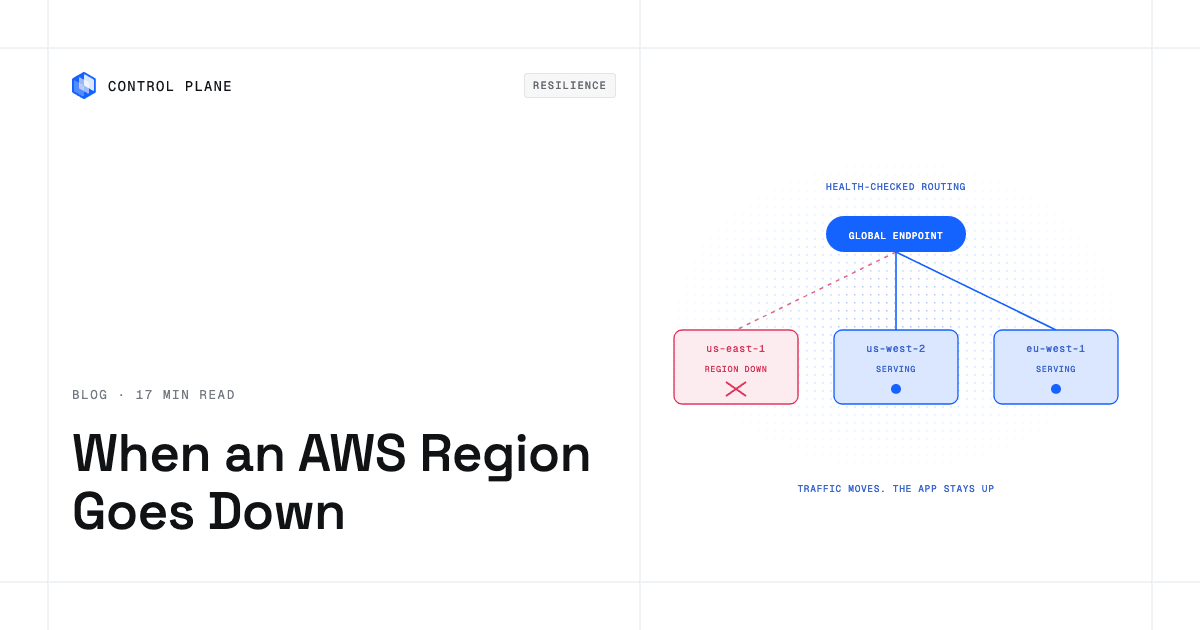
A workload deployed to a GVC runs active-active in every location of that GVC. A global endpoint routes each request to the nearest healthy location. That gives you failover without paying for idle standby capacity, and without hiring SREs to run a failover system.
The case for planning around provider failure rests on public data.
- The October 19-20, 2025 AWS us-east-1 outage lasted 14 hours 32 minutes per AWS’s post-event summary.
- In the Control Plane 2026 Cloud Outage Report, 62 major AWS, Azure, Google Cloud, and Cloudflare outages documented since January 2020 show two patterns. 34 (55%) started with a configuration or deployment change, a software bug, or automation acting on bad input. 31 of the 62 hit more than one region or a provider’s global services.
These failures span several providers and several failure types, so the planning rule applies to every provider. Running in several regions of one provider does not cover an outage that crosses regions.
During the October 2025 AWS us-east-1 outage, 20% of Control Plane customers had us-east-1 in their Global Virtual Clouds. Their workloads were active and running in healthy locations within 10 seconds, with no customer downtime, according to Control Plane internal incident telemetry.
For the full region-outage walkthrough, read How to Keep Your App Online When an AWS Region Goes Down. For the architecture, see how to build active-active high availability across regions and clouds.
How does Control Plane fit?
Control Plane handles Day 2 operations for you, including autoscaling, Capacity AI right-sizing, built-in observability, and security, with no Kubernetes cluster to operate.
- Workloads: serverless, standard, stateful, cron, and VM workloads.
- Where they run: AWS, GCP, and Azure, on clusters you already run through BYOK, on your own machines (bare metal or VMs) turned into managed locations with Managed Kubernetes (MK8s), and on premises.
- Operations: one API, with the same capabilities in the CLI, console, Terraform, Pulumi, and the Control Plane MCP server.
- Access: Universal Cloud Identity gives workloads short-lived, least-privilege access to 600+ AWS, GCP, and Azure services, with no long-lived cloud keys in your code.
- Compliance: Control Plane is PCI DSS Level 1, SOC 2 Type II, HIPAA, and GDPR compliant.
SAFE Health, a connected-diagnostics platform working with Mayo Clinic, moved 8 environments to Control Plane and cut its AWS spend 75%.
“We migrated 8 environments from AWS to Control Plane and no one noticed! Everything just worked.”
When should you build a platform team anyway?
Build a platform team in three cases.
- Very large scale. If you run thousands of services or very large fleets, the economics of owning the layers can favor in-house control. Control Plane supports large scale by offering a hybrid option allowing you to operate some of your own layers with Managed Kubernetes and Bring Your Own Kubernetes without building every layer.
- Unusual compliance or hardware needs. If your requirements are specific enough that no managed platform covers them, you will build around them.
- The platform is your product. If you sell infrastructure, developer tooling, or a platform to other engineers, building one is your core work.
If none of these applies, a platform team is likely a cost you can defer.
FAQ
How do I get production-grade infrastructure without hiring a platform team?
Adopt a platform that operates the runtime, networking, secrets, autoscaling, observability, and failover layers, and keep your Git, CI, and Terraform workflows. Pilot it with one production service before you commit.
What should a 50-person engineering team use instead of building an internal developer platform?
Choose between a simple PaaS such as Render or Heroku, which fit small teams that want git-push simplicity, and a platform that handles Day 2 operations across clouds, such as Control Plane. Building your own fits companies that already staff a platform team.
What’s the easiest way to do platform engineering without a dedicated platform team?
Reduce the layers you own. Use one deploy API, one workload definition across environments, and one place for logs, metrics, and traces.
How should we balance platform engineering spend without a dedicated platform team?
Count the build cost and the recurring run cost (on-call, upgrades, rotation, failover drills), then compare both to a usage-based platform. Spend engineer time on what differentiates your product.
What are the best internal developer platform tools?
An IDP is a set of components. Backstage provides a developer portal, Argo CD provides GitOps delivery to Kubernetes, and Terraform provides provisioning. Which combination fits depends on who will operate it.
What is the best platform as a service for infrastructure as code and provisioning without a platform team?
Pick one that works with the infrastructure as code tools you already use. Control Plane complements Terraform and Pulumi and exposes the same capabilities through one API.
How can we standardize CI runners and deployment pipelines across teams without a platform engineering team?
Keep your CI, deploy through one API from CI or Terraform, and use the same workload definition in every environment.
How do you implement observability standards across services without a platform team in multi cloud infrastructure?
Standardize log fields, service-level metrics, trace propagation, and alert routing, and have every location send signals to the same place in the same format.
Is Control Plane only for multi-cloud?
No. Many teams run it in one cloud. A GVC can span two regions of one cloud or locations on different providers.
What does the 99.999% availability SLA require?
The 99.999% availability SLA applies to workloads running at least two replicas in at least two locations. Those locations can be two regions of one cloud or locations on different providers.