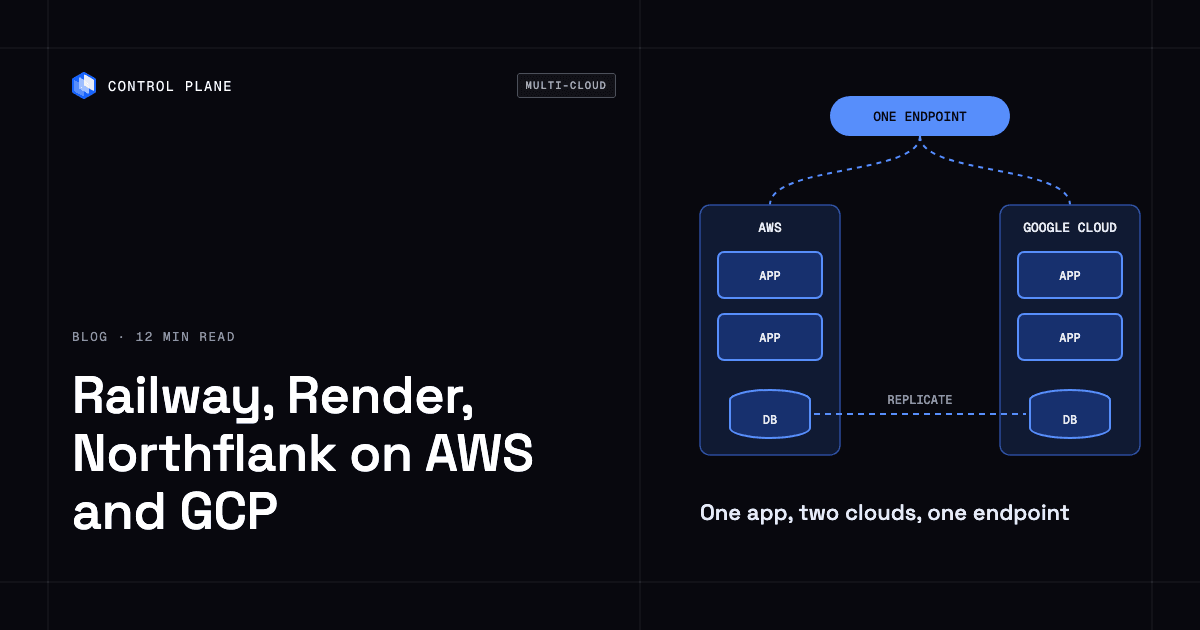
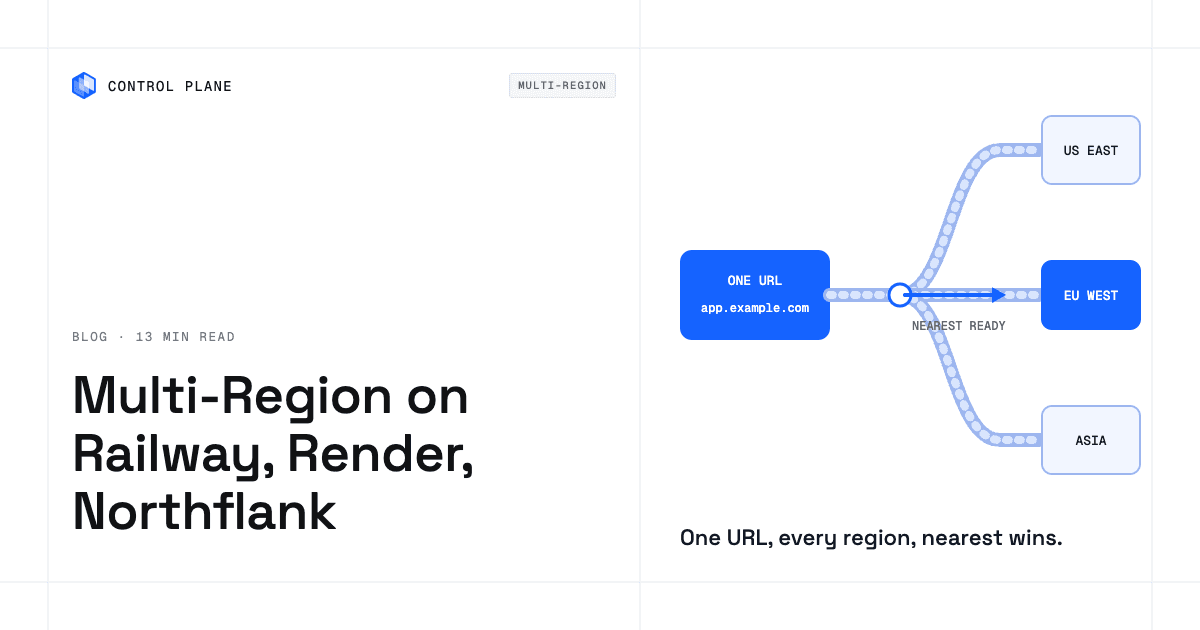
Control Plane runs one workload in many locations across AWS, GCP, Azure, and Oracle Cloud Infrastructure (OCI) behind one canonical endpoint that routes users to the nearest location where the workload passes its readiness probes, and it handles Day 2 operations for you, including autoscaling, built-in observability, and security. Railway routes each request to the nearest region running a service’s replicas, Northflank can geo-route one subdomain to services in different projects through its CDN, and Render runs each service in one region. On Railway, Render, and Northflank the managed Postgres primary stays in one region, and health-based failover between regions is not described in their documentation as of November 2026.
Disclosure: Control Plane publishes this guide.
TL;DR
Control Plane covers routing, failover, and a replicated database.
- Control Plane runs one workload across locations on several cloud providers, and when it runs in two or more locations and one fails, its endpoint sends users to the locations that still pass their readiness probes.
- Railway replicates a stateless service across its four regions and sends each request to the nearest one. Rerouting traffic away from a failed region is not described in Railway’s documentation as of November 2026.
- Render runs each service in one of five regions. Two regions means two separate services, and global routing between them is not described in Render’s documentation as of November 2026.
- Northflank runs each project in one of 17 managed regions, chosen at creation, and a subdomain can geo-route to services in projects in different regions through Northflank’s CDN. Health-based failover between regions is not described in Northflank’s documentation as of November 2026.
- The database is the hardest part. On Railway, Render, and Northflank, the managed Postgres primary lives in one region, so cross-region replication and failover are yours to design. Control Plane’s Template Catalog includes replicated databases such as Postgres Multi-Location and pgEdge.
- Failover between regions needs health checks, a routing layer that acts on them, and a database topology that survives losing the primary’s region. On Control Plane, the canonical endpoint supplies the first two from the workload’s readiness probes, and the Template Catalog supplies replicated databases for the third.
Can Railway, Render, or Northflank run one app in multiple regions behind one URL?
Control Plane runs one workload in every location of a GVC behind one endpoint. Railway, Render, and Northflank each document part of this pattern, and their documentation stops at different points on routing, failover, and data.
Control Plane is built for this pattern. You define a Global Virtual Cloud (GVC), Control Plane’s named set of locations across AWS, GCP, Azure, and OCI regions, and a workload runs in every location of its GVC. Each workload gets a canonical endpoint that DNS geo-routes users to the closest location where it is ready to serve. The first post in this series covers where Railway, Render, and Northflank stop on running one app across AWS and Google Cloud.
Railway lets one service run replicas in several regions. Railway’s edge routes each request to the nearest region running the service and then to a replica in that region. Railway documents four regions: US West (California), US East (Virginia), EU West (Amsterdam), and Southeast Asia (Singapore). Replica limits per service range from 1 on Free to 50 on Enterprise. Railway’s multi-region guide states that replicated services cannot use volumes and do not support sticky sessions, that any service with a volume attached, including the database, stays in one region, and that database failover is the database’s job.
Render deploys each service in one region chosen at creation, and Render does not currently support changing a service’s region after creation. Running in two regions means a separate service in each. Render’s documentation does not describe global routing or regional failover as of November 2026. Private networks are per region, and services in different regions communicate over the public internet.
Northflank deploys a project’s resources in the region selected when the project is created, so two regions means two projects. Northflank documents geo-routing a subdomain to services in different projects. Geo-routing requires Northflank’s CDN, and a subdomain’s routing mode cannot be changed after creation. Health-based failover between regions is not described in Northflank’s documentation as of November 2026.
What does each platform document today?
Each cell reflects what the platform’s own documentation describes as of November 2026.
| Capability | Control Plane | Railway | Render | Northflank |
|---|---|---|---|---|
| Regions available | Regions on four cloud providers (AWS, GCP, Azure, and OCI), plus your own clusters and on premises locations | 4 regions (US West, US East, EU West, Southeast Asia) | 5 regions (Oregon, Ohio, Virginia, Frankfurt, Singapore) | 17 managed regions |
| One service in two regions at once | Yes. A workload runs in every location of its GVC. | Yes. One service runs replicas in several regions. | Each service runs in one region; two regions means two services. | Each project runs in the region chosen at creation; two regions means two projects. |
| Built-in routing to the nearest region | Canonical endpoint with DNS geo-routing to the nearest location passing readiness probes | Edge routes to the nearest region running the service | Not described in Render’s documentation as of November 2026 | Geo-routing on a CDN subdomain to services in different projects |
| Routing away from a failed region | With two or more locations, users are routed to locations that pass readiness probes | Not described in Railway’s documentation as of November 2026 | Not described in Render’s documentation as of November 2026 | Not described in Northflank’s documentation as of November 2026 |
| Private networking across regions | Workload-to-workload calls are served in the caller’s location and can fail over to another location of the GVC | Private networking spans regions within one environment | Private networks are per region | Multi-project networking is documented for projects in the same team on the same cluster |
| Postgres across regions | Template Catalog includes replicated databases such as Postgres Multi-Location and pgEdge | Services with a volume, including the database, stay in one region; cross-region HA nodes are not described as of November 2026 | HA standby stays in the primary’s region | High availability stays in the project’s region; cross-region backup restore is on Enterprise |
| Constraints on replicated services | One workload definition runs in every location, so there is no per-region copy to keep in sync | No volumes and no sticky sessions on replicated services | Separate services per region | Separate projects per region |
Where does each platform’s documentation stop?
Each platform’s documentation stops at a different point between running in two regions and moving traffic when one of them goes down.
- Railway. Rerouting traffic away from a failed region is not described in Railway’s documentation as of November 2026, and health checks run at deploy time.
- Render. Each service runs in one region, and global routing and regional failover are not described in Render’s documentation as of November 2026.
- Northflank. Each project runs in the region selected when the project is created, and geo-routing across projects requires Northflank’s CDN. Health-based failover between regions is not described in Northflank’s documentation as of November 2026, and cross-region backup restore is an Enterprise feature.
Control Plane’s canonical endpoint routes on readiness probes, so it moves users to healthy locations without a separate health-check product. Read how to route users to the nearest healthy region for a deeper comparison.
What would you have to build, run, and pay for yourself?
Closing those gaps yourself means owning these pieces for as long as the app runs.
- A deployment in each region and a release pipeline that keeps every copy on the same version.
- A routing layer with health checks in front of every region, billed separately from the platform.
- Cross-region database replication and a promotion procedure you test on a schedule.
- Session storage and job scheduling that hold up when a request can land in any region.
- Data transfer charges between regions for app traffic and for replication.
- Monitoring and on-call coverage for the routing layer, the replicas, and each failover.
On Control Plane, the canonical endpoint is the routing layer, so there is no external load balancer to buy, and every location serves traffic, so you are not paying for idle standby capacity.
How do you run one app in multiple regions behind one URL on Control Plane?
The Control Plane path is one workload definition and a list of locations.
- Create a Global Virtual Cloud (GVC), Control Plane’s named set of locations, with two or more locations across AWS, GCP, Azure, and OCI regions.
- Deploy your container image as a workload in that GVC. The workload runs in every location of the GVC, so there is no per-region copy to keep in sync.
- Give the workload a readiness probe. Its canonical endpoint uses DNS geo-routing to send each user to the nearest location where the workload passes its readiness probes.
- Run at least two replicas in at least two locations, which is the condition for the 99.999% availability SLA.
- Set a routing tier per location with Control Plane’s location routing options when you want primary and failover groups. Lower tiers take traffic first and higher tiers act as failover groups.
- Add a replicated database from the Template Catalog, such as Postgres Multi-Location or pgEdge.
- Add a location to the GVC when you need another region. The workload runs there too, with no separate project to keep in sync.
When the workload runs in two or more locations and one goes down, the endpoint routes users to the locations that still pass their readiness probes.
What happens to your database when the app runs in two regions?
The database topology decides what losing a region costs you, and Control Plane’s Template Catalog supplies replicated databases.
| Pattern | Writes go to | Reads served from | If the primary’s region goes down | Fits |
|---|---|---|---|---|
| Single primary, app in two regions | The primary’s region | The primary, so reads from the remote region cross regions | Reads and writes stop until you restore from a backup in another region, and writes since the last backup can be lost | Apps that can accept a long outage and some data loss when a region goes down |
| Primary plus cross-region read replica | The primary’s region | A local replica in each region, which may lag slightly | Writes stop until a replica in another region takes over, and asynchronous replication can lose the latest writes | Read-heavy apps that can accept a short write outage and a small data-loss window |
| Consensus-based distributed SQL | Any region, with each write confirmed by a quorum across regions | Any region | Writes continue while a majority of regions survives, which needs three or more regions | Apps that need writes in every region with no conflicts and can accept cross-region write latency |
| Multi-primary with conflict resolution | Any region | Any region | The remaining regions keep accepting writes, and conflicting writes are resolved by the database’s conflict rules | Apps that need local writes in every region (pgEdge in Control Plane’s Template Catalog) |
When the app runs in two regions and the primary sits in one, every database round trip from the remote region crosses regions, so a request that runs several queries pays that cost several times. Read replicas in each region cut read latency, can return slightly stale data, and leave write latency unchanged.
On Control Plane, you add a replicated database from the Template Catalog and pick the replication model that fits your data. On Railway, Render, and Northflank, the managed Postgres primary stays in one region, so the cross-region replica and its promotion are yours to design and run.
A request can land in any location of the GVC, so keep session state in a store replicated across locations or in signed tokens, and give scheduled jobs and queue consumers one owning location or a lock. The guide on failing over a database and application between cloud regions covers promotion and failover order.
How Control Plane fits
Control Plane also handles Day 2 operations across every location, including autoscaling, built-in observability, and security. A GVC groups locations across AWS, GCP, Azure, and OCI regions, and by default every location serves traffic.
Each workload gets a canonical endpoint that uses DNS geo-routing to send users to the nearest location where the workload passes its readiness probes, so when a workload runs in two or more locations and one fails, users are routed to the healthy ones. Control Plane’s location routing options set a routing tier per location. The 99.999% availability SLA applies to workloads running at least two replicas in at least two locations, and those locations can be on different providers.
According to Control Plane’s internal incident telemetry, when a cloud region that 20% of Control Plane customers had in their GVC became unavailable, their workloads were active and running in healthy locations within 10 seconds, with no customer downtime.
Control Plane runs and routes the workloads in every location, and you pick the replication model that fits your data, from a read replica to a multi-primary database.
Control Plane runs container images, so an app that already runs as a container on Railway, Render, or Northflank can be deployed as a Control Plane workload. Control Plane is PCI DSS Level 1, SOC 2 Type II, HIPAA, and GDPR compliant. For the path from a single-region app to multiple regions, read going from prototype to multi-region without a platform team and running your app across multiple regions.
FAQ
Founders and small teams ask these questions when their app starts serving customers on more than one continent.
How do I put multiple regions behind one domain?
On Control Plane, deploy one workload to a GVC with several locations, and its canonical endpoint sends each user to the closest location that is ready to serve. Railway, Render, and Northflank each document part of this: Railway routes to the nearest region running a service, Northflank geo-routes a CDN subdomain across projects, and Render runs each service in one region. Health-based failover between regions is not described in the documentation of any of the three as of November 2026.
Can Railway run my app in multiple regions?
Control Plane runs one workload in every location of its GVC, and its endpoint routes users only to locations that pass readiness probes. Railway documents replicas of one service in several of its four regions, with routing to the nearest one. Rerouting traffic away from a failed region is not described in Railway’s documentation as of November 2026, and services with a volume, including the database, stay in one region.
Does Render support multi-region deployment?
Control Plane runs one workload in every location of its GVC behind one endpoint. Render runs each service in one region chosen at creation, and Render’s documentation does not describe global routing or regional failover as of November 2026.
Can Northflank route one domain to multiple regions?
Control Plane runs one workload in every location of its GVC, and its endpoint routes users to the nearest location that passes readiness probes. Northflank documents geo-routing a subdomain to services in different projects, with one project per region. Northflank’s documentation does not describe moving traffic between regions based on health checks as of November 2026. The Control Plane vs Northflank page compares the two in full.
What happens to my Postgres database in a multi-region setup?
On Control Plane, you can deploy a replicated Postgres from the Template Catalog, such as Postgres Multi-Location or pgEdge. On Railway, Render, and Northflank, the managed Postgres primary stays in one region. Railway keeps services with a volume, including the database, in one region, Render documents a standby in the primary’s region, and Northflank documents high availability within the project’s region. Cross-region replication and failover are yours to design and run on all three.
Do I need sticky sessions for a multi-region app?
No. On Control Plane, a request can land in any location of the GVC, so keep session state in a store replicated across locations or in signed tokens such as JWTs. Both survive instance restarts.
How does Control Plane run one app in multiple regions?
You create a GVC with locations across AWS, GCP, Azure, or OCI and deploy a workload, which runs in every location of that GVC. When the workload runs in two or more locations and one fails, the endpoint stops sending users there and routes them to the locations that still pass readiness probes.
What is the lowest-cost way to add a second region?
On Control Plane, add a second location to the workload’s GVC. The canonical endpoint routes between locations, so there is no external load balancer to buy, and every location serves traffic, so you are not paying for idle standby capacity.
Can I run one app across more than one cloud provider?
Control Plane supports it directly. A GVC can include locations on AWS, GCP, Azure, and OCI, and the workload runs across all of them behind one endpoint. Render runs each service in one of its own regions. Railway lists bring your own cloud on its Enterprise plan, and its documentation does not describe one service running across more than one cloud provider as of November 2026. On Northflank, each project runs in one region, so more than one region or cloud means more than one project.
Talk to the Control Plane team about running your app in multiple regions, or sign up free to deploy your first multi-region workload.