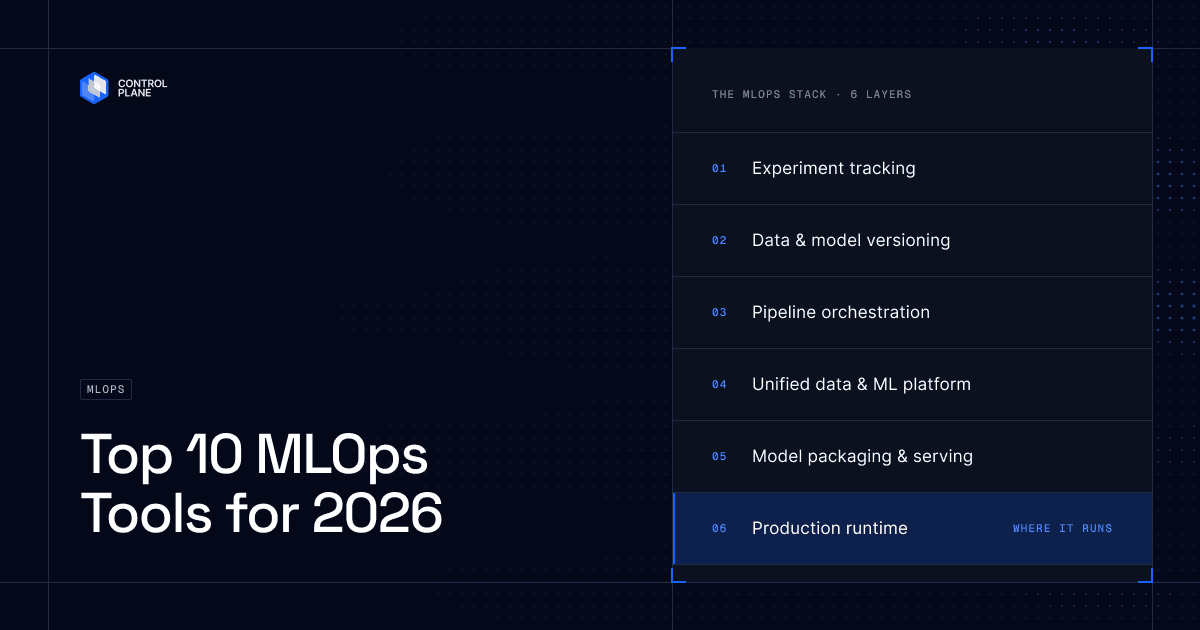
TL;DR: MLOps tools cover experiment tracking, data versioning, pipeline orchestration, model deployment, and monitoring. MLflow and Comet ML suit experiment tracking. DVC and lakeFS suit data versioning. Dagster and Kubeflow Pipelines suit orchestration. Databricks suits teams that want one platform for data and ML. BentoML suits teams that need to package and serve models. Control Plane is the runtime for teams running ML inference and AI agent workloads in production.
MLOps tools help teams build, deploy, and manage machine learning models in production. They automate recurring work such as versioning, training pipelines, deployment, and monitoring, so teams can spend their time on the models themselves. Production workloads now include GPU inference and AI agents, so a good MLOps stack covers where models run as well as how they are built.
The MLOps market is estimated at USD 5.83 billion in 2026, up from USD 4.15 billion in 2025, according to Mordor Intelligence.
What are MLOps Tools?
MLOps, which stands for Machine Learning Operations, is a set of practices that weave machine learning into software and data engineering. It involves using processes and tools to automate development and deployment and to maintain machine learning models at scale in production.
MLOps tools are designed to support best practices for machine learning. They focus on tasks such as version control of models, automating data pipelines, monitoring models, and running automated testing and validation.
These tools help data scientists and software engineers manage the entire lifecycle of machine learning models, including training and monitoring, so models perform consistently and reliably in production.
Types of MLOps Tools
- Model Versioning Tools: Let users manage and compare model versions to reproduce results. Tools like DVC and MLflow version machine learning models and datasets.
- Pipeline Orchestration Tools: Cover data preprocessing, model training, evaluation, and deployment. Tools like Kubeflow and Apache Airflow automate steps in the machine learning process.
- Monitoring and Management Tools: Track metrics such as accuracy, latency, and resource utilization, and detect anomalies and performance degradation.
- Deployment Tools: Support deployment strategies that roll out new models safely and efficiently. Tools like TensorFlow Serving and AWS SageMaker simplify deploying models to production.
Benefits of MLOps Tools
- Improved Collaboration: Data scientists, machine learning engineers, and operations teams work together more efficiently.
- Enhanced Automation: Tasks such as data preprocessing, model training, and deployment run automatically and more consistently.
- Increased Scalability: Teams can scale machine learning operations, handle larger data volumes, and deploy across environments without losing performance or reliability.
- Effective Model Management: Versioning, monitoring, and logging simplify the lifecycle of each model.
- Faster Time to Market: Models deploy to production automatically, so teams deliver solutions sooner.
Key Features to Look for in MLOps Tools
- Automation and Orchestration: The tool should automate and orchestrate data preprocessing, model training, and deployment.
- Scalability: The tool should scale as datasets and compute requirements grow, without losing performance or reliability.
- Monitoring and Logging: Real-time performance tracking and problem identification are essential for running any model.
- Integration: The tool should integrate with existing platforms. Support for well-known data science and DevOps tools keeps workflows intact.
Top 10 MLOps Tools for 2026
Control Plane is published by the team behind this blog.
1. Control Plane
Control Plane is not an experiment tracker or a pipeline authoring tool. It is the cloud where ML inference and AI agent workloads run once they are built. Teams deploy containers, serverless, cron, stateful services, and full Linux and Windows VMs under one workload model, on managed infrastructure or on Control Plane’s or their own AWS, GCP, and Azure accounts.
Main Features:
- Idle workloads scale to zero, and Capacity AI right-sizes CPU and memory as usage changes. This suits bursty inference traffic.
- Universal Cloud Identity gives workloads credential-free, least-privilege access to 600+ native AWS, GCP, and Azure services, so a model service can reach a bucket or database without stored keys.
- Workloads in the same GVC reach each other through internal DNS names (
<workload-name>.<gvc-name>.cpln.local) wherever they run. - Security, workload isolation, observability, and compliance controls are built in, including PCI DSS Level 1, SOC 2 Type II, HIPAA, and GDPR.
Best For:
Teams running ML inference and AI agent workloads in production who want lower compute costs and less infrastructure work.
Price:
Usage-based. Control Plane reports 30 to 50 percent lower compute costs than running directly on hyperscalers. To estimate savings on an existing Kubernetes cluster, try the free K8s cost calculator.
2. Pachyderm
Pachyderm is an MLOps solution with data versioning and end-to-end pipelines. It focuses on reproducibility and scalability for machine learning workflows.
Pachyderm was acquired by HPE in January 2023.
Main Features:
- Data versioning and lineage tracking.
- Scalable data pipelines.
- Git-like operations for data science.
Best For:
Organizations needing data versioning and reproducibility.
Price:
The open-source Community Edition (Apache 2.0) is limited to 16 pipelines and 8 parallel workers. The commercial product is HPE Machine Learning Data Management Software, priced by inquiry.
Review: “Ability to keep branches of your data sets when you are testing new transformation pipelines.”
3. Dagster
Dagster is an orchestration platform for developing, deploying, and managing data pipelines, supporting reliable and maintainable machine learning workflows. Dagster has announced that it is now part of Prefect (announcement).
Main Features:
- Integrates with popular data tools like Airbyte, Snowflake, and Slack.
- Built-in data asset management.
- Flexible and extensible design.
Best For:
Teams needing to orchestrate and manage complex ML workflows and build data pipelines.
Price:
Solo is $10/month plus $0.040 per credit (1 user, 30-day free trial). Starter is $100/month plus $0.035 per credit (up to 3 users). Pro is contact sales. Credits are consumed by asset materializations and op executions. See Dagster pricing.
Review: “Dagster is designed as a cloud-native orchestrator to simplify the development, production, and observation of data assets.”
4. Kubeflow Pipelines
Kubeflow Pipelines is a platform for deploying, orchestrating, and managing secure Kubernetes ML workflows. Kubeflow 26.03.1 (April 2026) includes Kubeflow Pipelines 2.16.1 and KServe 0.18.0 (release post).
Main Features:
- End-to-end orchestration of ML workflows.
- Reusable pipeline components.
- Tools for each stage of the ML lifecycle, including pipelines and model training.
Best For:
Kubernetes users looking for a comprehensive MLOps solution.
Price:
Open source (free).
Review: “The all-in-one feature of Kubeflow has made [the] team easy to use and [has] saved [a] lot [of] time. This is easy to use for new [learners].”
5. MLflow
MLflow is an open-source platform for managing the end-to-end ML lifecycle, including experimentation, reproducibility, and deployment. It includes tools for tracking and sharing models. MLflow is actively developed. Version 3.16.0 (September 2026) continues its focus on GenAI tracing and observability (release notes).
Main Features:
- Experiment tracking and management.
- Model registry and deployment.
- Integration with popular ML libraries.
Best For:
Teams needing experiment tracking and model lifecycle management.
Price:
Open source (free).
Review: “MLflow helps streamline the entire ML lifecycle with a simple setup and intuitive interface, enabling teams to reproduce results and collaborate easily.”
6. Comet ML
Comet ML is a customizable platform for tracking, comparing, and optimizing machine learning models. It integrates with popular frameworks like PyTorch and XGBoost through its open API. Comet also offers Opik, an open-source GenAI observability and evaluation product.
Main Features:
- Experiment management, tracking, and visualization.
- Team collaboration tools.
- Model production monitoring.
Best For:
Data science teams looking for advanced experiment tracking.
Price:
The MLOps platform has a Free plan ($0, 1 user, 100GB), a Pro plan at $19 per user per month (up to 10 users), and a custom Enterprise plan. See Comet pricing.
Review: “I needed a tool that would help me in keeping track of my experiments. I got a whole set of tools that are perfect for my ML research.”
7. lakeFS
lakeFS is a data version control tool that turns your object storage into Git-like repositories.
Main Features:
- Git-like version control for data lakes.
- Integrates with existing data tools.
- Scalable and efficient data management.
Best For:
Teams working on MLOps projects that need to manage large data lakes and require version control.
Price:
The Community edition is free. Starting with v1.87.0 it moves from Apache 2.0 to the Business Source License; earlier releases remain Apache 2.0 (details). Team is $499/month (30-day free trial, 5 users, 500GB, self-managed). Enterprise is custom. See lakeFS pricing.
Review: “lakeFS helps to transform data into a usable and livable form. It is easy to see snapshots of the data instead of being overwhelmed with everything.”
8. DVC
DVC is a version control system for ML projects. It integrates with Git to manage datasets, track experiments, and reproduce results, which streamlines tasks like experiment tracking. DVC is now maintained by lakeFS, which acquired the open-source project from Iterative in November 2025. It remains Apache 2.0 (details).
Main Features:
- Data versioning and management.
- Experiment tracking and reproducibility.
- Integration with Git.
Best For:
Developers looking for a lightweight data versioning solution.
Price:
Open source (free).
Review: “DVC allowed me to have an overview of my results, with plots and tracking the metadata. This improves and speeds up the research process, allowing reproducibility of the results and better teamwork.”
9. Databricks
Databricks is a unified analytics platform combining data engineering, data science, and machine learning. It offers collaborative tools and scalable cloud infrastructure for MLOps teams.
Main Features:
- Unified data analytics and machine learning platform.
- Collaborative notebooks.
- Scalable and optimized for big data.
Best For:
Organizations needing a unified platform for data and ML.
Price:
Offers a free trial and a pay-as-you-go pricing model. See Databricks pricing.
Review: “The greatest upside to the Databricks Platform that’s constantly being developed.”
10. BentoML
BentoML is an open-source Python framework for building model inference APIs and multi-model serving systems. Its managed platform, BentoCloud, deploys those services on GPU compute. BentoML is now part of Modular (announcement).
Main Features:
- Builds online serving systems for any open-source or custom model.
- Packages services as Docker containers for self-hosting or deploys them to BentoCloud.
- Supports GPU inference and autoscaling, including scale-to-zero on BentoCloud.
- Adaptive batching is a server-side dispatcher that groups requests. It is disabled by default and enabled on the @bentoml.api decorator with max_batch_size and max_latency_ms (docs).
- Observability includes a Prometheus /metrics endpoint, bentoml.monitor for inference data logging, and OTLP export (metrics docs, monitoring docs).
Best For:
Teams that want a code-first way to package and serve models, with the option of a managed GPU platform.
Price:
The open-source framework is free to self-host. BentoCloud is billed pay-as-you-go, with enterprise plans by quote. See the BentoML pricing page.
FAQ
What are MLOps tools?
Software that automates the machine learning lifecycle: data and model versioning, experiment tracking, pipeline orchestration, deployment, and monitoring.
Is Modelbit still available?
No. Modelbit shut down on September 1, 2025.
Which MLOps tools are best for experiment tracking?
MLflow and Comet ML.
Which tools handle data versioning?
DVC, lakeFS, and Pachyderm.
Which tool is best for serving models as APIs?
BentoML, an open-source framework for building model inference APIs with GPU support and autoscaling.
Which tool runs ML inference and AI agent workloads in production?
Control Plane. It runs containers, serverless, and VM workloads with scale-to-zero, Capacity AI right-sizing, and credential-free access to AWS, GCP, and Azure services. It can host serving frameworks such as BentoML.
Run Your ML Workloads on Control Plane
The right MLOps stack combines tools for building models with a runtime that fits how those workloads behave. Control Plane is a cloud for running those workloads. Idle services scale to zero, Capacity AI right-sizes running ones, and Universal Cloud Identity gives them credential-free access to 600+ native cloud services. Book a Demo to see how it runs your inference and AI agent workloads.